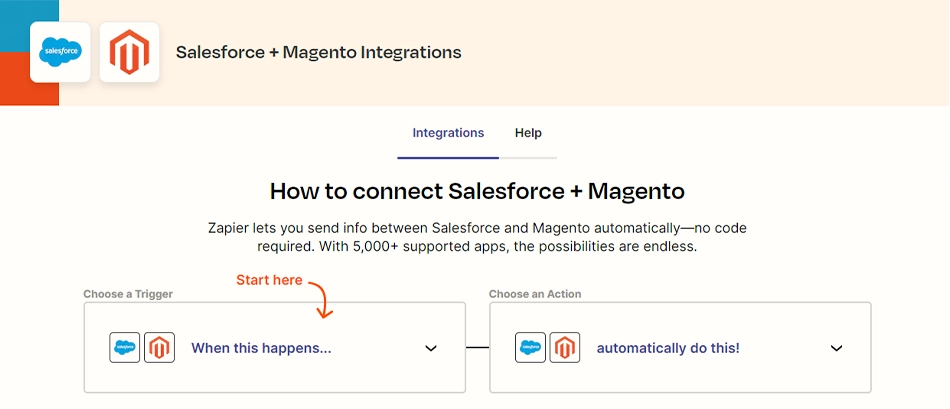
Magento Salesforce Integration: Complete Guide for eCommerce Success
Quick Summary
This guide provides complete instructions for integrating Magento with Salesforce CRM to eliminate manual data entry and unify eCommerce and sales operations.
We cover what syncs automatically, including customer data, orders, products, leads, and campaigns with real-time synchronization.
Learn six key benefits and discover three integration methods: pre-built connectors (1-7 days, $500-$2,000), middleware/iPaaS platforms (2-4 weeks), and custom API development (6-16 weeks, $10,000-$50,000+).
Know the detailed preparation steps, such as defining goals, auditing data quality, mapping fields between systems, and setting up testing, before going live.
Get solutions to six common challenges: data duplication, mapping complexity, sync delays, API rate limits, security compliance (GDPR, PCI), and error handling.
Two disconnected systems lead to manual data entry and lost opportunities. This is where Magento Salesforce integration solves this problem. Instead of managing two separate systems, you create one unified workspace where data flows automatically. Your team sees the complete picture. Be it order history, customer preferences, payment status, and next steps, all in Salesforce.
In this article, we will show how to integrate Salesforce with Magento, the reasons, benefits, and a lot more. We will also explain how this helps your business grow steadily and smartly. Let’s get started.
What Is Magento Salesforce Integration?
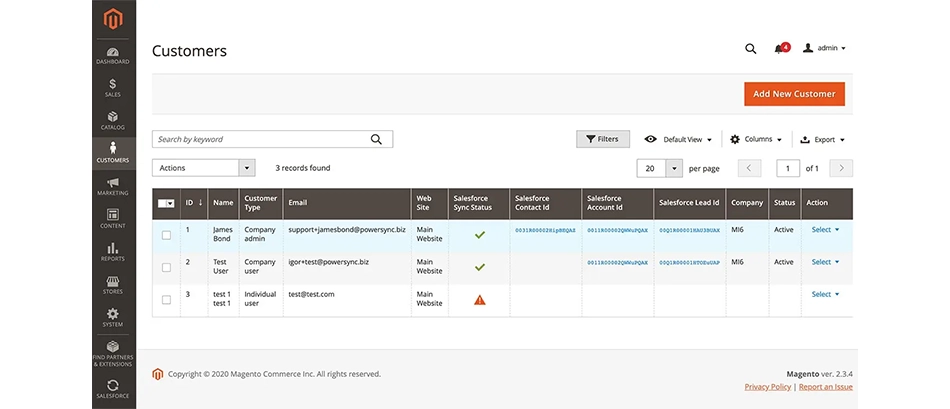
The term Magento Salesforce integration means to connect your Adobe Commerce or Magento eCommerce platform with Salesforce CRM. This connection syncs data in both directions. After this, information flows from Magento to Salesforce and back again.
Here is what gets synchronized:
Customer data: Names, email addresses, phone numbers, and purchase history.
Orders: Transaction details, amounts, dates, and status updates.
Products: Catalog information, pricing, and inventory levels.
Leads: Form submissions and contact requests become sales leads.
Campaigns: Marketing data updates in both systems.
This happens in real time. When a customer places an order in your Magento store, it automatically appears in Salesforce within seconds. When a sales representative updates a lead status in Salesforce, that information syncs back to your store.
This makes manual data entry and spreadsheet management redundant, and there are no copy-paste errors.
Why Integrate Magento with Salesforce?
Eliminate Manual Data Entry
If your team is spending hours every week entering data into Salesforce, this is the main pain point.
For example, if your operations work in this way:
Customer orders a product.
Someone manually logs it in the CRM.
Another team member updates inventory.
A third person creates a follow-up task.
This workflow is neither efficient nor scalable in the long term.
The Magento 2 Salesforce integration automates all of this. Orders sync automatically, and customer data updates instantly. Further, tasks create themselves based on order triggers.
You can easily save significant time by automating data entry between Magento and Salesforce.
Get Real-Time Customer Insights
Salesforce excels at something Magento does not. It is building complete customer profiles. Your eCommerce platform, like Magento, tracks transactions, and Salesforce tracks relationships.
When Magento and Salesforce integration happens, your sales team sees the full picture. They know:
What products did this customer buy before?
When did they make their last purchase?
Their total lifetime value.
Which abandoned carts do they have?
What interests have they shown in the past?
This context helps sales representatives personalize conversations and close deals faster.
Automate Business Processes
Salesforce Flows can trigger automated actions in response to events in your store. A few examples are:
A customer places an order over $500 → Create a task for the account manager.
Inventory falls below 10 units → Create an alert for the procurement team.
A customer completes their first purchase → Add them to a welcome campaign.
An order ships → Automatically update the customer record and send a notification.
With these automations, routine work is simplified, and your team can work on high-value activities.
Improve Customer Segmentation and Targeting
Magento collects order data, and Salesforce organizes customer relationships. Together, they create powerful segmentation.
Your marketing team can now:
Run targeted campaigns for repeat buyers.
Offer product recommendations based on purchase history.
Create loyalty programs for high-value customers.
Re-engage customers who haven’t ordered in the past 6 months.
Cross-sell and upsell based on actual buying behavior.
Make personalised content like email, blog, and social media posts based on customer data.
Connect with the target audience offline to drive loyalty and reward programs.
The result is higher conversion rates and better customer lifetime value.
Better Inventory Management
The best part about the Magento-Salesforce connection is the real-time synchronization. When Salesforce shows an order, your inventory count updates immediately. This prevents overselling and maintains high customer satisfaction.
Multi-store businesses benefit most from this. Different regions, different inventory levels, and availability are synchronized across one unified system.
Start LiveChat Agents and ChatBot Integration
Your customer service team can access the complete order history and customer preferences in Salesforce. When a customer contacts you via chat, the agent knows what they bought, when, and whether they had any issues.
Chatbots can be programmed to pull customer data from this Magento Salesforce CRM integration and provide personalized responses.
Speed Up Sales Cycles
When your sales team has complete data on customer behavior, they close deals faster.
Qualified leads get contacted immediately. Follow-ups happen on schedule, and opportunities move through the pipeline without delays. The Magento Salesforce Connector possibilities can be very helpful in this area.
How to Prepare for Magento and Salesforce Integration?
Before starting any Magento integration services, preparation is crucial. A successful integration between Magento and Salesforce requires careful planning to ensure smooth data flow, system compatibility, and adherence to the timeline. Here’s how to prepare for this integration.
Step 1: Define Your Integration Goals
Start by answering these questions:
What problem are you solving? (e.g., manual data entry, lost customers, inventory issues?)
Which data is most critical to sync? Orders, customers, or products?
What does success look like? (Time saved, revenue increase, customer satisfaction improvement?)
Who will use this integration daily?
Write these down. They guide every decision during implementation.
Step 2: Audit and Clean Your Existing Data
Your integration is only as good as your data quality. Before syncing, clean your databases.
In Magento, look for:
Duplicate customer records.
Incomplete phone numbers or email addresses.
Products with missing descriptions or images.
Orders with incorrect status labels.
In Salesforce, check for:
Duplicate account or contact records.
Fields with inconsistent formatting.
Empty required fields.
Old or inactive records that should be archived.
This cleanup prevents garbage data from syncing between systems.
Step 3: Map Your Fields
Field mapping is the blueprint for how data moves between systems. The Magento “First Name” field needs to map to the Salesforce “First Name” field. The Magento “Order Amount” needs to map to the Salesforce “Opportunity Amount.”
Magento Field
Salesforce Field
Data Type
Purpose
customer_email
Email
Text
Unique identifier for matching
order_total
Amount
Currency
Used for sales forecasting
created_at
CreatedDate
Date
Track when the record was added
product_name
Name
Text
Limited to 255 characters
inventory_qty
Quantity
Number
Updates in real-time
Do not assume fields match by name. Verify data types, field limits, and formatting rules.
Step 4: Choose Your Integration Method
Decide which approach fits your business. There are 3 main Magento 2 Salesforce integration methods:
Pre-built connectors
Middleware (iPaaS)
Custom API integration
We will cover each of them in detail later.
Step 5: Plan Your Data Migration
Decide what existing data to migrate:
All historical data: Heavier migration, more setup time, complete history.
Recent data only: Faster implementation, cleaner data, missing historical context.
Clean data only: Slower upfront work, but fewer problems later.
Test migrations in a development environment first. Never migrate directly to production.
Step 6: Set Up a Test Environment
Before going live, create an identical test environment. Sync a sample of data and run test orders. Finally, verify that everything works before affecting your live business.
Best Methods for Magento Integration with Salesforce
Method 1: Via Pre-Built Magento Salesforce Connectors
What are pre-built connectors?
Pre-built connectors are certain extensions or apps from third-party vendors. These connectors help the data to flow between Magento and Salesforce without custom coding.
How does it work?
Purchase the extension. Some of the best ones are Webkul, Mageplaza, and Amasty.
Install it in your Magento admin panel.
Configure field mappings (check out our preparation steps).
Enable synchronization.
Start syncing data.
Manually check or test the data on both platforms.
Timeline: 1-7 days to go live.
What syncs?
Customers to Salesforce Leads, Contacts, or Accounts.
Orders to Salesforce Opportunities or Orders.
Products to Salesforce Products.
Campaigns and Subscribers.
Advantages
Quick deployment.
No technical expertise needed.
Vendor provides support and updates.
Handles most common use cases.
Lower cost than custom development.
Disadvantages
Limited to standard features.
May not fit unique business workflows.
Less control over data transfer.
Vendor dependent for future updates.
Best for: SMBs, standard eCommerce operations, and companies that want fast results with minimal setup.
Method 2: Via Middleware or iPaaS (Integration Platform as a Service)
What is Middleware or iPaaS?
A middleware or iPaaS is a mediator (think of escrow) that acts as a bridge between Magento and Salesforce. These cloud-based platforms help to create custom workflows without coding and make data synchronization easy.
How does it work?
Sign up for an iPaaS platform (examples: MuleSoft, Boomi, DCKAP Integrator, APPSeCONNECT).
Fill in the data and ensure both platforms show in the middleware app.
Create pre-built connectors for Magento and Salesforce.
Design custom workflows using drag-and-drop builders.
Set up data transformation rules.
Monitor syncs from a central dashboard.
Test in real time and verify data fields after deploying.
Timeline: 2-4 weeks to go live.
What syncs?
Everything the pre-built approach handles.
Plus custom objects and complex logic.
Abandoned carts as Salesforce tasks.
Multi-step workflows with conditional logic.
Integration with multiple systems simultaneously.
Advantages
Balances flexibility and speed.
Low-code/no-code customization.
Handles complex business logic.
Works with multiple systems.
Better error handling and monitoring.
Automatic updates from the vendor.
Disadvantages
More expensive than pre-built connectors.
Learning curve for workflow design.
Still somewhat limited compared to custom APIs.
Monthly subscription costs.
Best for: Mid-market businesses, companies with custom workflows, and teams managing multiple integrations.
Method 3: Via Custom API Integration
What is custom Salesforce Magento integration?
A custom Salesforce–Magento integration is a specifically made developer-built solution. The purpose of this is to connect Magento and Salesforce via their APIs. It is designed exactly as per your business workflows, data structures, and automation requirements.
How does it work?
Your development team creates custom code.
Magento REST or SOAP APIs communicate with Salesforce APIs.
Custom logic handles data migration.
You control everything like timing, frequency, error handling, and security.
Timeline: 6-16 weeks to go live.
What syncs?
Anything you want, any way you want it.
Complex multi-step workflows.
Real-time or batch syncing.
Custom data structures.
Advanced error recovery.
Advantages
Complete control and customization.
Optimized for your specific needs.
Maximum performance and reliability.
Full ownership of the code.
Can handle any business requirement.
No loss of data in a complete migration.
Can be white labelled and would work for other brands.
Disadvantages
Expensive (can range from $1,000 to $50,000+).
Requires skilled developers.
Longer time to implement.
You are responsible for maintenance and updates.
Higher risk if the team doesn’t maintain the code.
Best for: Enterprise companies, organizations with unique business requirements, and organizations with development teams.
Recommended Approach: Start Small, Scale Up Later
Most businesses start with pre-built connectors to handle the core need like syncing customers and orders. Once that is working, they add more features through middleware or custom development.
Benefits of this approach:
Gets you live fast.
Proves the value of integration.
Reduces risk.
Spreads cost over time.
Challenges in Magento Salesforce Integration And How to Solve Them?
Challenge 1: Data Quality and Duplication
The problem: When you sync data from two sources, there is a risk of duplicate errors. One customer record can become three, or orders appear twice. Sometimes, even products get mismatched.
Why it happens: Different data formats, incomplete records, or matching logic that does not recognize the same customer under slightly different names.
The solution:
Before integrating, remove duplicates from both systems.
Decide how the system identifies the same customer, such as by email, phone, or customer ID.
If a Magento customer lacks a phone number. Check what Salesforce displays as the default value.
Use deduplication tools, as many integrations come with built-in duplicate detection.
Challenge 2: Data Mapping Complexity
The problem: Magento and Salesforce use different field names and formats. Magento calls it “mobile phone.” Salesforce calls it “Phone.” Or one stores dates as “MM/DD/YYYY” and the other as “YYYY-MM-DD.”
Why it happens: Different systems have different conventions. Not every field matches perfectly.
The solution:
Map everything upfront and document every field relationship before implementation.
Test edge cases and try different data types (very long names, special characters, currencies).
Use transformation rules so Middleware and custom APIs can automatically convert formats.
Validate after sync and check that the data looks correct on both sides.
Challenge 3: Real-Time Synchronization Delays
The problem: Data does not sync instantly. When a customer places an order in Magento, it might take up to 30 minutes to appear in Salesforce. By then, a sales rep may have already reached out.
Why it happens: API rate limits, network delays, or batch processing on a schedule (every 30 minutes or every hour) instead of real-time syncing.
The solution:
Choose real-time sync for critical data, such as orders and customers, so it syncs immediately.
Accept batch sync for less-critical data. This way, low-demand products can be updated every hour.
Monitor API limits imposed by Salesforce and plan accordingly.
Use event-driven architecture. Instead of polling every 5 minutes, trigger syncs when something actually changes.
Set expectations and tell your team that some syncs are real-time, others are batched.
Challenge 4: API Rate Limiting
The problem: Salesforce limits API calls. In high-volume stores, you might hit those limits, and syncs might fail.
Why it happens: Cloud services limit API calls to prevent abuse and guarantee system stability. Salesforce limits depend on your license type.
The solution:
Check your Salesforce license and limits to know how many API calls you have.
Instead of syncing one order at a time, batch 100 together.
If you hit limits, sync customers and orders first, then products.
Set up monitoring or notifications to track when you are reaching limits.
If you regularly hit limits, a higher Salesforce license tier may be necessary.
Challenge 5: Security and Compliance Concerns
The problem: You are transferring sensitive customer data between systems. A single security gap can expose this information.
Why it happens: Data in transit can be intercepted, and APIs may be misconfigured. Additionally, leaked credentials pose a significant risk and can damage your reputation.
The solution:
Use OAuth 2.0 authentication as it is more secure than username/password combinations.
Encrypt data in transit and ensure your integration uses HTTPS/TLS.
Avoid syncing payment card data or passwords. Set limits, or transfer only the necessary information.
Conduct regular audits and review logs to track who accessed what and when.
Comply with regulations such as GDPR (Europe) and CCPA (California), as well as industry-specific standards such as HIPAA and PCI.
Before going live, perform a thorough security audit.
The problem: If something fails silently, you do not notice until customers start complaining about missing data.
Why it happens: Integration failures aren’t always obvious. A sync might fail for one record but succeed for 99 others.
The solution:
Enable detailed logging and track every sync attempt and any errors.
Set up alerts to get notified immediately if syncs fail.
Retry failed syncs. This way, the mediator or connector automatically tries again if something fails the first time.
Create dashboards to monitor sync health in real-time.
Final Thoughts
The Magento Salesforce integration completely changes how eCommerce teams work. As mentioned before, it eliminates manual data entry, provides sales teams with real-time visibility, and automates repetitive tasks.
The integration method you choose depends on your timeline, budget, and complexity:
If you want fast, simple integration with limited data, choose pre-built connectors, as they take days to go live.
For moderate complexity, choose middleware/iPaaS (weeks to go live).
Finally, for unique requirements, choose custom API integration, which may take months to implement.
Again, the best approach is to start with pre-built connectors to solve your immediate problem. As you grow, add middleware for more complex workflows. Only invest in custom development if you truly need it.
Real businesses see these results and save hundreds of hours annually. They close deals faster and even reduce human error to near zero.
The question is not whether to integrate, but rather how. It is also how quickly you can get started with it. If you need help with this integration, connect with our experts today!
FAQs on Magento Integration with Salesforce
Q1. Do I need technical skills to set up the Salesforce Magento integration?
Pre-built connectors require no technical skills, and you can start with just admin access and configuration. Middleware requires some technical knowledge, but not coding. Custom APIs require experienced developers.
Q2. What data should I sync?
Start with three: customers, orders, and basic product information. Once that is working, add campaigns, inventory, and custom objects as needed.
Q3. Will the Magento Salesforce integration slow down my store?
No, if properly configured. Real-time syncs happen asynchronously (in the background). Your customers will not notice any slowdown. Batch syncs run during off-peak hours.
Q4. How do I handle existing data in Salesforce and Magento?
Audit and clean both systems first. Then decide to migrate all historical data (slower but complete) or migrate only recent data (faster implementation). Always test in a development environment first.
Q5. Can I sync custom fields in Salesforce?
Yes. Pre-built connectors support most standard fields. Middleware supports standard and custom fields. Custom APIs support anything.
Q6. Is my customer data secure in Magento?
Yes, if you use secure authentication (OAuth 2.0), encrypt data in transit (HTTPS), and follow security best practices. Verify your integration vendor’s security certifications.