What Is a Headless API? Architecture, Benefits, and Real-World Use Cases
Quick Summary
A headless API separates the backend from the frontend, allowing the system to deliver data and logic without being tied to a single UI.
Headless APIs are built for multiple channels, meaning the same backend can power web, mobile apps, dashboards, kiosks, and even IoT devices.
REST and GraphQL are the two common approaches in headless architecture. REST keeps things simple, while GraphQL gives the frontend more control over what it fetches.
Headless brings flexibility and long-term scalability, but it also demands strong API design, solid frontend engineering, and continuous monitoring to stay fast and stable.
Today, users browse the internet using different devices. A customer might browse on an iPhone, buy through a laptop, and track the order on a smartwatch. As a business owner, this means your backends need to stay consistent. But when the frontend and the backend are glued together, it creates issues.
One small change in the website design can ripple into the database, the checkout flow, and even the mobile app. It leads to slower updates, bugs, and complex integrations. That’s where the idea of a headless API becomes relevant.
A headless API solves this issue by separating the frontend and the backend. The logic, data, and rules are present in the backend. The API becomes the bridge that delivers data wherever needed. It leads to faster releases, easier scaling, and a setup that won’t collapse every time you add a new platform.
In this blog, we’ll focus on headless APIs and explore their architecture, benefits, and use cases. Let’s start.
What is a Headless API?
A headless API allows software to share data without being tied to one fixed screen or design. It’s the “data and rules” layer that sits behind an app. It doesn’t decide how things should look. It simply delivers what’s needed, such as products, prices, user details, or content, when another system asks for it.
In simple terms, “headless” means the front end is detached. The API is built to serve multiple front ends simultaneously. A website, mobile app, smart TV app, or even an in-store kiosk can all connect to the same backend through this API. Most headless APIs use familiar formats like REST or GraphQL over HTTP so that different systems can communicate in a clean, predictable way.
Headless APIs vs Traditional APIs
Both headless APIs and traditional APIs enable apps to communicate with the backend, but their intent differs. A traditional API is often built with one main app in mind, so the backend and frontend grow together. In contrast, a headless API is built to stay independent. It serves data in a clean, neutral way so that any interface can use it.
The difference appears in architecture and developer experience. Traditional APIs are like “custom-made” solutions for one product screen, while headless APIs are more like a shared service. They are designed to support multiple channels, many teams, and frequent changes. Below is a quick comparison table of the two.
Factor
Headless APIs
Traditional APIs
Coupling with the Frontend
Fully decoupled. The API doesn’t assume how the UI looks or works.
Often loosely or tightly tied to one frontend’s needs and edge cases.
Flexibility and Reusability
High reuse. Same endpoints can serve web, mobile, and new platforms easily.
Reuse is limited. Endpoints may be shaped around one app’s flow.
Scalability
Scales cleaner across channels because the API stays consistent and independent.
Can scale, but changes often create ripple effects across the frontend.
Frontend Technology Choice
Freedom to use React, Vue, mobile frameworks, kiosks, or anything else.
Frontend choices may be restricted by how the API was designed.
In day-to-day work, headless APIs feel more predictable and future-ready. Traditional APIs can be faster to build for a single app, but they often develop “product-specific baggage.” So many brands are moving to headless eCommerce, as it keeps the backend focused on data and behavior.
How Headless API Architecture Works
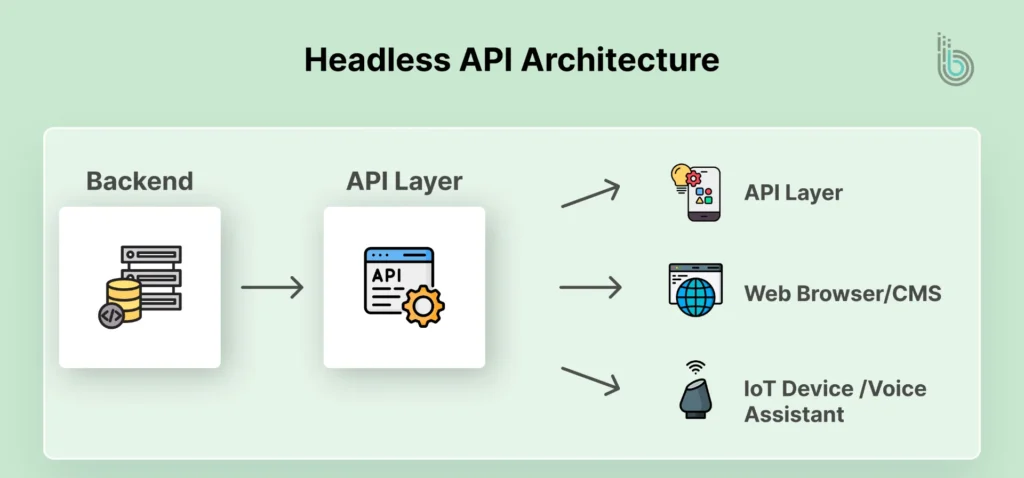
In a headless setup, the backend is treated as a product rather than a page builder. It performs essential tasks such as storing data, enforcing rules, and running workflows. It is responsible for inventory checks, login security, pricing logic, order creation, and permissions. The backend exposes these capabilities through an API that serves as the single point of contact for your frontends.
The frontends are independent. A website, iOS app, Android app, or even a kiosk can all pull from the same backend without sharing code or design patterns. The UI simply requests what it needs, then renders it in its own style and layout.
This is also why many teams now plug in specialized backend services rather than building everything from scratch. For example, a headless CMS for content, Stripe for payments, Auth0 for login, and a product database for catalog data. Each service has APIs, and the frontend brings the experience together.
REST vs GraphQL in Headless APIs
Most headless systems use REST or GraphQL, but they shape the developer experience in very different ways.
REST is endpoint-based. You access /products, /categories, or /orders/123. It’s straightforward, stable, and easy to understand. It works well when the data structure is consistent, and you don’t mind making a few separate calls.
GraphQL is query-based. Instead of multiple endpoints, you can request a custom response in a single request. This is useful when different screens need different data. For example, a product page may need images, reviews, stock, and pricing together. GraphQL can fetch that cleanly, but it also requires strong governance. Without limits, queries can become heavy and slow.
Why Decoupling the Frontend and Backend is Important
Decoupling gives you control and clarity. The backend stays focused on data and rules. The frontend concentrates on experience and speed. When the API is well-designed, the UI can evolve without affecting core systems. And the backend can scale without being affected by design changes.
Key Benefits of Headless API Architecture
Below are some of the most essential benefits of adopting a headless API for your platform.
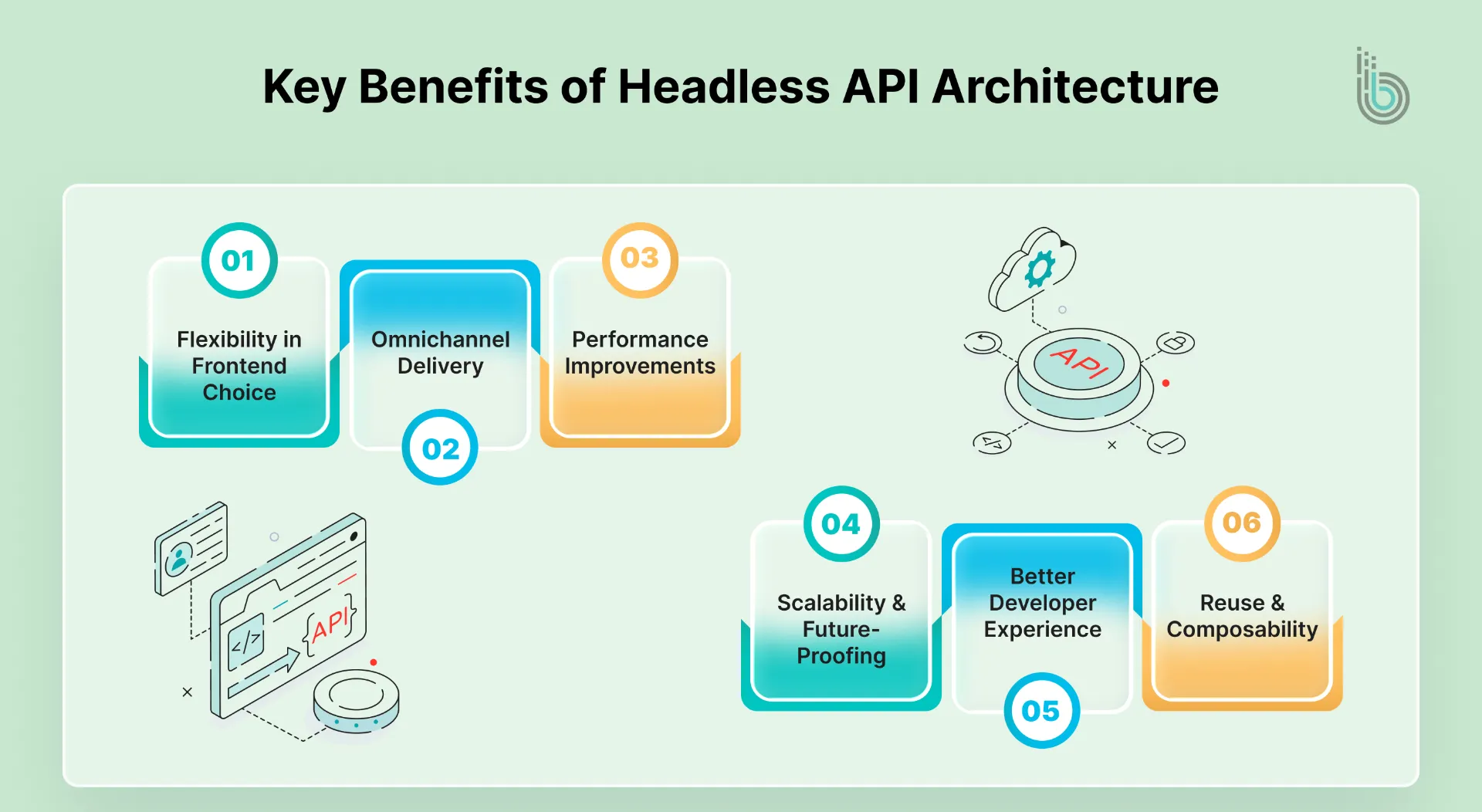
Freedom in frontend choice: With headless APIs, the backend doesn’t care what your UI is built with. React, Next.js, Vue, native iOS, Android, anything works. This keeps your product flexible. You can change its appearance without touching the backend.
Omnichannel delivery from one source: A headless backend can power multiple touchpoints simultaneously. Your website, mobile app, partner portal, smart devices, and in-store screens can all pull the same data. That means fewer mismatches, fewer manual updates, and a more consistent customer experience.
Better performance control: Traditional systems often send extra code and content you don’t need. Headless lets you fetch only what the screen requires. You can also optimize each frontend separately. This makes it easier to hit speed goals, especially on mobile networks.
Scalability is easy: As traffic grows, headless systems scale more cleanly because responsibilities are separated. The backend can scale for data and requests, while the frontend can scale for rendering and UI delivery. You don’t have to work around one giant system for everything.
Future-proofing: Technology changes quickly. Headless architecture makes change less risky. You can redesign your frontend, move to a new framework, or rebuild one channel at a time. The backend can stay steady while the UI evolves around it.
A smoother developer experience: Headless architecture establishes clearer boundaries. Frontend teams don’t need to wait for backend teams for every small UI change. Backend teams don’t need to bend logic to match one screen. Work moves in parallel, with fewer collisions and cleaner handoffs.
Reuse and composability: When APIs are designed well, features become reusable building blocks. A “product catalog” service can support search, listings, recommendations, and checkout. The same applies to users, payments, and content. You stop rebuilding the same logic in multiple places.
Easier integration with best-in-class tools: Most modern platforms in the ecosystem are API-first. Payments, analytics, shipping, email, and identity, everything connects through APIs. Headless fits naturally into this. You can mix different tools rather than forcing one platform to do everything.
Cleaner governance and security boundaries: A well-built API layer makes it easier to control access. You can lock down sensitive actions, add rate limits, and enforce authentication in one place. It’s a more disciplined way to protect data than spreading logic across multiple frontends.
Overall, headless APIs bring many benefits, like the ability to choose from different headless commerce platforms, easy scalability, better integration with tools, and more. These benefits make them a really good option to fulfill modern development needs.
Common Use Cases for Headless APIs
If your product is displayed on more than one screen or will be displayed on more than one screen in the next year, a headless approach is often the best option. Below are the most common real-world use cases where this architecture fits perfectly.
Headless CMS: A headless CMS stores content in a structured way and delivers it through APIs. This works well when the same content must appear on a website, mobile app, email templates, and even digital signage. Writers publish once, and the frontends decide how it looks. This way, you avoid duplicating pages across platforms.
Headless commerce: In headless commerce, the backend handles products, pricing, inventory, carts, and checkout logic, while the frontend remains customizable. This approach is ideal when you want a fast, branded shopping experience without having to fight a rigid theme system. It also helps when you need multiple storefronts for different regions or customer types.
Mobile apps and SPAs: Single-page apps and mobile interfaces need quick data without constant page reloads. Headless APIs are a clean way to fetch real-time content, user profiles, orders, or search results. This keeps the UI smooth, while the backend stays stable. This is common in SaaS products, booking apps, and dashboards.
IoT and multi-device delivery: Smart devices don’t rely on “web pages.” They need data and commands. Headless APIs simplify serving the same core system to smart TVs, wearables, kiosks, scanners, or voice assistants. The backend remains the source of truth, while devices behave like lightweight clients.
Third-party app integrations: Most modern businesses rely on external tools such as CRMs, analytics, shipping, payments, and support systems. Headless APIs make integrations cleaner because your backend exposes standard endpoints. Instead of relying on direct database access, systems connect through controlled, auditable API calls.
Custom dashboards and micro-apps: Teams often need admin panels, reporting dashboards, partner portals, or small workflow apps. Headless APIs are perfect here because internal tools can reuse the same backend logic as the customer-facing product. That reduces mismatched data and prevents “shadow systems” from growing.
Multi-brand or multi-site platforms: If you manage multiple brands, franchises, or regional sites, a headless platform is a strong foundation. Each site can have its own design and content strategy. But all of them can share a standard backend for products, users, and business rules.
Rapid prototyping and MVPs: Headless APIs let you build a quick frontend without rebuilding the backend every time you change direction. This is valuable for startups and product teams testing ideas. The API stays steady while the UI evolves through iterations.
In short, headless APIs are useful for multi-brand platforms, third-party app integrations, custom dashboards, and more — especially when implemented through expert Headless eCommerce development services, making them a highly useful and flexible option.
Challenges of Headless APIs
Headless APIs can feel clean and modern, but they’re not “set it and forget it.” They shift responsibility. Instead of relying on one bundled platform to handle everything, you’re designing a system made of parts. That freedom is powerful, but it comes with a few real trade-offs.
Strong API design becomes necessary.
In headless systems, the API is the product backbone. If endpoints are inconsistent, poorly named, or missing key data, every frontend suffers. You also need clear rules for versioning, error messages, and authentication. Without that discipline, the system becomes frustrating to build on.
Frontend work can get more complex.
Traditional platforms often provide ready-made pages and templates. Headless doesn’t. Your frontend team must build the UI, routing, state management, and rendering logic from the start. That’s not a problem for mature teams, but it can slow you down if you expect quick plug-and-play results.
Monitoring and performance tuning are essential.
With multiple frontends calling APIs, small inefficiencies quickly add up. Too many requests, heavy payloads, or slow database queries can hurt the user experience. You’ll need logging, rate limits, caching, and performance dashboards to keep things running smoothly under load.
More moving parts mean more coordination.
Headless setups often include several services such as CMS, payments, search, auth, and more. Each one has its own uptime, updates, and quirks. When there is an issue, debugging can take longer.
Content and preview might be an issue.
In traditional CMS platforms, editors can preview exactly how a page will look. In a headless environment, content is stored separately from design. Previewing needs extra setup, and non-technical teams may need guidance at first. It’s solvable, but it’s not automatic.
Security and access control need careful planning.
An API-first world exposes more surfaces to protect. Tokens, roles, permissions, and request validation must be done right. If security is treated as an afterthought, headless can create risk rather than reduce it.
Headless APIs are worth it when you want long-term flexibility and multi-channel delivery. But to fully utilize their benefits, a more structured development approach is necessary.
Planning to go headless? Let our experts help you do it the right way!
Headless APIs make it easier to serve modern users across websites, mobile apps, and new channels without rebuilding everything. The backend focuses on data, rules, and workflows. The frontend focuses on design and experience. While they are technically separate, the user should never notice the gap.
Traditional APIs often grow around a single app, while headless APIs are built to be neutral and reusable. This is why headless fits so well in headless CMS, commerce, SPAs, IoT delivery, and third-party integrations. When implemented correctly, it results in a cleaner codebase and a smoother path for long-term growth.
That said, headless demands strong API design, thoughtful frontend engineering, and careful monitoring. The right move is to adopt headless only when flexibility and multi-channel delivery are real needs, not just trends.
FAQs on Headless API
1. What is the difference between an API and a headless API?
An API is an interface that allows two software systems to communicate. It can be built for one specific app or workflow. A headless API is designed to stay independent from any single frontend. It delivers data and actions without assuming how the UI will look. In short: every headless API is an API, but not every API is truly “headless” in design.
2. What is a headless API call?
A headless API call is a request made by a frontend (like a website or mobile app) to a backend through an API. The frontend asks for data or triggers an action, such as “get product details” or “create an order.” The backend returns structured data, typically in JSON format. The frontend then decides how to display this data, without relying on backend templates.
3. What is the difference between headless and microservices?
Headless refers to separating the frontend from the backend so that multiple frontends can use the same backend through APIs. Microservices involve dividing the backend into smaller services, like payments, users, and inventory, each running independently. You can use headless without microservices and microservices without headless. Many modern systems use both, but they solve different problems.