How to Create an eCommerce Marketplace? A Complete Guide
Quick Summary
Marketplaces scale faster than regular stores because sellers bring the inventory, while you focus on the platform, trust, and smooth buying experience.
Start with a tight MVP that supports transactions (listings, search, checkout, payments, seller tools) and expand only after you validate demand.
Your marketplace wins on execution basics like clean UX, strong SEO, balanced supply and demand, and reliable operations like payouts, refunds, and dispute handling.
Post-launch growth comes from data and loyalty. Optimize weak points using metrics, add AI/local payments at the right time, and keep sellers and buyers engaged long-term.
Online shopping became popular because of three main reasons: convenience, better prices, and more options. Online marketplaces are most popular when it comes to eCommerce. Multiple sellers compete in one place, which often brings prices down. And buyers get a wider product range than single-seller stores or retail shops.
But if you’re figuring out how to create an eCommerce marketplace, it’s not the same as launching a normal online store. You’re building a two-sided system for buyers and sellers. That means getting onboarding, payments, trust, and product management right. One weak link can slow growth early.
Global B2C eCommerce revenue is expected to reach $5.5 trillion by 2027, growing at 14.4% CAGR. In this blog, we’ll discuss how to build an online marketplace step-by-step, from MVP to launch. Let’s begin.
What is an eCommerce Marketplace?
An eCommerce marketplace is a website where many sellers sell in one place. Customers can compare prices, brands, and options without leaving the site. The marketplace runs the system, including product listings, search options, checkout, and payments, while sellers fulfill orders.
Marketplaces scale faster by adding sellers rather than buying more inventory. More sellers mean more products, better prices, and more sales opportunities. That’s why platforms like Amazon Marketplace, Walmart Marketplace, eBay, and Etsy work so well in the US, and Alibaba globally.
Why You Should Build an Online Marketplace
Online marketplaces are becoming the default way people shop. Buyers want choice, speed, and fair pricing. Sellers want customers without spending years building traffic. That’s why building an online marketplace can be a really good move right now, as online buying is already a daily habit.
Bigger Reach from Day One: A marketplace can attract both buyers and sellers, which helps you grow faster than a single store.
Wider Product Range: Multiple vendors mean more variety without you holding inventory.
24/7 Selling: Your platform keeps earning even when you’re offline.
Lower Overhead than Retail: No rent, fewer staff needs, and less stock risk compared to physical stores.
Stronger Pricing Appeal: Seller competition often brings better deals, attracting more buyers.
Flexible Income Streams: You can earn through commissions, subscriptions, ads, or featured listings.
Faster Scaling: Add new sellers and categories without rebuilding your entire business each time.
Better Customer Trust Over Time: Reviews, ratings, and secure payments make people comfortable buying again.
If the goal is long-term growth, building an online marketplace gives you a business that can expand in products, sellers, and revenue without increasing your costs at the same rate. Ready to launch your own scalable platform? Then choose our comprehensive eCommerce marketplace development services for the best results.
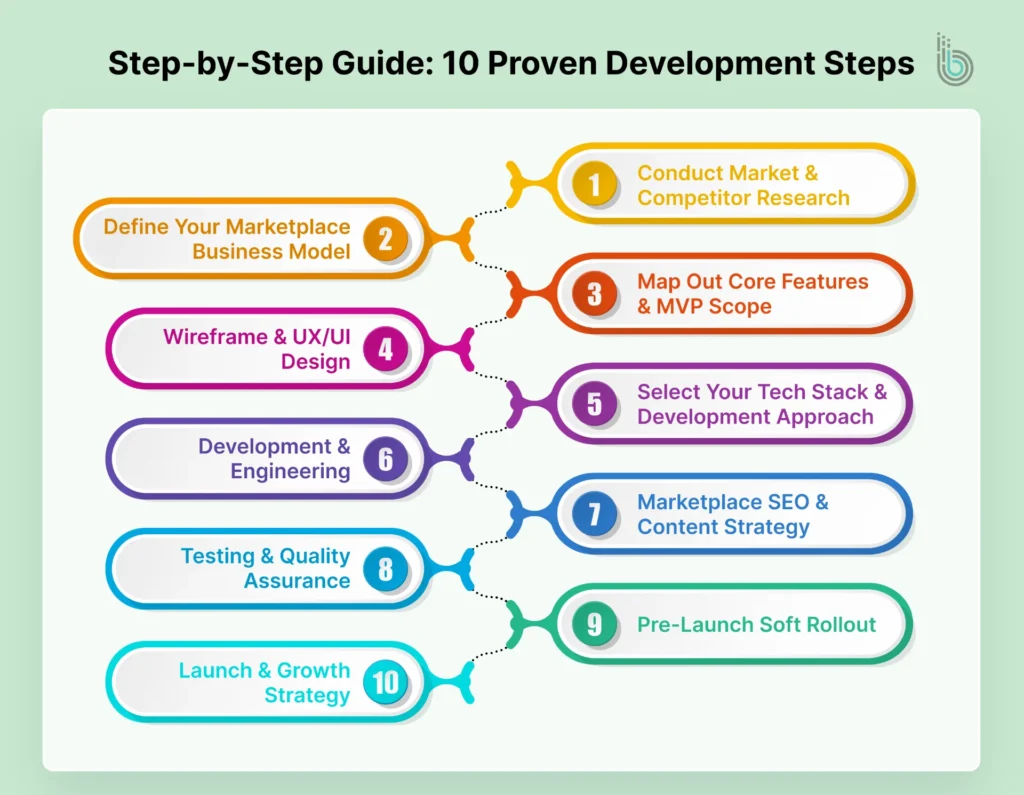
Step-by-Step Guide: 10 Proven Development Steps
Below are the steps that you should follow to build a successful eCommerce marketplace. These steps cover everything from market research to marketplace SEO and testing.
Step 1: Conduct Market & Competitor Research
Before you start building, do thorough research about your niche. Understand who your buyers and sellers are. Look at existing online marketplaces and note where they succeed or fail. This upfront work helps you define the right marketplace business model and identify gaps you can fill in customer experience, pricing, or product range.
Step 2: Define Your Marketplace Business Model
Choose the model based on your preferences: B2C, B2B, C2C, or hybrid. Also, decide on your revenue model. The options include commissions, seller subscriptions, listing fees, and others. A clear business model guides your entire marketplace website development and monetization strategy.
Step 3: Map Out Core Features & MVP Scope
List must-have features. Buyers need category browsing, search, filters, product pages, cart, checkout, payment, and order tracking. Sellers need features such as sign-up, onboarding, product listing (images, price, stock), and order handling.
Build a marketplace MVP first to test your idea with real users and gather early feedback. Launch the MVP, validate demand, then expand.
Step 4: Wireframe & UX/UI Design
Design plays an important role, so keep it clean. It should also focus on real user actions. Map both journeys: buyer flow (discover → compare → checkout) and seller flow (onboard → list → fulfill → get paid). Wireframe key pages first, including home, category/collection pages, product detail, cart, checkout, seller dashboard, and admin.
Reduce friction with smart defaults, clear filters, strong search, and trust signals like reviews, delivery dates, and return clarity. A clean UX improves conversion more than any feature upgrade.
Step 5: Select Your Tech Stack & Development Approach
Choose between marketplace software, headless platforms, or custom development. Each one has its pros and cons. Pick based on your marketplace type and MVP scope, not trends. Your stack must support fast search, organized category structure, stable payments, and smooth seller tools.
Plan key integrations early, like shipping, taxes, email/SMS, and analytics. Most importantly, build for marketplace scalability and performance so growth can be handled by the platform.
Step 6: Development & Engineering
Build the marketplace in layers. eCommerce frontend focuses on what users see. eCommerce backend supports sellers, orders, payments, and admin tools. Treat the marketplace payment system as a core module, with clear rules for refunds, cancellations, and split payouts.
Ensure the platform is built for scalability and performance. Optimize for speed, search, caching, and clean APIs because traffic and listings grow quickly. Lock down security with role-based access, fraud checks, and safe data handling for buyer and seller accounts. A fast, stable, and secure website will attract repeat orders.
Step 7: Marketplace SEO & Content Strategy
Marketplaces don’t grow on ads alone. You need search traffic that keeps coming every month. Build category pages, structured URLs, and a logical category hierarchy so Google and users both understand your catalog. Make sure the product descriptions are detailed and keyword-rich.
Create content that supports discoverability and reduces reliance on paid ads. Give users options to compare products. Also set rules for product titles, descriptions, and attributes to keep listings consistent and searchable.
Step 8: Testing & Quality Assurance
Before you launch the marketplace, do thorough QA & testing. Review the platform as a seller and a customer. Check search accuracy, filters, checkout, payments, refunds, and order updates end-to-end. Validate seller actions, including listing edits, stock changes, cancellations, and payouts.
Focus on speed, broken flows, and mobile usability because most users won’t forgive friction. Fix issues before launch, because trust is hard to win back.
Step 9: Pre-Launch Soft Rollout
Start with early access by inviting a small group of sellers and early customers to use your site. Collect feedback and adjust pricing, onboarding, or features. Watch where users drop off, such as at sign-up, product upload, checkout, or delivery tracking.
Improve your marketplace onboarding process, policies, and support flow based on real feedback. This phase helps you stabilize operations before scaling traffic.
Step 10: Launch & Growth Strategy
The launch of the marketplace is just the start. Now, focus on marketplace customer acquisition and seller supply at the same time, or the platform feels empty. Use targeted online marketplace marketing, partnerships, and referral loops to build momentum.
Track key numbers like conversion rate, repeat buyers, seller activation, and order success rate. Then refine pricing, categories, and operations to support long-term marketplace growth strategy.
When each step is executed clearly, your marketplace launches stronger, grows faster, and avoids early-stage breakdowns.
Avoid Common Mistakes When Building an Online Marketplace
When building an online marketplace, there are a few mistakes that should be avoided, as they can quietly stall your growth. Below are key mistakes to avoid and how to prevent them.
Poor UX & Confusing Paths: If browsing and checkout are complex, conversions will drop. Test every path as a buyer and a seller. Simplify filters, clarify buttons, and make actions obvious to first-time users.
Inadequate Market Validation: If there is no demand for products, it will just waste resources. Run surveys, small ad tests, and early seller interviews before committing to full development.
Ignoring SEO Fundamentals: Relying only on ads increases long-term costs. Structure pages and listings with clear keywords, descriptive URLs, and rich content so organic traffic grows over time.
Underestimating Supply-demand Balance: Too many buyers without sellers or vice versa will frustrate everyone and kill momentum. Start with a niche focus, recruit sellers early, and monitor fill rates so demand meets supply.
Skipping Mobile Optimization: More than half of online purchases today happen on phones. If your marketplace is slow or hard to use on mobile, you lose large segments of buyers and sellers.
Weak Marketplace Payment System: A fragile payment setup leads to failed checkouts and seller distrust. Use reliable payment partners, support split payouts, and handle refunds cleanly.
Neglecting Trust and Safety: Without reviews, verification, and clear policies, users hesitate to transact. Build simple but strong trust signals like ratings, seller verification, and dispute resolution.
Overlooking Performance and Scalability: Slow sites lose customers fast. Monitor load times and optimize early so growth doesn’t break your platform under load.
Avoiding these common mistakes will set a stable foundation. Focus first on clarity, trust, and real user behavior, then let your marketplace grow with confidence.
Post-Launch: How to Scale & Evolve
After launch, if you want the marketplace to grow, you need sharp execution. Small upgrades, done consistently, create results that add up.
Add Advanced Features: Introduce AI recommendations once you have enough browsing and purchase data. Use it to improve search relevance, “similar items,” and personalized homepages. Add localized payments and region-friendly checkout options as you expand to new markets or customer segments.
Optimize Using Marketplace Data: Track conversion rate, search-to-cart rate, repeat purchase rate, seller activation, and order success rate. Fix the biggest drop-off first. These are usually present in search, product pages, or checkout. Test changes in small batches.
Focus on Seller Performance and Retention: Give sellers better tools like inventory control, pricing insights, faster payouts, and clear policy support. Reduce friction in onboarding and make listing quality easy to maintain. Good sellers create better customer experiences, which lifts your whole marketplace.
Focus on Customer Loyalty: Use wishlists, reorder reminders, price-drop alerts, and simple membership perks. Keep delivery timelines clear and returns easy. Loyalty grows when buying again feels safe.
Scale Operations Without Losing Control: Automate refunds, cancellations, and dispute handling where possible. Keep fraud checks active and protect both sides with strong verification and reviews. A trustworthy marketplace will grow in the longer run.
If you keep improving the experience for buyers and sellers, your marketplace won’t just grow; it will become the place people return to by habit.
Build an eCommerce Marketplace With Advanced Features Today!
Building an online marketplace is one of the smartest ways to grow in eCommerce because it scales with sellers, not with your inventory. To make it successful, pick the right niche, validate demand early, and launch an MVP that supports transactions. Strong UX, clean product discovery, and a reliable payment flow do more for growth than useless features.
Display reviews, clear policies, and consistent delivery keep buyers coming back. Long-term success comes from discipline after launch. Balance supply and demand, keep your catalog structured, and use data to fix the weakest step in the customer journey. Add advanced upgrades like AI recommendations and localized payments only when your platform has enough usage to support them.
If you build for speed, safety, and seller success, your marketplace becomes a business that compounds over time. Ready to build your online marketplace? Hire dedicated eCommerce developers to get started.
FAQs on Creating an eCommerce Marketplace
Q1. How much does it cost to build an eCommerce marketplace?
It depends on scope, features, and build approach. A basic MVP can cost less, while a full custom marketplace with advanced seller tools costs much more. The biggest cost drivers are payments, seller onboarding, admin controls, and integrations. Start lean, validate demand, and then scale features.
Q2. What's the difference between eCommerce and an online marketplace?
A regular eCommerce store usually has one seller selling their own products. An online marketplace has many sellers listing and selling on the same platform. Marketplaces manage the system, including search, checkout, payments, and rules, while sellers handle inventory and fulfillment. That’s why marketplaces offer more variety and competitive pricing.
Q3. What is the best eCommerce marketplace platform?
There’s no single best platform for everyone. The right choice depends on your budget, timeline, and whether you want speed or full control. For fast launch, marketplace software works well. For flexibility and scale, headless or custom development is stronger. Pick a platform that supports multi-vendor selling, secure payments, and performance at scale.
Q4. How to create a private marketplace?
A private marketplace is built for a restricted group of buyers, sellers, or both. You control access through approvals, invite-only sign-ups, or account verification. The core build is similar to a public marketplace, but with stricter onboarding, role-based access, and customized pricing or catalogs. These marketplaces are well-suited for B2B, wholesale, and enterprise use cases.
Q5. What is the best marketplace builder?
The right option depends on your budget, timeline, and customization needs. Ready-made marketplace builders are faster and less expensive for MVPs, while custom or headless builds offer greater control and scalability. Choose a builder that supports multi-vendor management, secure payments, SEO-friendly structure, and future growth.