How to Hire eCommerce Developers: Step-by-Step Guide for Business Owners
Quick Summary
A professional eCommerce developer is needed to build a store that loads fast, works smoothly on mobile, and keeps checkout stable during real traffic.
Hiring becomes easier when the project is clearly defined, including the platform choice, must-have features, integrations, UX expectations, and SEO basics.
The safest hiring process is structured: shortlist, review portfolio, test technical skills, interview for communication, and conduct a test before full commitment.
Cost depends on experience, location, and hiring model, but the cheapest option often leads to slow fixes, broken flows, and higher long-term expenses.
If an eCommerce store were only about design, hiring would be easy. Pick a clean theme, add products, and go live. But that’s not how it works. There are many technical aspects that need to be addressed. A poorly developed eCommerce site will be slow. It will have issues like filters not working, orders dropping at checkout for no reason, and more.
To make sure your site doesn’t suffer from such issues, it’s very important that you hire the right eCommerce developers. You need someone who understands online selling. They should have the required expertise to tweak load speed, mobile flow, payment failures, product variations, tax rules, shipping logic, and more.
The right developers will deliver a site that can be easily scaled when the catalog grows from 50 products to 5,000. A portfolio won’t always show that. The right questions will.
In this step-by-step guide on how to hire eCommerce developers, we’ll cover the entire eCommerce developer hiring process. We’ll discuss everything from defining what the store actually needs to shortlisting, evaluating, and hiring. So, let’s get started.
Why Do Businesses Need a Professional eCommerce Developer
When building an eCommerce platform, the website works like the sales team, cashier, and support desk. So hiring an experienced eCommerce developer matters. Not just for code, but for a store that runs smoothly, sells better, and stays stable as the business grows.
Expectations of Modern Online Shoppers
Shoppers don’t wait. Most browse on mobile. If the site is slow, confusing, or checkout takes too long, they leave. A professional developer builds fast pages, clean navigation, and a smooth checkout. They also improve search and product pages to help buyers make faster decisions.
Competitive Advantage with Customised Features vs. Template Sites
Template stores look similar and have limitations. Custom eCommerce development helps add features that fit the business, such as bundles, subscriptions, advanced filters, order fulfillment, and B2B pricing. This makes the store easier to shop from and helps the brand stand out.
Scalability, Security, and SEO Benefits
Growth brings pressure. More traffic, more products, and more campaigns. A professional developer builds for scale, so the site stays fast and stable. They also protect customer data and payment flows. Plus, they set up technical SEO early, like clean URLs, redirects, and fast load speed.
Post-launch Support and Maintenance are Important
Launch is just the start. Updates, new offers, plugin changes, and fixes will keep coming. Professional developers provide ongoing support to keep the store reliable and keep improving.
In short, don’t consider hiring a professional developer an extra expense. It’s going to protect the customer experience, brand reputation, and the money coming in every day.
Defining the Project Requirements Before Hiring
Hiring becomes easier when requirements are defined. Without them, even a skilled developer will make guesses. It will cost you a lot of money in eCommerce. Define your store’s requirements, integrations, and goals before contacting developers. This preparation ensures you can clearly explain what success for the project looks like.
Business Goals and Platform Choice
Start with the business goal, not the platform.
Is the goal to launch fast and validate demand?
Or is it to build a long-term brand with deep customization?
The answer will determine the next step.
If the priority is speed and simplicity, it often makes sense to hire Shopify developers.
If the store needs more control over features and plugins, many businesses hire WooCommerce developers.
If the catalog is large, operations are complex, or B2B is involved, finding Magento developers for hire may be smarter.
When choosing an eCommerce platform, don’t look for what’s trending; look for a platform that fits the business model, budget, and team. A strong developer will guide this, but only if the goals are defined upfront.
Functional Requirements
This is the “must-have list.” Not nice-to-have. Not future ideas. Only what the store needs on day one.
You don’t need developers who integrate these; you need developers who can do it without creating issues with other functionalities like checkout or reporting. If integrations are a big part of the project, it’s often better to hire an experienced eCommerce development team or outsource eCommerce development to a company that has done similar builds.
UX/UI Expectations
Design is not just how the site looks. It’s how it feels to shop.
Be clear about the experience expected:
Mobile-first layout (thumb-friendly navigation)
Clean category pages with strong filters
Product pages that answer doubts fast (size, specs, shipping, returns)
A checkout that feels short and simple
Trust signals (reviews, badges, clear policies)
If the brand already has references, share them. If not, define whether you want minimal, premium, playful, or bold designs. A good developer can build it if the directions are clear.
SEO & Conversion Requirements
SEO should not be an afterthought. Fixing it later costs more and takes longer.
Basic SEO expectations should be written upfront:
Fast-loading pages
Clean URL structure
Proper redirects (especially if migrating)
Schema markup for products and reviews
Indexable category and product pages
Strong internal linking support
Conversion requirements matter just as much:
Quick add-to-cart and smooth cart editing
Guest checkout option (if the brand allows it)
Minimal steps to purchase
Easy returns and refund flow
Clear shipping and delivery messaging
Technical Requirements & Stack
Even if you don’t understand the technical aspects, it should be defined properly. It decides how easy the store will be to maintain later. Below are some questions you need to answer:
Will the business need custom APIs for apps or marketplaces?
What level of performance is expected (especially on mobile)?
If the plan includes advanced flexibility, hiring full-stack eCommerce developers or headless commerce developers becomes important. If the plan is simpler, a strong platform specialist is often the better choice. When these requirements are written clearly, hiring becomes easy. It also improves delivery, because the developer isn’t building from assumptions.
Key Skills to Look For in eCommerce Developers
Skilled developers will build a fast store that handles payments securely and remains stable as traffic grows. While hiring, these are the skills that actually matter.
Technical Skills
Platform proficiency: The developer should know the platform beyond the basics. Whether it’s Shopify, WooCommerce, or Magento, they must understand themes, apps/plugins, checkout limits, and common failure points.
Front-end development & responsive design: The store must look clean and function perfectly on mobile devices. This includes smooth menus, readable product pages, and a checkout that feels easy. A good developer builds for real shoppers, not just desktop screens.
Back-end logic & database skills: Pricing rules, inventory updates, coupons, shipping logic, and order flows need solid back-end work. Weak logic creates bugs that show up during peak sales hours.
APIs and third-party integrations: A store must connect with payment gateways, shipping tools, CRM systems, email marketing, and analytics tools. The developer should know how to integrate these without affecting checkout or tracking.
Site performance and security best practices: Speed affects sales. Security protects trust. Look for someone who understands caching, image optimization, secure admin access, and safe handling of customer data.
Soft Skills
Communication & project management: Updates should be clear, regular, and honest. A good developer explains progress in simple words and flags risks early.
Problem-solving and adaptability: eCommerce projects always change midway. The developer should stay calm, fix issues fast, and adjust without chaos.
Understanding of UX and business goals: The best developers think beyond code. They understand what drives purchases and build flows that support conversion, not confusion.
Simply put, look for technical mastery in platform architecture, responsive design, and secure integrations to ensure a fast, scalable store. Hire eCommerce developers with strong problem-solving skills and a business-first mindset who can align complex backend logic with conversion goals.
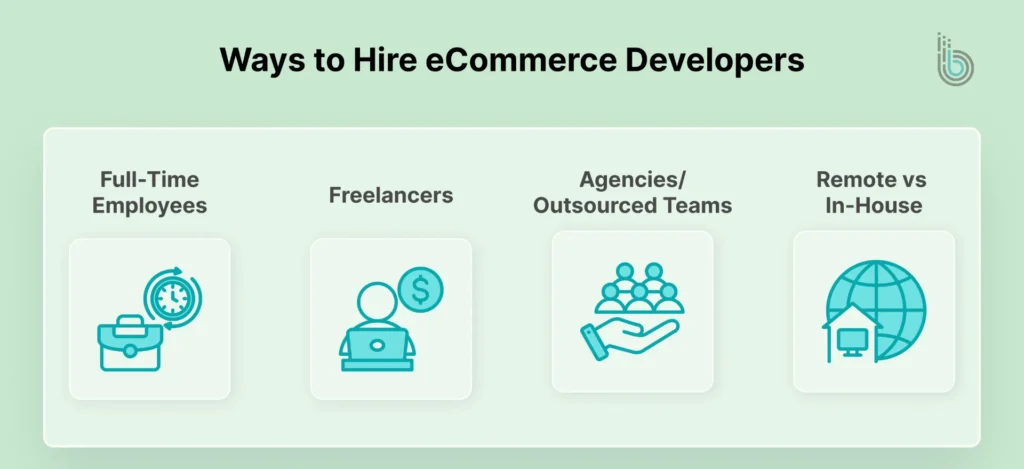
Ways to Hire eCommerce Developers
The right hiring model depends on your budget, timeline, and the complexity of the store.
Full-Time Employees: Best for businesses that need ongoing development every week. You get full control, faster internal coordination, and long-term ownership. But it’s the highest fixed cost and takes longer to hire.
Freelancers: Good for small builds, quick upgrades, or specific tasks. Hiring is faster and usually cheaper. The risk is uneven quality and limited accountability on larger projects. Works best with a clear scope and strict milestones.
Agencies or Outsourced Teams: Ideal for full builds and custom eCommerce development. You get a complete team for design, development, QA, and management. Delivery is more structured but costs more. A solid option if you want to outsource eCommerce development without building an in-house team.
Remote vs In-House: Remote offers access to a wider talent pool and flexible costs. In-house gives tighter collaboration but higher overhead. The remote option works well when communication and documentation are strong.
Choose the setup that keeps delivery the way you expect and has reliable support after launch.
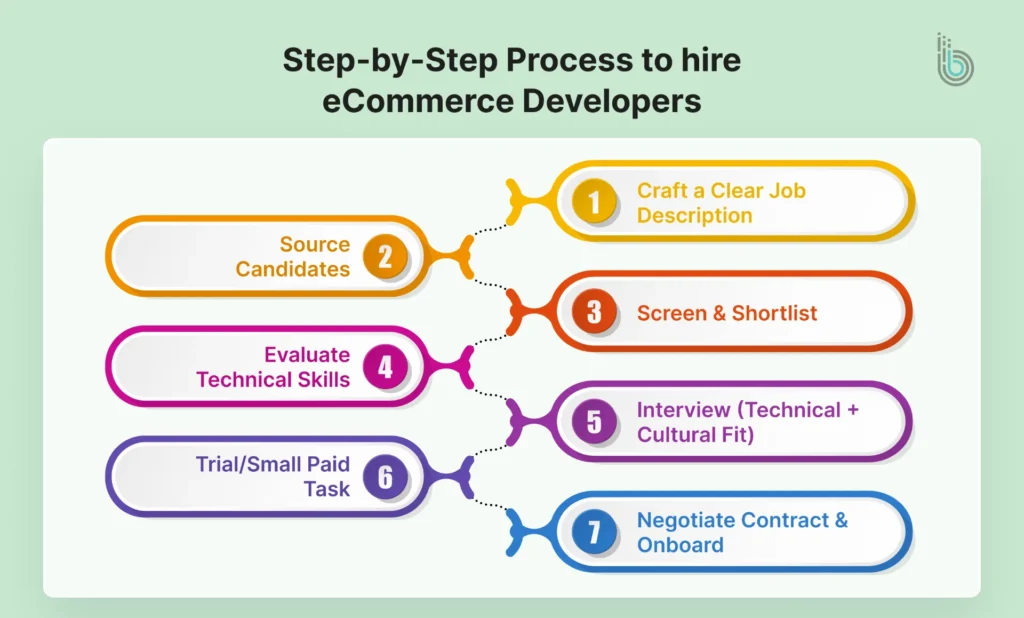
Step-by-Step Process to Hire eCommerce Developers
Hiring the right eCommerce developer is easier when the process is structured. Following these steps will help reduce the risk of bad hires.
Step 1: Craft a Clear Job Description
Start with a short role summary and description of what a successful platform looks like. Mention the platform (Shopify, WooCommerce, Magento, or a custom platform). List key deliverables like the homepage, product pages, checkout, speed targets, and basic SEO setup. Add what support is expected after launch.
Step 2: Source Candidates
Use LinkedIn, job boards, and niche platforms where eCommerce website developers actively work. If the project is large, consider an eCommerce development agency or a dedicated team instead of a solo hire.
Step 3: Screen & Shortlist
Filter fast. Look for relevant platform experience, real store builds, and clear project outcomes. Skip vague resumes. Shortlist people who match your scope and budget.
Step 4: Evaluate Technical Skills
Don’t judge only by design screenshots. Review live stores, page speed, mobile flow, and checkout stability. Ask how they handle security, integrations, and performance. A quick code review or test task can reveal quality.
Step 5: Interview (Technical + Cultural Fit)
Ask direct questions:
How do you prevent checkout issues?
What integrations have you handled before?
How do you plan milestones and updates?
What do you need from me to avoid delays?
Step 6: Trial/Small Paid Task
Give a small paid task like fixing a cart issue or improving page speed. This shows how they work under real conditions.
Step 7: Negotiate Contract & Onboard
Set payment terms, milestones, timelines, and ownership clearly. Confirm documentation, access sharing, and post-launch support. A clean contract prevents future confusion.
In short, follow a structured hiring process by setting clear requirements and sourcing candidates with proven platform-specific success. Validate expertise through technical screenings and trial tasks to ensure seamless integration, security, and clear project ownership.
Cost of Hiring eCommerce Developers
The cost of hiring an eCommerce developer depends on what you’re building and how fast you need it done.
Factors Affecting Cost
Skill level (Junior vs Senior)
Junior developers cost less, but they often need more guidance. Senior developers charge more because they solve problems quickly and build stable systems with fewer long-term fixes. For revenue-critical work like checkout, payments, and performance, prefer experienced eCommerce developers.
Location (Onshore vs Offshore)
Onshore developers in the US usually charge higher rates. Offshore talent can be more affordable, but the quality range is wide. The best results come from strong screening, a clear scope, and written milestones.
Type of Engagement (Full-time, Hourly, Fixed Project)
Hourly works well for ongoing improvements and support. Fixed project pricing suits clear, one-time builds. Full-time hiring is best when the store needs regular work every week.
Typical Cost Ranges
Engagement Type
Estimated Cost
Notes
Freelancer (Hourly)
$15-$120/hr
Depends on expertise
Agency
$5,000-$50,000+
End-to-end services
Full-Time Developer
Salary varies
Best for ongoing work
If the store is a serious revenue channel, don’t go for the cheapest option. Choose the most dependable one. Keep in mind that development costs vary by scope, platform, and region. For comprehensive store development, opt for eCommerce website development packages that cover everything.
Common Mistakes to Avoid When Hiring
Below are some common mistakes to avoid when hiring an eCommerce developer, as these can get expensive.
Vague Job Descriptions: A vague job post attracts vague candidates. If the role doesn’t mention the platform, core features, integrations, and timelines, you’ll get random profiles. Define what the store must include, what “done” means, and what support is expected after launch.
Ignoring Portfolio Depth or References: A few screenshots don’t prove real skill. Always check live stores they built. Test mobile speed, search, filters, and checkout flow. Ask what they personally handled. If possible, speak to a past client. One honest reference can save weeks of regret.
Over-focusing on Cost Instead of Value: Cheap builds often become costly repairs. A lower rate looks good upfront, but weak code creates slow pages, broken checkout, and constant fixes. Pay for reliability, clean work, and someone who can finish without drama.
Poor Communication Expectations: Most projects fail due to silence, not skill. Set expectations early, like the update frequency, response time, and how changes will be handled. Clear communication keeps the project on track and prevents last-minute surprises.
Avoid these mistakes, and you will save a lot of time, money, and frustration. Vague job descriptions attract the wrong people and superficial portfolios are very common.
Post-Hire Best Practices
Once you’ve hired eCommerce developers for your project, you need to keep a few things in mind. Follow the best practices outlined below to ensure a smooth development process and a clean, predictable delivery.
Set clear milestones & KPIs: Split work into short phases with clear outputs. Track key KPIs, including page speed, mobile usability, checkout success, and bug count. If it can’t be measured, it can’t be managed.
Use collaboration tools: Keep everything documented. Use Slack for quick updates. Use Jira or Asana to track tasks, set deadlines, and assign ownership. A single source of truth prevents confusion and duplicate work.
Run regular review meetings: Do a short weekly review. Check progress, approve what’s done, and flag blockers early. Small corrections now prevent big fixes later.
Plan long-term updates: A store needs ongoing care. Set a monthly plan for updates, backups, security checks, and performance fixes. This keeps the platform stable and avoids sudden breakdowns.
These best practices will keep the development process streamlined from the beginning and help ensure on-time delivery and that your expectations are met.
Need Experts to Develop Your eCommerce Store? Get in Touch Today!
To build a fast eStore that works perfectly on mobile and doesn’t create issues when customers use it, you need experienced eCommerce developers. Hiring the wrong person will lead to delays, bugs, and constant patchwork. Have clarity before hiring and set goals; decide on features from day one.
A smart hiring process doesn’t have to be complicated. Define the scope, shortlist the right profiles, test skills through real work, and lock timelines with milestones. Don’t choose based on price alone. Choose based on stability, speed, and long-term support because the store isn’t “done” after launch. It needs updates, fixes, and upgrades to keep growing.
FAQs on Hiring eCommerce Developers
Q1. Should a business owner learn basic eCommerce tech before hiring a developer?
It is not absolutely necessary, but knowing the basics helps. Learn what checkout, hosting, plugins/apps, and integrations mean. It makes conversations clearer. It also helps spot vague answers. The goal is confidence, not coding.
Q2. How long does it usually take to build an eCommerce store from scratch?
A simple store can take 2-6 weeks. A custom build with integrations can take 2-4 months. Timelines depend on product count, design needs, and approvals. Delays often happen when the scope keeps changing.
Q3. What should be owned after the project is finished?
Full access to the store admin, hosting, and domain. Also, ask for source code, theme files, and documentation. Make sure all third-party accounts are in your name. Ownership avoids lock-in later.
Q4. Should I hire a platform-specific developer or a generalist?
If the store is on Shopify, WooCommerce, or Magento, a platform specialist is usually the safer pick. They know the limits, best practices, and common issues. A generalist works fine for simple builds but may struggle with deeper platform work. For custom builds, a strong full-stack developer is better.
Q5. What questions should I ask before signing the contract?
Ask what exactly will be delivered and what is out of scope. Confirm timeline, milestones, and payment terms. Ask how bugs, revisions, and delays will be handled. Also confirm who owns the code, admin access, and third-party accounts after delivery.
Q6. Is post-launch support included or separate?
It depends on the agreement. Many developers include a short support window, then charge monthly or hourly after that. Always confirm what support covers. Having updates, bug fixes, security patches, and performance issue fixes in support is necessary.