How to Use Shopify Collective for a Brand-to-Brand Selling Network?
Quick Summary
Shopify Collective sets up a B2B network between retailers and suppliers (all Shopify merchants) to source and sell products without maintaining inventory.
With Collective, retailers can expand their catalog without inventory risk, while suppliers gain new distribution.
Orders are automated, with the supplier handling fulfillment. Collective creates a powerful, asset-light growth strategy for both parties.
Imagine doubling your product catalog overnight, and that too, without stocking a single product. While it may seem unheard of, Shopify Collective makes it possible.
Shopify Collective fundamentally reshapes online retail, moving it from isolated storefronts to dynamic, collaborative ecosystems. The three words that best describe this model are: Connect, Share, and Sell.
This blog explains what Collective is, how it works, its benefits, challenges, and limitations, how to set it up, and more.
What is Shopify Collective?
Shopify Collective is a built-in ecosystem to build collaborative partnerships with other verified merchants. With this platform, an e-commerce business can seamlessly source and sell products from other merchants within its own store.
It’s a built-in dropshipping-like model that expands a store’s catalog without holding the inventory.
What Does Shopify Collective Do?
Enables brand-to-brand product sharing: Retailers can partner up with other retailers or suppliers to source and sell products. However, both parties should be on the Shopify platform.
Fulfills orders automatically: When a customer purchases an externally-sourced product, the order goes directly to the supplier for fulfillment. You don’t need to coordinate with them manually.
Syncs product details automatically: Collective syncs the supplier’s product to the retailer’s store. When the supplier changes pricing, stock, images, variants, etc., the changes are synced and displayed automatically.
Keep margins predictable: Suppliers set wholesale prices, and retailers set retail prices. Both sides retain their profits.
Who is Shopify Collective for?
Retailers/Curators
Don’t want to carry inventory.
Wants to expand the product catalog instantly.
Wants a fast way to test new categories.
Suppliers/Brand
Wants to reach highly targeted audiences.
Wants new revenue channels.
Prefer controlled wholesale relationships.
Who is Shopify Collective NOT for?
Needless to say, if you want to use Shopify Collective, you need an active Shopify plan. Other than that, you need to comply with a few requirements:
Shopify Payment: For Shopify Collective, you must use Shopify Payments as the payment gateway for the store as well as Collective payout.
If your Shopify store doesn’t comply with these requirements, you CANNOT use Shopify Collective.
Shopify Collective helps merchants scale product variety with zero inventory risk. With it, brand collaborations come quite easily, resulting in higher Average Order Value (AOV) and repeat purchases. You can also strengthen Shopify-native partnerships without any external apps.
How Does Shopify Collective Work?
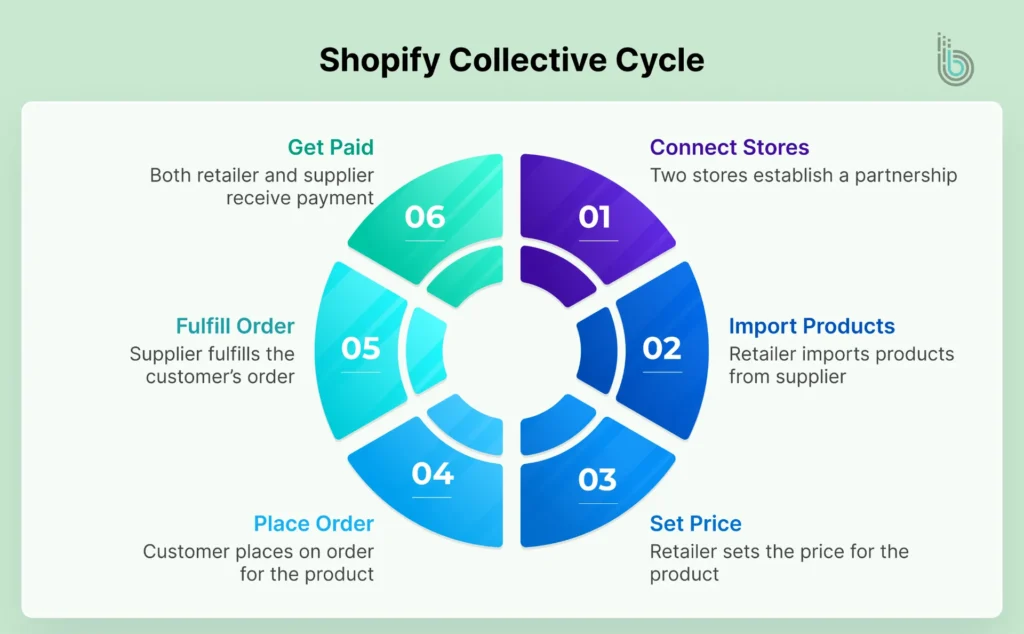
Shopify Collective automates a partnership between your store and another brand’s store. Here’s how it works.
Two Stores Connect & Collaborate: A retailer brand (seeking more products) partners with another brand (either a retailer or a supplier). Once approved, the two Shopify stores can work together.
Retailer Imports Products: The retailer picks the products from the supplier’s catalog and puts them in their store. Shopify Collective will kindly update product info, like:
Product images
Product descriptions
Variations
Inventory
Retailer Sets Their Price: The supplier sets wholesale prices, and the retailer gives their retail price with a set margin.
A Customer Places an Order: When a buyer picks a product from the retailer’s store, the order goes to the supplier automatically.
Supplier Fulfills the Order: Next, the supplier takes care of e-commerce fulfillment, which includes:
Product shipping
Tracking updates
Orders marked as fulfilled
Both Sides Get Paid: The customer pays the retailer at checkout. Shopify automatically pays the supplier their wholesale amount. Everyone keeps their respective margins.
When you use the Shopify Collective app to collaborate with another brand, you handle marketing and frontend. Your collaborative partner, on the other hand, handles inventory and shipping.
As responsibilities get distributed across multiple parties in this setup, maintaining consistency in storefront experience and integrations often requires dedicated technical involvement, which is why it becomes useful to understand how development effort typically varies for Shopify projects, as explained in our Shopify developer cost guide.
Benefits of Using Shopify Collective in 2026
The Shopify Collective sales channel creates a symbiotic partnership between retailers and suppliers. They can use each other’s strengths to grow their businesses.
For Retailers
Zero Inventory Risk: The retailer brand won’t have to stock, store, or manage product inventory.
Expand Product Catalog: A retailer can add new products without setting up inventory or negotiating prices with suppliers.
Higher AOV & Conversions: More suppliers result in a larger variety of products. This gives customers a better chance to find what they are looking for.
Reduced Operational Workload: Suppliers handle the packaging, shipping, and delivery of the orders. That means a lesser workload for the retailers.
Automatic Syncing: Price list, inventory, and product info are automatically synced between suppliers and retailers. No need for manual work.
For Suppliers
Access to Curated Audiences: Retailers usually have niche communities and enjoy strong brand loyalty.
Controlled Wholesale Pricing: You set wholesale prices and maintain stable margins.
Stronger Brand Partnerships: Suppliers and retailers have stronger, smoother, and more long-term collaboration.
New Revenue Channels: With Shopify Collective, suppliers can sell their products through a new revenue channel, i.e., trusted Shopify retailers.
No Additional Marketing Cost: With retailers promoting and selling their products through Collective, suppliers won’t have to invest in marketing and advertising.
These points show that Shopify Collective suppliers and retailers can both benefit from this ecosystem. And if you are leveraging it for your brand, get our Shopify integrations services. We will analyze your brand and integrate the most suitable platforms to amplify Collective’s benefits. That can improve conversions and increase AOV.
But how is this different from traditional dropshipping?
Shopify Collective vs Traditional Dropshipping
Factor
Shopify Collective
Traditional Dropshipping
Supplier Network
Curated, vetted brands on Shopify.
Open market; global suppliers (for example, AliExpress).
Product Quality & Branding
Known, often premium brands; products are branded or customizable.
Often generic; quality can be inconsistent.
Shipping & Reliability
Fast, domestic shipping from partner brands. High reliability.
Long shipping times (often 2-4 weeks). Higher risk of delays.
Integration
Seamless, automated within Shopify
Often requires 3rd-party apps and manual order processing.
Business Model
Strategic curation and partnership.
Volume-based, price-driven competition.
Shopify Collective App builds a curated store with trusted brands. Traditional dropshipping, on the other hand, often focuses on sourcing low-cost products from a global marketplace.
How to Set Up Shopify Collective?
The process of setting up Shopify Collective differs based on whether you’re a retailer or supplier. Once installed, you can use Shopify Collective to import the products and create price lists (or sell products to the retailers, if you are a supplier).
Set up for Retailers
Step 1: Install Shopify Collective App: Navigate to the Shopify App Store and install the Shopify Collective app.
Step 2: Connect With Suppliers: Explore the vetted supplier network and connect with brands that align with your customer base.
Step 3: Import Products from Price Lists: Once connected, browse their available products and import them directly into your store with a single click. Then you can set your own retail price.
Step 4: Sell & Manage Orders: When a customer purchases a Collective product, the order is automatically forwarded to the Supplier for fulfillment. The retailer only manages the customer communication.
Step 5: Optimize Your Shopify Store: Showcase and market these products alongside your own. Also, make sure to analyze the sales data to determine if the strategy is working.
Set up for Suppliers
Step 1: Install Shopify Collective: Log in to the app store and install the Shopify Collective: Supplier app to your store.
Step 2: Set Up Your Supplier Profile: Create a compelling profile showcasing your brand and product categories to attract the right retail partners.
Step 3: Create & Share Price Lists: Define your non-negotiable wholesale pricing for retailers. You can create different price lists for other partners or product groups.
Step 4: Connect With Retailers: Approve retailer connection requests. Once connected, your shared products will be available for them to import and sell.
Want help with leveraging the Collective ecosystem for your Shopify store’s benefit? Then consult with a professional Shopify development company.
Common Challenges With Shopify Collective
Despite its streamlined integration, using Shopify Collective introduces specific complexities requiring proactive management.
Incomplete Product Data Syncing
Product descriptions or images may not sync fully from the supplier.
Solution: Manually review and enhance all imported product pages before publishing.
Communication Delays
Slow supplier responses can delay the resolution of order issues.
Solution: Establish preferred communication channels (e.g., Slack, email) and response time expectations up front.
Limited Shipping Options
Suppliers may not offer the shipping speeds or methods your customers expect.
Solution: Clearly list the shipping carrier and speed on the product page to manage customer expectations.
Pricing Display Inconsistencies
“Compare-at” or discount pricing may not display correctly in your Shopify store.
Solution: Manually check and reconfigure the pricing rules for imported products in your Shopify admin.
Geographic Restrictions
Suppliers may not only ship to certain countries, limiting your market.
Solution: Filter and partner only with suppliers whose shipping zones match your target customer base.
Limited Retailer Control Over Pricing
Retailers cannot control the supplier’s wholesale price increases, affecting margins.
Solution: Set your retail price with a healthy margin buffer to absorb potential supplier price changes.
Despite these challenges, experts leverage Collective effectively and ensure the best results. For that, there are some key tips.
Top Tips for Using Shopify Collective
There are a few ways to maximize Shopify Collective’s potential for retailers and suppliers.
Tips for Retailers
Curate Different Suppliers: Explore different suppliers’ catalogs and select the products that complement your best-sellers. Try to increase the AOV rather than expanding into unrelated categories.
Audit Product Pages: Optimize the imported product details before publishing them. Rewrite the product descriptions to align with the brand voice and optimize the images.
Be Transparent About the Logistics: Retailers must be transparent about the delivery timelines and shipping details. That will prevent and reduce post-purchase support requests.
Price Strategically: Set a healthy margin while pricing your imported products. Consider any unexpected price changes from the suppliers.
Tips for Suppliers
Optimize Your Profile: Within the supplier profile, clearly define the product categories and use high-quality branding. It should attract the retailers like a sales pitch.
Manage Price Lists Diligently: Keep your wholesale price lists updated and organized. The retail partners should be well aware of any changes well in advance.
Prioritize Reliable Fulfillment: Maintain fast, accurate shipping and precise tracking for long-lasting partnerships.
While these tips should deliver the right results, you can hire Shopify developers for technical support with the store.
Real-world Success Stories Using Shopify Collective
Shopify Collective is more than a mere feature; it’s a network for growth. These anonymized scenarios show how brands leverage it for tangible results.
Lalo
Lalo is a DTC brand known for its high-quality children’s products. One of its flagship products is play tables. To offer more engaging toys with their play tables, Lalo used Shopify Collective to partner with other suppliers.
This brand offered products that complemented its own, like art supplies and puzzles from other premium brands. That’s why Lalo is popular among teachers and parents alike.
Paceline
Paceline is a wellness platform that rewards users for staying active. To make the rewards more compelling, Paceline used Shopify Collective to build an entire wellness marketplace. It helped seamlessly onboard and offer products from top health and fitness brands.
The network automates the entire order and fulfilment process. So Paceline could focus on user engagement while their partners handle logistics.
Conclusion
Shopify Collective marks a fundamental shift in e-commerce: isolated competition has transformed into collaborative growth. With this platform, retailers and suppliers share a codependent relationship. The model directly ensures expanded assortment and operational efficiency.
BrainSpate offers you a full-cycle consultation for Shopify Collective. We help you select the right partners, optimize the product pages, and more, to maximize its potential.
So, want BrainSpate’s assistance with your store operations? Then connect with us today!
FAQs on Shopify Collective
1. Is there a limit to collaborating on Shopify Collective?
No, there is no set limit on the number of supplier partnerships or the number of products you can add. Collective offers extensive catalog growth.
2. How are Shopify Collective payments handled between retailers and suppliers?
The retailer receives the customer’s payment. Shopify Collective then automatically settles the wholesale cost to the supplier and the profit margin to the retailer.
3. How to know if Shopify Collective is right for your business?
Shopify Collective program is ideal for those looking to expand product offerings without inventory management or fulfillment.
4. Can any Shopify store join Shopify Collective?
No, it’s an application-based program. Both retailers and suppliers must meet preset criteria and be approved by Shopify beforehand.
5. How are orders managed within Shopify Collective?
When a customer purchases a product from the retailer’s store, the order goes directly to the supplier. The latter will then fulfill directly. The retailer can track its status and handle after-sale queries.