Web 3.0 e-commerce is shifting power to the users. It leverages blockchain, introduces verifiable ownership via NFTs, direct wallet-based payments, and more. This model eliminates or at least tries to reduce the core issues with data privacy, transparency, trackability, etc. And businesses can benefit from new revenue streams and deeper customer engagement.
When you buy something valuable or a limited edition product online, there’s always a thought and concern about authenticity. This concern is even greater when dealing with cryptocurrencies and other unregulated technologies. But with Web3 e-commerce, customers can receive a digital token or proof of ownership stored in a personal wallet on the blockchain.
With Web3 e-commerce, customers can even sell this token in open marketplaces, which gives the original brand a royalty. It’s all a part of blockchain, digital assets, and decentralized protocols.
We understand it all sounds a bit too technical. So, allow us to dial it back and explain what Web3 and e-commerce built on it in 2026 are all about. Let’s begin.
What is Web3?
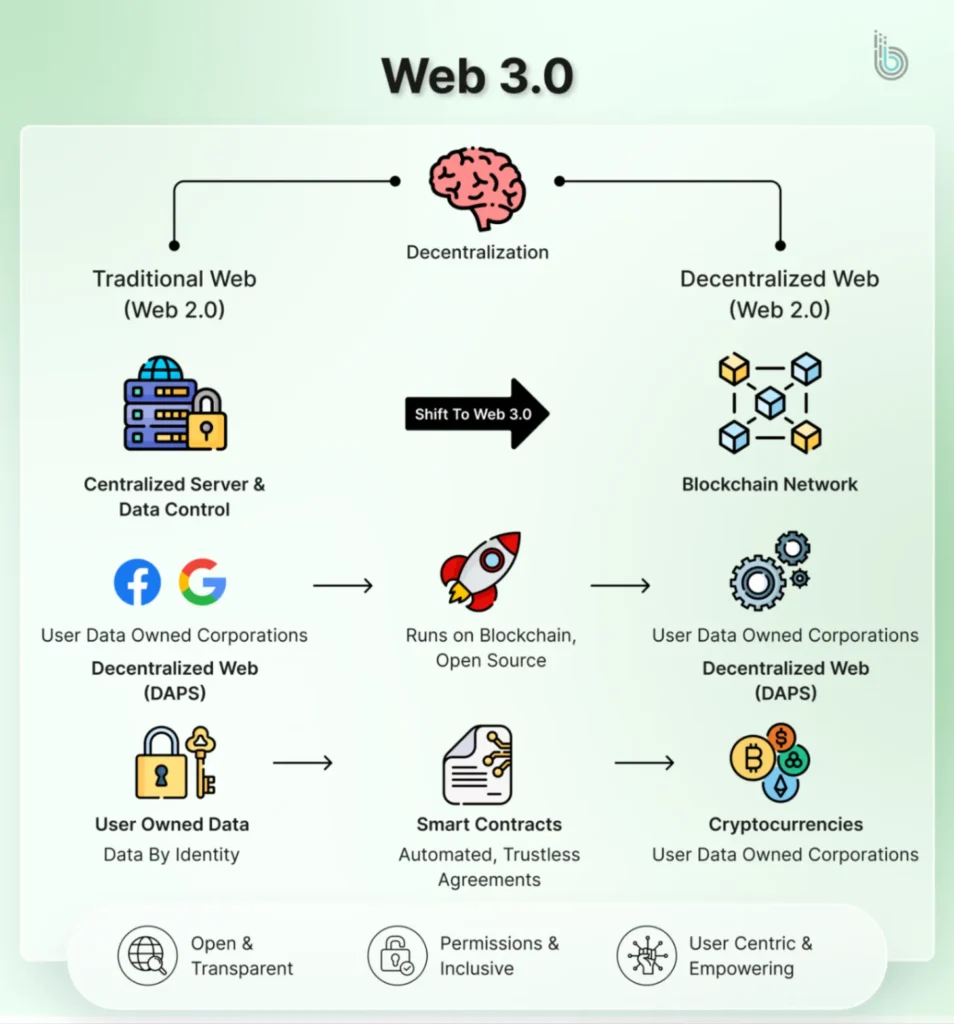
Web3 is the latest evolution of the internet, or “web,” built on decentralized technologies, primarily the blockchain. Data and platforms on today’s internet (Web1 and Web2) are controlled by centralized companies (like Google, Meta, etc.). But Web3 shifts control and ownership of data back to users.
With Web3.0, people can manage their identities without middlemen, own digital assets, and run smart contracts directly on the blockchain.
So there’s little to no reliance on big platforms, payment processors, data brokers, and more.
All in all, Web3 is a more transparent, user-focused, and trusted form of the internet where participants can interact directly.
“Web3.0 delivers true tech value by solving consumer problems and offering superior experiences.”
– Blockchain experts at BrainSpate
Core Concepts of Web3
Web3 operates on a few core concepts to provide users with control, transparency, and privacy. Let’s discuss them one by one.
Decentralization
Rather than on a central server, user data and their assets are stored across a network. That means less censorship and fewer single points of failure.
Blockchain
Transactions are conducted through blockchain, which means there’s no need for intermediaries like banks. That means more secure, immutable, and transparent records.
User Ownership & Control
With Web3 and blockchain, users can own their digital identities and assets independently without any issues. There are no centralized parties or platforms involved. They can also control access and monetize their assets and data, rather than just being on the customer side.
Interoperability
Web3.0 is interoperable to the extreme, so you can port and transfer data between devices, platforms, services, and more without issues.
Crypto & Tokenization
With tokenization, you can represent real-world physical and digital assets as tokens on a blockchain. These crypto tokens represent ownership, access rights, and the asset’s real-world value.
A token can represent the entire asset, or just a fraction or unit of it. So it’s easily divisible and tradable for quick value.
As mentioned earlier, all four of these concepts aim to provide absolute privacy and transparency to users. So does that mean Web1.0 and Web2.0 aren’t as secure or convenient for the users? How do they compare against Web3.0? Let’s find out.
Web1 vs Web2 vs Web3: How the Internet has Shifted
Web 1.0, Web 2.0, and Web 3.0 are the evolutionary phases of the internet. Each one has its own distinct capabilities, and the next ones surpass them.
Let’s compare them briefly.
Comparison Factor
Web1.0
Web2.0
Web3.0
Core Name & Focus
The Static Web
The Social Web
The Decentralized Web
Primary Function
Read-Only
Read-Write
Read-Write-Own
User’s Role
Passive Consumer
Content Creator
Owner & Participant
Data Ownership
Hosted on the company server; static
Centralized; owned/monetized by platforms (like Meta, Google)
Decentralized; owned by the user (Self-Sovereign Identity).
Interaction
One-to-many (Publisher→Reader)
Many-to-many (Peer-to-peer via Platform).
Peer-to-peer (Wallet-to-Wallet without intermediaries).
Key Tech
HTML, hyperlinks, static pages.
Mobile, Cloud, Social Media, AJAX.
Blockchain, AI, Smart Contracts, Edge Computing.
Monetization
Page views and directories.
Targeted advertising and personal data usage.
Tokens, cryptocurrencies, and micro-transactions.
What is Web3.0 E-commerce?
Web3.0 e-commerce uses blockchain, smart contracts, and decentralized networks for selling products and services online. With it, buyers and sellers get more control, transparency, and ownership. Sellers and buyers don’t have to rely on intermediaries; the transactions and interactions are handled through trustless, programmable systems.
In Web3 e-commerce, customers can pay through cryptocurrencies and receive on-chain proof of ownership for digital or physical products. They can also manage their identity without sharing excessive personal data.
Brands can run token-based loyalty programs and sell NFT-backed products. Plus, they can engage with the communities directly without platform lock-in.
Features of Web3 Commerce
Unlike traditional e-commerce, Web3 e-commerce has unique features that make it the way forward.
Decentralized, Blockchain-based Identity
Rather than being stored in a centralized platform, your identity is stored on the blockchain. The unique, singular, secure identity provided by the blockchain keeps your personal data and information secure throughout every transaction.
Smart Contracts
A smart contract is a feature of convenience through automation. Based on the type of transaction, the terms of a deal are automatically dictated and enforced. So every transaction proceeds exactly as intended and is fair to all parties concerned.
Decentralized Payment Gateways
In Web3.0 e-commerce, payments are processed via blockchain and cryptocurrencies, bypassing banks and traditional financial institutions. So you can rest assured that there are no additional fees associated with financial institutions. It makes Web3 ecommerce easier to trust.
NFT Integration
NFTs are a major part of the Web3.0 revolution. It’s a way to prove authenticity and ownership of a unique item or asset. When you buy or sell something, you and all other parties concerned are absolutely sure of the ownership and transactional rights.
Decentralized Storage
This is a security and privacy feature of Web3.0 e-commerce. Rather than being centralized, your personal data, information, and assets are spread across the blockchain. So it’ll be harder for the hackers and cheats to access what is yours.
P2P Trading
In Web3.0, there are no third parties or intermediaries. You buy and sell products and services directly with the other party. Since there are no middlemen, costs are lower, and transactions are much simpler.
These features make Web3.0 e-commerce a much more enticing model than traditional e-commerce. So if you want to build your own Web3-based eStore, let’s help you out.
How to Build a Web3 Ecommerce Platform?
Building a dedicated Web3.0 e-commerce platform involves shifting from a centralized store to creating a decentralized ecosystem. That means integrating blockchain, creating smart contracts, and much more.
Step 1: Set Clear Goals & Identify Requirements
First and foremost, you need to define the purpose of your Web3 e-commerce website and what you want to achieve with it. That means deciding on the key features (unique and others) and how they will help your platform stand out.
This first step is fundamental to the whole process and will dictate how you will proceed.
Step 2: Create the Frontend Web3.0 Website Design
Yes, in Web3.0, buyers and sellers interact and transact without any third-party involvement. But you still need a proper e-commerce frontend to showcase products and engage users.
So use the best tools and platforms to create a visually good and user-friendly frontend design.
Step 3: Develop the User Interface
After the overall design, we come to the user interface; it’s where the potential customers will find and possibly interact with your product (AR/VR). So you need to make sure the UI is appealing and easy to use.
Step 4: Select the Blockchain
Blockchain is the foundation of your Web3.0 e-commerce website. Everything from payment transactions to data and asset storage happens on the blockchain. So the one you choose should be fast, secure, and scalable as your business grows.
Two of the most popular blockchain options are Ethereum and Binance.
Step 5: Create Smart Contracts
Smart contracts are self-executing contracts that enforce business logic. Based on the type of transaction, they dictate the terms of a deal and enforce them automatically. So make sure they are secure to build trust among customers.
A few functions taken care of by the smart contracts include:
Mint product NFTs
Process payments via Escrow
Enforce secondary sale royalties
Step 6: Add Blockchain Features
Now we integrate the features that enable your frontend to read from and write to the blockchain. That includes integrating wallet APIs (such as the MetaMask SDK) and using Web3 libraries (such as ethers.js and web3.js).
Step 7: Set Up or Enable Decentralized Storage
Next, you need to set up decentralized storage to host customer data, product data, payment-related information, and more. It’s much more secure and protected than traditional storage options.
Step 8: Enable the Key Payment Methods
Web3 is a relatively new concept and it’s a little harder for most people to trust the shopping and payments on it. So you need to integrate the popular payment gateways paired with direct crypto payments via smart contracts.
Integrate major cryptocurrencies like USD Coin and DAI. You can also adopt the fiat-to-crypto approach for directly converting traditional currency into crypto.
Step 9: Implement the Essential Marketplace Features & Functionalities
A key part of this platform will be the e-commerce functionality. So at least, you need to integrate the basic and popular marketplace features, like:
A browsable catalog of tokenized items
A seamless purchase flow
Intuitive product searches
User profile system with liked addresses
Step 10: Test & Launch the Website
Once both aspects of your platform are ready, i.e., Web3.0 and e-commerce, you can proceed with testing. Conduct exhaustive testing, including:
Smart contracts security audits
User acceptance testing
Stress testing
Execute this process to the tee to build a technically sound Web3 e-commerce platform. A successful implementation will tie in the decentralization, ownership, and user sovereignty, defining the blockchain ecommerce platform.
Challenges With Traditional E-commerce (& How Web3.0 Solves Them)
While traditional e-commerce is forever booming (and stats speak for themselves), there are still some problems with it. A range of these challenges, though, can be taken care of with Web3.0.
Data & Cyber Security
Challenge: Centralized databases are a high-value target for large-scale data breaches. Hackers can breach once and steal hundreds and even thousands of customers’ data.
Web3’s Solution: With the decentralized architecture of Web3.0, there’s no single point of failure. Critical data and information are secured through cryptography.
Customer Experience
Challenge: While it’s not really a challenge, in traditional e-commerce, journeys can be fragmented across login, payment, support, and more.
Web3’s Solution: Crypto-based wallet handles identity, payments, and even asset ownership. That means a more streamlined and unified journey across the compatible platforms.
Data Privacy
Challenge: Users have little to no control over how their personal and transactional data is collected, sold, or used.
Web3’s Solution: Web3 ecommerce shifts data back into the user’s control. So users can independently choose what to disclose via their wallets, thereby minimizing security risks.
Online Identity Verification
Challenge: Traditional e-commerce often relies on insecure passwords or centralized databases for login. It creates friction and risks fraud.
Web3’s Solution: Web3.0 lets users control their self-sovereign identity through a crypto wallet. So login is seamless, secure, and pseudonymous across the platforms, and you don’t have to surrender personal data to any intermediaries.
Attracting & Converting the Perfect Customer
Challenge: Marketing strategies, in general, are broad-focused and can be expensive. They may fail to reach the genuinely interested target audience.
Web3’s Solution: Brands can engage pre-qualified communities based on specific tokens or NFTs. That means direct, meaningful outreach to invested audiences.
Customer Loyalty
Challenge: Traditional points programs are siloed, inflexible, and lack any perceived value.
Web3’s Solution: Token-based loyalty programs offer tradable, versatile rewards. Owning your brand’s NFTs can grant access to exclusive products and perks. Plus, the customer has a stake in the community, which forms a deeper bond and allegiance.
Cross-border E-commerce
Challenge: Currency conversion, high transactional fees, and slow international payments can create barriers.
Web3’s Solution: One of the key advantages of crypto-based payments is that they are borderless and can be settled in minutes. They bypass any traditional ecommerce intermediaries and fees. Plus, if you use stablecoins, there are fewer chances of market volatility.
Web3’s Solution: Community-driven growth models leverage token incentives for peer-to-peer referrals and content creation. It aligns marketing spend directly with results and community building.
You can hire dedicated eCommerce developers with us to create the best Web3.0 eStore while successfully mitigating the above-mentioned challenges.
Conclusion
Web 1.0 was the ancient World Wide Web, and Web 2.0 is the internet you are used to. But now is the age of Web3.0.
Web3.0 e-commerce has shifted the conventional e-stores to decentralized marketplace platforms through blockchain. That means safer and more lucrative crypto payments, transaction transparency, and better security.
If you want to leverage Web3.0 for your e-store, BrainSpate is who you need. Consult with us, and we’ll bring your business into the blockchain future.
FAQs on Web3.0 E-commerce
1. What are blockchain use cases in e-commerce?
Overall, blockchain makes e-commerce safer and more transparent. With it, you can offer secure payments using cryptocurrencies. And there’s a direct connection between the buyer and seller on the decentralized platform, so you can track the products from start to finish.
2. How much does it cost to build a Web3.0 e-commerce website?
The cost of building a Web3.0 e-commerce website depends on the platform’s complexity and size. If your platform’s design is unique, with a well-defined layout and several advanced features, it’s going to cost more.
In general, this type of online shopping platform will cost you around a few thousand dollars or more.
3. Why invest in a Web3 e-commerce marketplace?
Web3.0 and blockchain ensure better data transparency, faster and more secure transactions, enhanced security, lower cost, improved trackability, and more.