In B2B markets, your website often acts as the first interaction between your company and potential buyers. Before speaking to sales, decision-makers prefer to research vendors, compare the solutions they offer, and evaluate their credibility.
So it needs to make a strong impression. Good design is not about how the website looks. A good design builds trust, guides users to their answers, solves problems, keeps them engaged, and turns visitors into customers.
It is a best practice to regularly review your website and look for ways to improve it. This is especially important for B2B eCommerce websites. B2B customers do not buy on impulse. They take their time and carefully look at every detail. That’s why your web design should be clear, professional, and easy to use.
In this blog, we will discuss B2B web design in detail, examine the top trends, and provide examples. But first, let’s see what B2B website design exactly is.
What is B2B Web Design?
B2B web design is all about creating websites that speak directly to businesses, not individual consumers. These websites differ from B2C websites, which often focus on impulse purchases or emotional appeal. But B2B design needs to build trust, showcase expertise, and guide potential clients toward a logical decision.
Your website is your 24/7 sales rep, credibility booster, and a gateway for leads to explore your solutions. Every element, from layout to content, should make it easy for busy professionals to find what they need, understand your value, and take the next step.
Good B2B web design is:
Clear: No jargon, no clutter, just straightforward messaging.
Trustworthy: Case studies, testimonials, and professional visuals build confidence.
Functional: It is fast-loading, has intuitive navigation, and is mobile-friendly.
Goal-driven: Every page nudges visitors toward action, whether a demo request, a contact form, or a download.
In short, a good B2B website design is about creating a smooth, professional experience that turns visitors into clients.
The Most Important Elements of a Good B2B Web Design
A good B2B website design prioritizes clarity, trust, and lead generation by using a clear value proposition, intuitive navigation, and strong, action-oriented CTAs. When these elements work together with a strong visual design, the result is a high-performing B2B website.
Here are a few must-have elements that make a website that converts:
Clear Value Proposition and Messaging
A well-designed website homepage mostly starts with a banner. It immediately communicates what you do, who you serve, and the benefits of your service or product within seconds of arriving on the website. It should not only create a good impression, but also prompt the user to scroll down or take an action.
Strategic Call-to-Action (CTA)
Use prominent, action-oriented buttons, such as Request Pricing or Schedule a Call. When placed strategically throughout the website, they serve as a guide for users. There should be a design sensibility for the placement and size of these CTAs. Moreover, either overuse or a very limited number of CTAs can look odd to users.
Trust Signals and Social Proof
Client testimonials, case studies, partner logos, and industry certifications build credibility with risk-averse B2B buyers. Placing them strategically across the site strengthens credibility. Further, social proof provides validation and confidence to B2B buyers, which is important for establishing long-term relationships.
Intuitive Navigation and User Experience (UX)
Create a clear, logical structure that helps visitors to find information quickly, featuring user-friendly menus. Whether it’s the navigation bar or the footer menu, clearly placing links and pages plays a big role in keeping the user on your website. Further, the goal here should be to help a user easily find what they are looking for.
The repercussions of not following this principle directly impact the brand identity. It also results in more bounce backs, which is a negative signal.
High-Quality Visuals and Videos
Use custom, authentic images rather than generic stock photos. 93% of B2B buyers say video plays a big role in purchasing decisions.
Mobile-First Optimization
Ensure the site is responsive and performs on all devices. Mobile usage is increasing among B2B users as well. Optimize for every screen size and A/B-test screens before deployment. The bounce rate for mobile users is high when they cannot find what they are looking for. This makes this a very essential factor.
Lead Generation Tools
Integrate gated content (whitepapers, webinars) and live chat options (major buyers prefer this for quick questions) to capture leads.
Fast Loading Speed and Security
A secure, fast-loading site is critical for maintaining credibility and preventing user drop-off. It not only affects the usability of the design but is also an important factor in ranking your website on relevant search engines.
Content Strategy
Provide in-depth content that addresses pain points and caters to multiple stakeholders in the buying group.
Clean Design and Readability
Lastly, use ample whitespace, a consistent, professional color palette, and easy-to-read fonts to ensure content is easy to digest. No one likes clutter, and the trend toward clear, minimal design is evergreen.
Use these principles as the backbone to design your website. A well-designed B2B website makes it easy for potential clients to see your value and take action. If these elements are missing, you might be losing leads without realizing it.
Want to create a strong B2B eCommerce site that works? Our eCommerce web design services are here to help you build a website that looks great and drives results.
Why is B2B Web Design Important for Firms?
Modern B2B buyers behave more like B2C consumers in their research of solutions. They research on their own, compare options, and ask peers for recommendations before talking to your team. Many do most of their research online before they contact sales.
In short, you can win or lose a $10,000 deal based on how your homepage loads on a prospect’s phone during their commute.
That means your website has to:
Make the value of your solution obvious.
Build trust quickly with brand logos, testimonials, certifications, and results.
Guide each visitor to the right information for their role.
Offer low-friction ways to ask questions or book a call.
If your website is slow, confusing, or vague, buyers will simply leave and shortlist your competitors instead. For B2B eCommerce, this problem is even bigger.
In B2B, decisions are made after multiple touchpoints, and your website is often the first and most frequent point of contact. A $10,000 deal could be won or lost based on how your homepage loads on a prospect’s phone during their commute.
That’s why leading firms treat their website not as an expense but as a revenue-generating asset.
B2B vs B2C Web Design: Key Differences
It is essential to distinguish between these two models because a high-performing B2C layout can actually hinder B2B sales by oversimplifying complex decisions.
Feature
B2B (Business-to-Business)
B2C (Business-to-Consumer)
Buying Journey
Multiple stakeholders (IT, Finance, Legal). Long cycles require consensus.
Usually, a single buyer. Rapid, often impulsive or emotional decisions.
Content Depth
Problem-solution narratives, technical specs, ROI proof, and implementation details.
High-level benefits, lifestyle imagery, and quick-read product descriptions.
CTAs & Conversions
Low-friction entries, such as ebooks and webinars, lead to high-intent demos/proposals.
High-friction immediate actions like Add to Cart or Buy Now.
Information Architecture
Structured by industry, use case, and partner resources. High use of cross-linking.
Simple hierarchy focused on product categories and a fast path to checkout.
Key Takeaway: The biggest mistake in web strategy is applying fast-fashion B2C design patterns to B2B products that require high trust and technical validation.
Major Structural Components of B2B Website Design
Let’s explore the essential pages and components that make up a high-performing B2B website.
The Homepage
The homepage must immediately orient visitors. It clearly shows who you are, what you offer, and who it is for within 50 milliseconds. A good homepage has:
Hero Section: Features a clear, benefit-driven headline (10–15 words), a subheadline for context, and a primary call-to-action (CTA) like Request a Demo.
Trust Signals (Social Proof): Recognizable client logos, testimonials, or industry awards placed above the fold to build instant credibility.
Product/Solution Overview: A concise summary of key solutions, focusing on benefits rather than technical specs.
The most important part of the homepage is identifying pain points. It highlights the problems you solve to instantly connect with the visitor’s needs.
Product or Service Pages
These pages must educate buyers, offering in-depth technical information and how-tos.
Solution Pointers: Concise explanation of the product and the problems it solves.
Feature/Benefit Sections: Explaining capabilities in terms of business outcomes (ROI).
Visuals and Demonstrations: Screenshots, videos, or interactive product tours.
Integration Information: Showing how your solution fits into their existing technology stack.
Secondary CTAs: Contextual, softer calls to action.
A product page should not only contain detailed information about the product but also show its effects, benefits, how to use it, and all the major topics of concern.
About Us Page
This page is critical for fostering trust, proving your company is stable and reliable. It mostly has the company’s story, mission, vision, and core values. It also includes leadership profiles, such as photos and bios of key team members. Additionally, timelines or milestones are good-to-haves. The page should be a visual representation of growth that shows stability.
Blog / Resource Center
It is an essential hub for SEO, thought leadership, and nurturing prospects. Add educational content like whitepapers, e-books, webinars, and articles. You can also do content filtering, such as searching by topic, format, or industry. It’s the best place to keep gated content (lead magnets). Use high-value resources requiring email signup to capture leads.
Contact / Request Quote Page
A critical point of conversion that must reduce friction. A few examples of that are:
Simple Form: Minimal fields (5–7 maximum) to encourage completion.
Multiple Channels: Direct phone numbers, emails, and live chat/chatbot options.
This acts as a bridge between the website visitor and your sales team.
Pricing Page
This is a key factor for B2B decision-makers assessing budget alignment. You can clearly define packages with feature comparisons. Use ROI calculators and other interactive tools demonstrating value. Lastly, present a custom option that provides a clear path to tailored, complex solutions.
Global Structural Components
These are components such as the navigation menu, footer, and mobile responsiveness. They are simple, 5–7 items that make the website easy to navigate and have clear labels.
Each of these components works in harmony to create a cohesive digital experience. When all of them are implemented, they build trust, demonstrate expertise, and ultimately drive business growth. To know more about B2B web design agencies, join this Reddit thread.
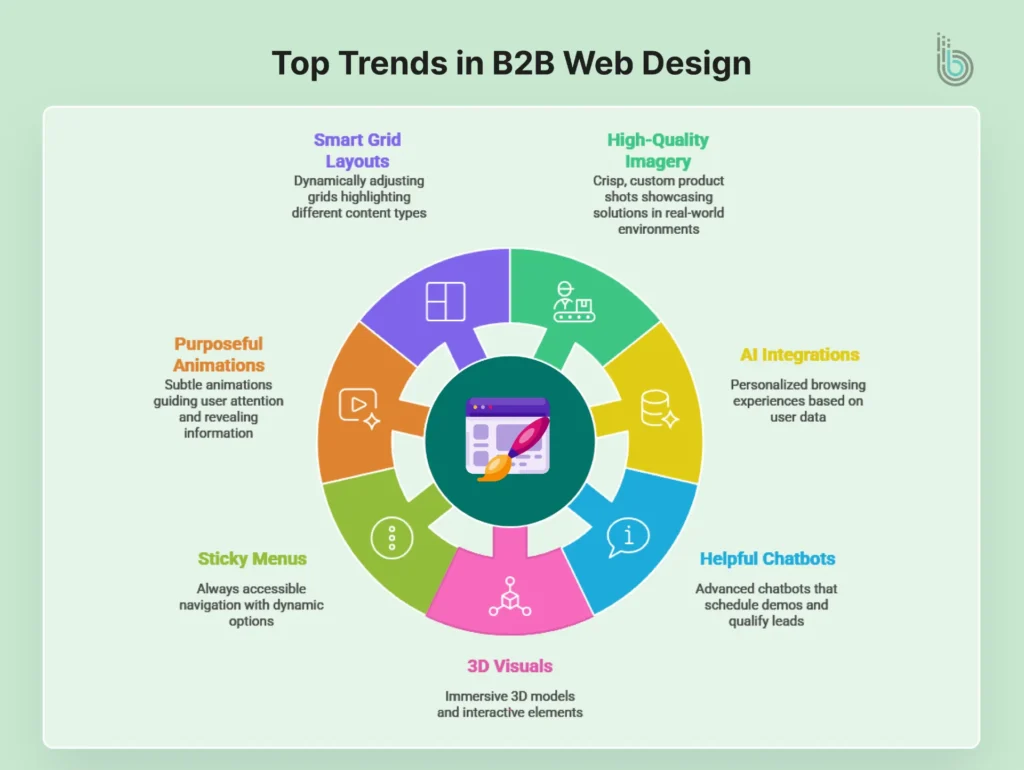
Your B2B website needs to do more than just inform. It needs to engage and convert. These cutting-edge design trends are helping leading companies stand out and drive better results:
High-Quality Product Imagery
Gone are the days of generic stock photos. Today’s top B2B sites use crisp, custom product shots that showcase solutions in real-world environments. Think of detailed close-ups of manufacturing equipment or software interfaces in actual use. These authentic visuals help buyers visualize exactly what they’re getting.
AI Integrations
Forward-thinking B2B sites now incorporate AI to personalize the browsing experience. Imagine a site that remembers a returning visitor’s industry and automatically surfaces relevant case studies. Some platforms even adjust pricing displays based on the visitor’s company size or past interactions.
Chatbots That Actually Help
Modern chatbots go beyond basic FAQs. They can now schedule demos, qualify leads, and even recommend products based on a quick conversation. The best ones use natural language processing to understand complex questions about specifications or compatibility.
3D Visuals and Interactive Elements
Industrial companies are bringing products to life with 3D models that users can rotate and examine from all angles. Service firms use interactive flowcharts to demonstrate processes. These immersive elements keep visitors engaged longer and help them better understand complex offerings.
Sticky Menus That Work Harder
As pages get longer, smart sticky menus ensure that key navigation is always accessible. The newest versions highlight the current section being viewed and may even change available options based on how far down the page the user scrolls.
Purposeful Animations
Subtle animations guide users’ attention where you want it, like a gentle pulse on an important CTA button. More sophisticated sites use scroll-triggered animations that reveal information progressively, making complex data easier to digest.
Smart Grid Layouts
Modern grids dynamically adjust to highlight different content types, seamlessly mixing text, images, and videos to tell your product’s story logically. The best implementations rearrange content priority based on device type or user behavior.
Personalized Landing Pages
Nowadays, many B2B companies prefer to create personalized landing pages for specific industries, accounts, or marketing campaigns. These pages provide customized messaging, case studies, and CTAs for the visitor’s context. Considering the survey, personalized landing pages have improved conversion rates.
These trends aim to remove friction from the buyer’s journey. When technical specifications become interactive 3D models and when chatbots instantly connect visitors to the right sales rep, you are not just impressing potential clients; you’re accelerating their decision process.
How to Design a B2B Website That Converts?
These steps combine patterns from several modern B2B website guides and design processes.
Step 1: Define Strategy and Goals
What pipeline or revenue should the website influence?
Which actions matter most? (demos, RFQs, trial signups, inbound calls)
Which segments and industries are the highest priority?
Write these down. They will guide every decision.
Step 2: Research Your Buyers and Competitors
Talk to sales and customer success about common questions and objections. Interview 3–5 existing customers to understand their research process and decision criteria. Analyze 3–7 competitor sites for structure, messaging, CTAs, proof, and UX.
Look for content gaps and friction points on your current site compared to theirs.
Keeps navigation simple but deep enough for detail.
Uses progressive disclosure, such as high-level pages linking to detailed subpages.
At this stage, think about which pages need to exist right now, and which can come later.
Step 4: Plan and Write Content
Content is what actually sells, not the layout alone. Start with the homepage, the top 3–5 solution pages, and at least a few proof pieces, such as case studies, testimonials, or success stats. Use problems–agitate–solve structures for hero sections and solution pages. Lastly, include social proof and specific outcomes whenever you can.
Step 5: UX and UI Design
Translate your sitemap and content into wireframes, then full designs. Start by defining components like hero blocks, feature rows, CTAs, proof sections, forms, etc. Then, set up a crisp design system (colors, typography, spacing, buttons). Additionally, design for accessibility and mobile from the start, not as an afterthought.
Step 6: Build, Integrate, and Optimize Performance
During development, use a modern, SEO-friendly stack and CMS that your marketing team can maintain. Integrate CRM, analytics, and marketing automation later. Optimize for speed by lazy-loading images, minimizing scripts, and monitoring Core Web Vitals.
B2B eCommerce implementations will also require proper product data modeling, search, and pricing logic. This is where partnering with a dedicated eCommerce website design company like BrainSpate helps.
Step 7: Launch, Measure, and Iterate
A B2B website is not a one-off project. It is a product.
Set up tracking for form submissions, demo bookings, quote requests, and key page views.
Use session recordings, heatmaps, and A/B tests to find friction points and improve them over time.
We recommend adding new content based on questions from sales calls and support tickets. Using these steps, you can design a next-level B2B website that converts easily.
B2B Web Design Mistakes to Avoid
Even smart companies make these common website errors. Steer clear of these pitfalls to keep your B2B site effective:
The Mystery Homepage: Visitors should understand what you do within seconds. If your headline doesn’t explain your value in seconds, you’re losing leads.
Broken Conversion Paths: Great content means nothing if your CTAs are hidden or forms don’t work. Test every link and button regularly.
Mobile Neglect: Over half of B2B research happens on phones. If your site pinches or scrolls awkwardly, you’re frustrating potential clients.
Stock Photo Overload: Generic office scenes and handshakes scream “impersonal.” Real team photos and authentic workspaces build trust.
Pricing Silence: “Contact us for pricing” frustrates time-poor buyers. At least provide starting ranges or typical investment levels.
Case Study Hide-and-Seek: Burying your success stories is like hiding references during a job interview. Feature them prominently where buyers look.
Dead-End Blog: Publishing without promoting is like throwing a party no one attends. Add internal links, email signups, and share buttons.
“About Us” That’s Really About You: Clients care about how you solve their problems, not about your founding year or mission statement. Keep the focus on their needs.
Slow Load Times: Every second of delay costs you leads. Compress images, minimize plugins, and choose quality hosting.
No Clear Next Steps: Don’t make visitors guess how to engage. Every page should guide them toward a logical action.
The fix is simple. Look at your site the way your buyer would. Where do they get stuck? What questions aren’t being answered? Small changes to these pain points can lead to big improvements. With the right B2B eCommerce development services, you can turn those weak spots into opportunities that boost results.
Emerging Technologies and Uses in B2B Website Design
Beyond trends, several technologies are reshaping what B2B sites can do:
AI-Driven Personalization
Dynamic content blocks that change based on industry, location, or account segment. This reduces noise and makes the site feel more relevant.
Headless and Composable Architectures
Separating front-end and back-end lets you connect multiple systems (PIM, ERP, CRM) and push content to many touchpoints while maintaining high performance.
Progressive Web Apps (PWAs)
Faster loading, offline capabilities, and app-like experiences for complex B2B portals and eCommerce stores.
Advanced Analytics and CRO Stacks
Deeper event tracking, form analytics, and funnel analysis to understand exactly where buyers drop off and what changes drive better conversions.
More Robust Accessibility Tooling
Automated checks and WCAG-based design systems make it easier to maintain compliance over time.
Voice Search Optimization
The use of voice assistants and conversational search is rising. To stay relevant to audiences’ preferences, B2B websites optimize content for natural-language queries and voice search.
Wrap It Up
When you invest time in understanding your customers, you can create a better web experience for them. A well-designed B2B website will help them easily find relevant information on your site. Be it intuitive navigation or case studies, every element should build trust and guide decisions.
A strong B2B website is no longer just a nice-to-have. It is the core of your digital pipeline. They answer questions before they are even asked, remove friction from the buying process, and turn casual visitors into qualified leads.
Get in touch with us and talk to our B2B web design experts today and discover how a high-performing website can generate more qualified leads for your business.
FAQs on B2B Web Design
Q1. How often should we update our B2B website?
Aim for minor updates quarterly and a full redesign every 2-3 years. Regular content refreshes (blogs, case studies) keep your site relevant. Technology and design standards evolve quickly, so don’t let your website fall behind.
Q2. What is more important: design or content?
Both matter equally. Great design grabs attention, while strong content builds trust. They work together to guide visitors toward conversion. Prioritize clarity in both elements for the best results.
Q3. How can we make our site stand out from competitors?
Focus on your unique value proposition first. Then, use authentic visuals, client success stories, and intuitive navigation. What makes your solution different should be immediately clear to visitors.
Q4. What role does content play in B2B website design?
Content is the main driver of trust, education, and lead quality. Design supports content; it does not replace it. Good B2B content first talks about buyer problems and outcomes. It also explains solutions in plain language and uses evidence such as data, quotes, and stories to build confidence. It matches different stages of the buyer journey. Without strong content, even the best visual design will underperform.
Q5. How can I measure the success and performance of my B2B website?
Track metrics that connect to the pipeline, such as:
Demo or consultation requests.
Quote requests and form submissions.
Resource downloads that lead to sales conversations.
Conversion rates by traffic source and page.
Engagement on key pages (scroll depth, time on page, bounce rate).
Combine this with CRM data to see which pages and campaigns drive actual deals, not just visits.