Online businesses are offering a personalized shopping experience to visitors with the help of cutting-edge technologies like AI and AR/VR. As a result, the conversion rates have increased. A study shows that B2C eCommerce sales are growing at 8.9% annually and are predicted to reach $6.8 trillion by 2028.
This article explores the concept of B2C eCommerce, its models, benefits, limitations, platforms, and a criterion to choose the right platforms. It also discusses future trends and good marketing strategies.
What is B2C eCommerce?
B2C eCommerce refers to businesses using online platforms to sell their goods and services to consumers. In this model, businesses create and operate an online store for their customers to browse and purchase products or services. Although it’s a straightforward method with no middlemen, many B2C companies rely on third-party marketplaces like Amazon and Walmart.
Types of B2C eCommerce Models
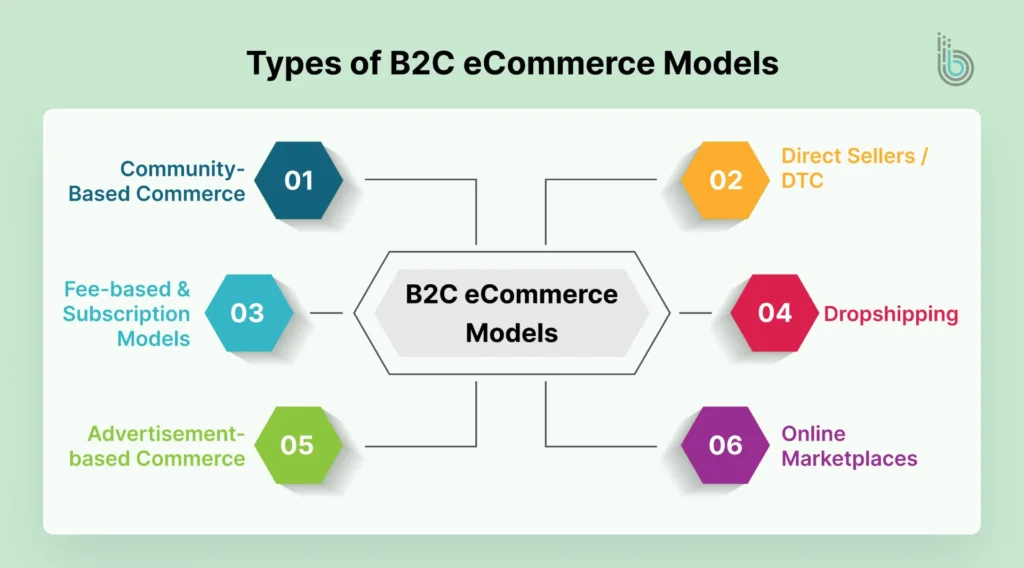
Online stores use various methods to execute B2C eCommerce. It is important to pick a suitable business model to ensure high ROI. Here, we discuss the most commonly used B2C models.
Direct Sellers / DTC
Direct-to-Consumer is the most widely used B2C eCommerce model. It allows customers to buy directly from online retailers. These retailers either use their own website or a marketplace like Walmart or Amazon to sell products manufactured by themselves or other companies.
Dropshipping
In the dropshipping model, businesses operate without an inventory. Customers are required to place an order and pay first. Only after that, businesses process the order, sending it to the manufacturer or logistics, who directly deliver the product from the warehouse to the customer’s house.
Online Marketplaces & Intermediaries
This is the model where an online platform or a marketplace acts as an intermediary between the seller and the consumer. They do not own any product or brand but provide necessary infrastructure and logistics to the sellers who do. Popular online intermediaries include Amazon, Alibaba, and eBay.
Community-Based Commerce
Using online community platforms, like social media, forums, and other applications where communities gather in large numbers, to sell your products or services is called community-based commerce. In most cases, these communities are niche-specific, attracting people with certain hobbies or interests. If you are selling the product for the same category, these entire communities act as a potential customer base.
Fee-based & Subscription Models
A business model where the seller charges users a certain fee to use their services or products for a specific period is known as a subscription model. Streaming platforms like Netflix and Spotify are popular examples. Such a model is also used widely in the apparel and healthcare industries.
Advertisement-based Commerce
When a company sells advertising space and services online, it is known as advertisement-based commerce. Every sponsored content, from texts to video ads are covered in this. Businesses use this model to raise brand awareness and generate more traffic or leads to their actual store.
Examples of Leading B2C Platforms
Businesses must choose the right platform because it determines their store’s performance, operational efficiency, security, and customer experience. Some of the most popular and reliable B2C eCommerce platforms are discussed below:
Magento/Adobe Commerce
Magento is a perfect fit for complex, enterprise, or highly tailored eCommerce requirements. It is an open-source platform that provides advanced customization capabilities and flexibility. Therefore, it also demands a team of experienced developers for efficient eCommerce development, hosting, security, updates, and optimization.
Shopify
Shopify comes with a simple setup and is easy to use. It helps you build an eCommerce website that registers uptime even in the face of high-volume traffic or transactions. It is an ideal platform for startups looking to build and launch a store quickly.
However, the lower-tier plans of this platform have limited customization options. You have to use third-party integrations to implement advanced eCommerce features.
BigCommerce
Businesses looking for scalability and flexibility should choose BigCommerce. It offers headless capabilities through powerful features with an API-first architecture. With BigCommerce, you can create and manage multiple storefronts. It supports a large range of tools, allowing you to scale your store without depending greatly on third-party apps.
WooCommerce
It is the only eCommerce platform offering extensive customization capabilities without any compromises, limits, or monthly fees. WooCommerce is an open-source platform available as an eCommerce plugin for WordPress. Using this, developers can turn any simple website into a full-scale eCommerce store. It provides built-in features for adding products, handling payment options, setting up shipping and logistics, and implementing integrations.
Platform
Best For
Type
Shopify
Small to mid-size B2C stores
SaaS
Magento / Adobe Commerce
Enterprise-level stores
Open-source/enterprise
BigCommerce
Scalable mid-to-large businesses
SaaS
WooCommerce
WordPress-based stores
Open-source
B2C eCommerce Vs Other eCommerce Models
There are many types of eCommerce models apart from B2C, such as B2B, D2C, and C2C. Each of these models is part of the eCommerce domain but has a distinct business infrastructure, as explained well in this Reddit thread.
For example, the B2C business model often relies on third parties such as wholesalers and retailers. Whereas in the D2C business model, a subset of B2C, businesses sell directly to consumers.
In this section, we will understand the key differences between B2C eCommerce and other eCommerce models.
Aspect
B2C
B2B
D2C
C2C
Target Audience
End-Consumers
Other Businesses
End-Consumers
End-Consumers
Order Size
Small and individual purchases
Bulk orders
Small and individual purchases
Small to medium
Prices
Fixed prices, seasonal discounts, and offers
Tiered prices, subject to negotiations
Tiered pricing and bundled offerings, often tailored
Flexible prices, subject to negotiations.
Sales Cycle
Short
Long
Short to medium
Short to medium
Real World Examples
Amazon, Walmart
Alibaba, Grainger
Warby Parker, Casper
eBay, Facebook marketplace
What to Look for When Choosing a B2C Platform
Having clarity on your requirements helps you find a suitable framework. However, every good B2C eCommerce platform must deliver the following:
Scalability & Performance
Your eCommerce platform must support scalability to handle increasing traffic, sales, customer base, and catalog as your business expands. Along with that, performance is a critical factor that your B2C platform must deliver. Fast-loading sites and streamlined navigation ensure an enhanced performance, reducing bounce rates and cart-abandonment.
Seamless Integrations
Check if your platform allows for seamless integration with existing or third-party systems like marketing automation platforms, CRM systems, and shopping and logistics tools. A platform offering seamless integration and data sync capabilities ensures enhanced operational efficiency.
SEO Tools
Use a platform that helps build SEO-friendly eCommerce websites. It should not only support SEO best practices but also offer built-in tools that help optimize the site and its content for better search visibility.
Mobile Optimization
Most of the online visitors or internet users nowadays are smartphone users. So, it is important to have a platform that can prepare a responsive web design for mobile devices, especially when you are selling to consumers. Many popular B2C platforms offer mobile-responsive themes for eCommerce development.
Global Commerce Tools
A powerful eCommerce platform provides functionalities that enable businesses to sell products or services. It offers features to support multiple languages, compliance with local tax laws and other regulations, and payment integrations.
Features & Capabilities of Top B2C eCommerce Platforms
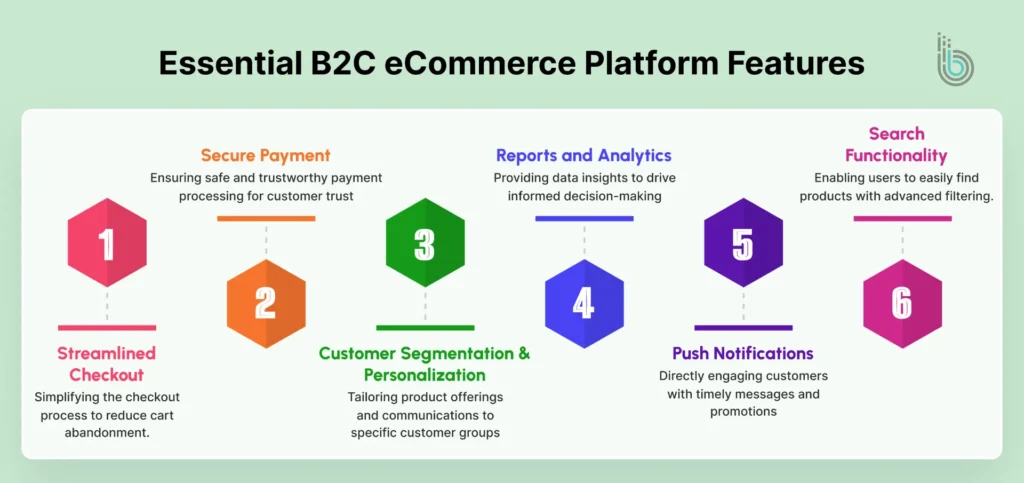
To build a successful B2C eCommerce website, you need a platform that offers robust capabilities that fulfill the modern requirements of users. Here are the top essentials that your B2C platform must offer.
Customer Segmentation & Personalization: The B2C eCommerce platform should provide the capabilities to set up an advanced customer segmentation for personalized product offerings, pricing, and discounts.
Reports and Analytics: Efficient data analysis and detailed reports are critical in the digital age to understand how your online business is performing and what your customers are actually looking for. It helps drive actionable insights, making informed decisions, and a winning eCommerce strategy.
Push Notifications: Pushing notifications on the user devices ought to attract their attention, no matter what they are doing. It helps bring the user back to the store and into the sales funnel. Businesses can use push notifications for advertisements, run promotions, or announce new releases, etc.
Good Search Functionality: Having a robust search engine with advanced filtering options helps visitors find the products quickly and accurately. You can also use AI to enhance the search with an autocomplete feature.
Secure Payment: Running a site with unsafe payment gateways would be like inviting scammers and fraudsters. Secure payment options help build trust and loyalty. It is a necessity for an eCommerce platform and a priority for online businesses.
Streamlined Checkout: A simple and streamlined checkout process helps complete the transaction quickly. With less friction and a better experience, the user is less likely to get frustrated and leave before completing the order purchase.
Benefits and Challenges of B2C eCommerce
B2C eCommerce is a business model with unique strengths and weaknesses. Understanding them will help you make the most out of the model and prepare for possible setbacks.
Benefits of B2C eCommerce
Adopting B2C eCommerce offers numerous benefits, such as global reach, which helps drive more revenue and deliver a better customer experience.
Global Reach: Building a digital store will obviously increase your reach to a global audience. You can sell your products locally as well as internationally.
Low Costs: With B2C, you can sell products worldwide without opening a brick-and-mortar store. This helps you reduce costs and increase your customer base.
Data & Customer Insights: Businesses selling to customers through digital platforms can collect and analyze their data with consent to provide personalized offers and experiences.
Continuous Selling 24/7: Unlike a physical store, a digital store is open 24/7. This allows customers to buy products even during off-hours from the comfort of their home.
Challenges of B2C eCommerce
Even after offering high-impact benefits, like every other business model, B2C has a few limitations. Using this model for your eCommerce model would present challenges like:
Competition: Opening an online business store is quite easy. So the competition is high. Moreover, capturing customers’ attention online is also quite competitive nowadays, especially for businesses.
Customer Acquisition Costs: Acquiring a customer online is expensive. Businesses have to implement SEO and marketing best practices, including paid advertisements, and run relevant offers to attract and retain customers.
Logistics & Fulfillment: Logistics issues arise when selling internationally or handling a massive volume of orders. In that case, managing the inventory level and ensuring timely deliveries can be challenging.
Technical Complexity: Technology is evolving rapidly; keeping your store up-to-date is a challenge, but also a necessity. On top of that, each integration with external systems like ERP, CMS, and payment gateways can add another layer of complexity.
B2C eCommerce Trends in 2026 & Beyond
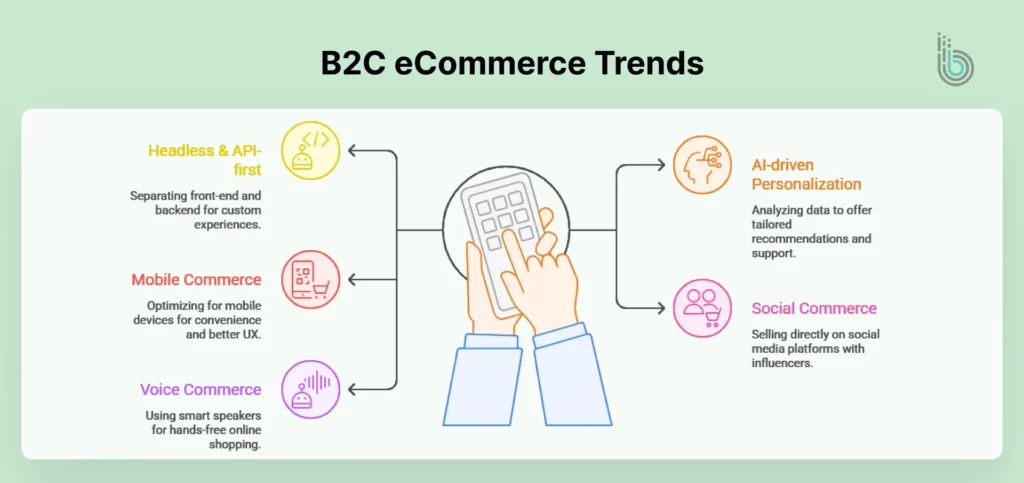
The eCommerce market is continuously evolving with the advancements of new technologies and continuously shifting customer needs. To ensure high-impact outcomes with B2C eCommerce development services, keep an eye on the following trends.
Headless & API-first Adoption
Setting up a headless architecture gives multiple benefits, like building custom storefronts, delivering an omnichannel experience, etc. It is achieved by separating the front-end from the backend of your online store and using APIs that help connect and customize every eCommerce service. This makes your eCommerce store composable, which means taking down or updating one service won’t affect another, and overall performance.
AI-Driven Personalization
Research suggests that consumers expect personalized interactions and are easily frustrated when they don’t receive one. Recent AI advancements have made it possible to analyze large volumes of customer data, identify behavioral patterns and preferences, which help make personalized recommendations. On top of that, AI also helps offer customer support, cart reminders, and more personalized eCommerce functionalities.
Mobile Commerce
Mobile commerce is rapidly revolutionizing online shopping. Since mobile devices provide more convenience, more people are using them to buy products and services. The experience is also completely different from shopping on desktops. They can do it from anywhere and at any time. Businesses need to optimize their site design for mobile devices to attract more audience and deliver a better user experience.
Social Commerce
Brands are now using social media platforms such as Facebook and Instagram to sell their products directly to consumers. Influencers and viral marketing play a vital role in attracting more audience.
The companies behind these social media apps have realized this trend early and have started offering a dedicated space for commerce. Brands can post, put a story with product images, customer reviews, and a product page link, turning a simple social interaction into a potential lead generation.
Voice Commerce
Smart speakers are widely used for different domestic purposes as well as online shopping. Users now don’t have to reach for their smartphone, manually search, compare different products, and finally place an order.
A smart speaker can do it for them just with a simple voice command. Voice assistants like Google Assistant and Amazon Alexa help shoppers buy a product of their choice without even lifting a finger. Therefore, voice search is another necessity if you want to build a modern eCommerce store.
SEO Best Practices in eCommerce for B2C
Every eCommerce business needs to implement effective strategies to increase brand visibility. Adhering to SEO best practices is a way to bring more organic traffic to your site.
High-quality content
Google’s algorithm is becoming more focused on finding high-quality content. So, creating user-centric content that accurately answers the user’s query is a priority. Original and helpful content always finds a place in the SERPs, whether it is a blog, product page, landing page, or FAQs.
Keyword Research
User intent is the foundation of SEO. Therefore, you must find out the keywords visitors use to search for products sold in your store. A keyword with high-volume will drive the most traffic, but it also means more competition. Target both short-tail and long-tail keywords to drive better search visibility. Your B2C SEO strategy should be to create relevant content around user intent to ensure high ROI.
Technical Optimization
Optimize all of your eCommerce pages for on-page SEO, like meta titles, meta descriptions, images, and site speed. It also focuses on creating a responsive page layout, implementing schema, and streamlining navigation for better UX. Getting the SEO technicalities right improves search crawlability along with the user engagement rate, CTRs, and conversions.
Local & Mobile SEO
Optimize your eCommerce website for local search by using local citations, registering with Google My Business, and pinpointing locations on Google Maps. Implementing mobile-friendly strategies like mobile-first designs and voice search helps reach a wider range of audiences.
Backlinks
Backlinks from relevant and authoritative websites help increase your site’s authority and search rankings. This B2C SEO practice includes writing guest posts, brand partnerships, and getting mentions from trustworthy websites. This helps build up domain authority, making search engines believe that your eCommerce website is a trusted and authoritative platform in the given niche or industry, increasing SERPs and organic traffic as a result.
Real-World Examples
Let’s take a look at some real-world examples of successful B2C stores:
Amazon
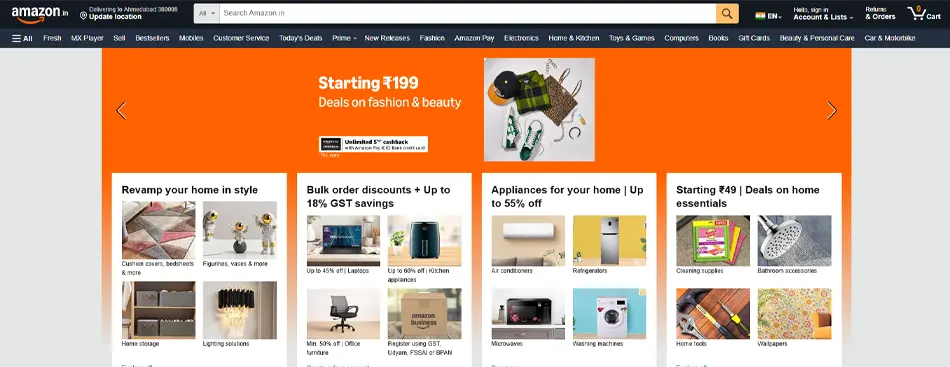
Amazon is one of the biggest B2C brands offering a massive range of products. It’s like they sell everything on their site. Moreover, they prioritize the customers’ comfort, which made the personalized recommendation a reality, an eCommerce feature now commonly used across all B2C sites.
Facebook Marketplace
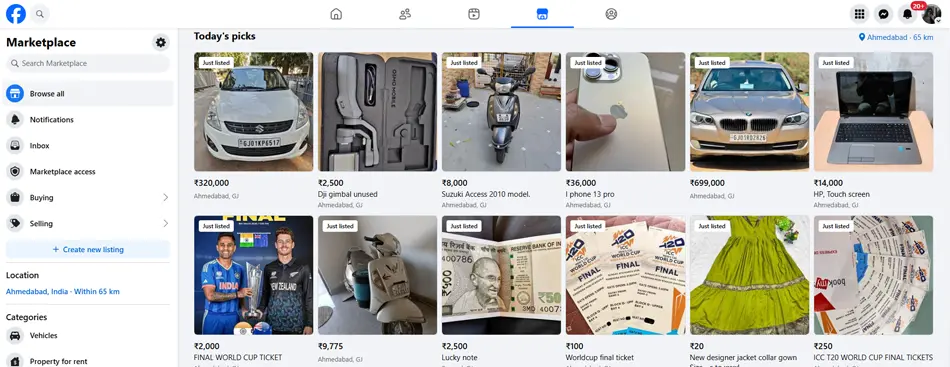
Facebook provides a marketplace where businesses are allowed to run ads and sell their products or services directly to consumers. The platform also allows people with similar interests to form Facebook groups to interact with each other. Such groups help marketers find targeted audiences easily.
Nike
Nike has created an eCommerce store that gathers customer data and uses it to provide a personalized shopping experience. The Nike application uses features like personalized product suggestions, virtual product try-outs, mobile-first loyalty programs, and integrated rewards.
Nike sells their products from various platforms like website, application, and physical stores, but makes sure to deliver a consistent shopping and brand experience to the customers. They don’t just focus on a single platform but use multiple platforms to drive an omnichannel experience.
Ready to launch your successful B2C eCommerce store?
Building a secure and high-performance B2C eCommerce store requires a strategic implementation of technology, design, and architecture. Choosing a suitable B2C eCommerce platform makes all the difference. The primary objective of eCommerce is to convert visitors into paying customers. However, to achieve that, eCommerce companies need to be agile to adapt to the latest trends and customer requirements.
FAQs
Q1. What is B2C eCommerce?
B2C eCommerce refers to the practice where businesses sell their products or services to consumers through an online platform. It includes all forms of online sales, either made through retailers or directly to consumers.
Q2. What is a B2C example?
eCommerce platforms where the transaction happens between the company and you. Netflix subscriptions, Amazon orders, and Shopping on Nike are all popular examples of B2C eCommerce.
Q3. What payment methods are common in B2C ecommerce?
The most commonly used payment methods in B2C eCommerce are credit cards, debit cards, and digital wallets such as Apple Pay and PayPal. Many sites have also started providing a BNPL (Buy Now Pay Later) option for customer convenience.
Q4. What marketing strategies work best for B2C ecommerce?
SEO, content marketing, influencer marketing, social media marketing, paid advertising, and email campaigns are some of the marketing strategies that work best for B2C eCommerce.
Q5. What is the difference between B2C and B2B eCommerce?
The major difference between B2C and B2B eCommerce lies in the targeted audience and the nature of transactions. In B2C, products or services are sold directly to consumers, whereas in B2B, businesses cater to the needs of other businesses. Transactions in B2B are complex due to bulk orders, longer sales cycles, and tailored prices with an option for negotiation. Meanwhile, B2C has smaller orders, and payments are done upfront or upon delivery.
Q6. Can you have a B2B and B2C ecommerce store?
Yes, you can build and use a hybrid eCommerce site that caters to the needs of both businesses and consumers. You don’t need two separate B2B and B2C eCommerce stores. With the right settings, you can just segment both types of customers differently within the same store to offer relevant product catalogs and prices. It is also possible to optimize your site’s SEO and run marketing campaigns for both kinds of audiences.