
Quick Summary
- B2C relies on retailers and marketplaces to reach a broader audience.
- D2C enables brands to sell directly and own customer relationships.
- Customer data ownership gives D2C brands stronger personalization capabilities.
- B2C offers faster market reach but limits control over brand and data.
- Many brands combine B2C and D2C to balance scale and profitability.
For decades, reaching customers at scale depended on retailers, distributors, and online marketplaces. While those channels remain important, brands today prefer to sell directly without depending entirely on third-party channels.
Businesses have more flexibility to choose between selling through established third-party channels (B2C) or building a direct sales line to their customers (D2C). Both models carry distinct advantages in margin, brand control, customer data, and scalability.
This guide breaks down the B2C vs D2C difference in plain terms, what each model looks like in practice, how they compare on the metrics that matter, and which one makes sense depending on where your business is headed.
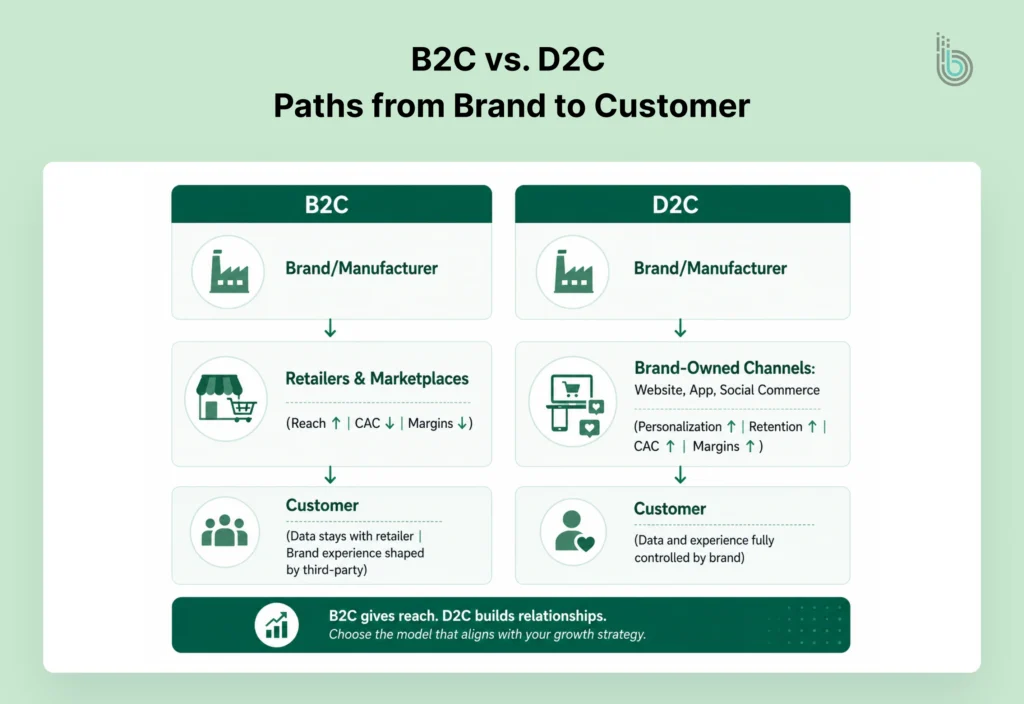
What Is the B2C eCommerce Model?
B2C has long been the default way for brands to reach customers, relying on retailers, marketplaces, and distributors to get products in front of buyers. Let’s deep dive into this concept.
The Definition of B2C
B2C stands for Business-to-Consumer. It’s a business model where a company sells products or services to individual end users, typically through a third-party channel rather than a direct storefront. For example, retail chains, online marketplaces, and distribution networks act as the middlemen between the brand and the buyer.
How B2C eCommerce Actually Works
A B2C brand sells its products on platforms like Amazon, Walmart, or Target, online or in-store. Most of the customer-facing work is handled by the retailer or marketplace, including payments, fulfillment logistics, customer service infrastructure, and often marketing visibility.
B2C brands don’t have to build an audience or trust from scratch; they can leverage the platform’s existing authority and reputation. Revenue reaches the brand after the “middleman” (retailer or marketplaces) gets its share, whether that’s a commission, a wholesale margin, or a platform fee.
Common Characteristics of B2C Businesses
Rather than a niche segment, the B2C business model typically serves a broad, general audience. Generally, business owners have less control over their brand in this model:
- Retailer mark-ups and competitive pressure on the platform often influence pricing,
- Brand messaging is filtered through the retailer’s environment, and
- The intermediary owns in-depth customer data, not you.
In this B2C eCommerce segment, volume wins the game with lower margins and higher transaction counts.
| ? Interesting Read: Everything You Should Know About B2C eCommerce |
What Is the D2C eCommerce Model?
In this approach, brands bypass middlemen and sell directly to customers through their own channels, building brand equity on their own terms. Let’s take a closer look at how it works.
The Definition of D2C
D2C, also written as DTC, stands for Direct-to-Consumer. Without involving any wholesalers, retailers, or intermediaries, the brand manufactures (or sources) a product and sells it straight to the end buyer through its own channels:
- A branded website,
- A mobile app, or
- A proprietary storefront.
The shift toward direct commerce is accelerating. PwC’s Global Consumer Insights Survey found that 63% of consumers have already purchased directly from a brand’s website, highlighting a growing preference for direct brand relationships over traditional retail channels.
How D2C eCommerce Works
The D2C business model controls the end-to-end customer journey, from the first ad impression to post-purchase follow-up. Every touchpoint is brand-owned:
Shoppers discover the brand.
↓
They land on the brand’s website.
↓
They complete the purchase through the brand’s checkout.
↓
They receive the product via the brand’s fulfillment setup (whether in-house or through a third-party logistics provider).
D2C is no longer an alternative channel; it’s a strategic growth engine. It has become increasingly common in categories like beauty, apparel, wellness, and food & beverage, where brand story and product experience drive purchasing decisions.
Common Characteristics of D2C Brands
D2C brands invest heavily in self-owned marketing channels, including email, SMS, social, website, and app. They own first-party customer data, which means they can personalize communication, test products faster, and respond to feedback in real time. Profit margins are generally higher because there’s no intermediary, but customer acquisition costs (CAC) are handled entirely by the brand.
B2C Vs D2C: The One Letter That Changes Everything
At first glance, both models appear similar because they serve the same end customer. But the pathway to reach them is fundamentally different.
Why These Two Models Get Confused
B2C and D2C both sell to consumers, operate in the eCommerce space, and look the same on the surface, involving a brand, a product/service, and a customer. That’s why people find it difficult to tell them apart.
Furthermore, the D2C business model is technically a subset of B2C. Any transaction ending with a consumer is B2C, but when people say “B2C” in a business context, they commonly mean the retailer-mediated version, not direct.
The Fundamental Difference Between B2C and D2C
So what is the difference between B2C and D2C? The primary one is the middleman or intermediary; B2C uses one while D2C doesn’t.
Here’s a quick comparison across the core dimensions:
| Dimension | B2C | D2C |
|---|---|---|
| Sales Channel | Third-party platforms, retailers, marketplaces | Brand-owned website, app, or storefront |
| Brand Control | Limited: Varies by retailer environment | Complete: Full messaging & UX ownership |
| Customer Data | Owned by an intermediary | First-party data owned by the brand |
| Profit Margins | Lower: Intermediary takes a cut | Higher: No revenue sharing |
| Pricing Flexibility | Restricted by retailer mark-ups | The brand sets its own price |
| Customer Relationship | Indirect, filtered through the retailer | Direct, one-on-one with the buyer |
| Marketing Control | Broad, often co-op or platform-dependent | Targeted, brand-owned campaigns |
| Startup Ease | Easy: Leverage existing platforms | Difficult: Build an audience from scratch |
While this overview provides a quick comparative analysis, it’s better to dive deeper and understand where these business models truly differ.
D2C eCommerce Vs B2C eCommerce: Breaking Down The Real Differences
From customer data to profit margins, understanding these differences is essential for choosing the right eCommerce strategy for your business.
Customer Relationship
- In B2C, the retailer mediates the relationship. For example, a customer buying your product on Amazon interacts with Amazon’s interface, Amazon’s return policy, and Amazon’s customer support. Your product is one listing among thousands.
- In D2C, the customer interacts solely and directly with your brand via email, your sales team, your website, your app, or your loyalty program. This relationship builds into genuine brand loyalty over time.
Brand Control
- B2C channels often limit how products are showcased. Even with extensive product listing features, the third-party platform’s rules and design govern the content, placement, discovery, and customer interactions.
- D2C gives you full control, from the typography on your homepage to completely personalized post-purchase support. Every brand signal is yours to design and own.
Customer Data Ownership
- One of the biggest limitations of B2C is customer visibility. Brands may receive sales data from retail partners, but they typically have limited access to the customer information needed to understand buying behavior and preferences.
- D2C brands build a first-party data asset that includes purchase history, browsing behavior, email engagement, and lifetime value, all tied to real audiences. That data fuels personalization, retention, and product development.
Recognizing the growing importance of first-party data in a privacy-first digital landscape, General Mills’ Global Commerce Lead Jay Picconatto said:
“First and foremost, we’re trying to make sure our first-party data network is as robust as possible.”
As third-party tracking becomes less reliable, customer data has evolved into a critical asset for personalization, retention, and product development.
Profit Margins
- B2C margins leak at every intermediary layer. For example, a product that retails for $50 may profit a net of $20 or less after wholesale pricing, platform fees, and logistics.
- D2C brands close that margin gap, but this business model redirects costs toward customer acquisition and marketing. It takes time and upfront capital to build audience reach and brand loyalty from scratch.
Marketing and Advertising Costs
- B2C brands often benefit from the retailer’s marketing infrastructure, such as Amazon Sponsored Products, Walmart promotions, and in-store placement. This approach reduces the brand’s marketing burden and control simultaneously.
- D2C brands own their marketing stack. They bear the full cost to run paid social ads, SEO, influencer partnerships, email campaigns, and more. For new brands, Customer Acquisition Costs may be higher than expected in the beginning.
Product Pricing Strategy
- B2C pricing depends on retailer mark-ups, MAP (Minimum Advertised Price) agreements, and competitive pressure from other brands on the same shelf or page.
- D2C brands set their own prices without any interference. They can test pricing, run exclusive promotions, and adjust in real time based on demand patterns and consumer behavior.
Customer Experience
- B2C customer experience is largely influenced by the retailer. Your customers engage with the retailer’s website, store environment, checkout process, packaging, and return policies, not your preferred experience or vision.
- D2C brands design every customer touchpoint: landing pages, product pages, unboxing experiences, store experiences, follow-up emails, and re-engagement campaigns. With proper execution, this creates a cohesive, memorable shopping experience.
Inventory and Fulfillment Management
- In B2C, products are sent in bulk shipments to a retailer’s warehouse. Last-mile delivery is handled by the middleman, simplifying logistics for B2C business owners while reducing flexibility.
- D2C brands manage their own inventory and fulfillment, either in-house or through a 3PL (Third-Party Logistics). It’s far more complex but allows for faster product updates, smaller batch sizes, and direct control over shipping quality.
Long-Term Business Growth
- B2C scales quickly through retail networks where distribution is already established. But dependency on third-party channels creates vulnerability; for instance, a delisted product or algorithm change can cut sales overnight.
- D2C growth is slower to start but more manageable. The result? A loyal customer base, owned data, and brand equity that don’t disappear when a platform changes its rules.
B2C Vs D2C Examples: Brands You Already Know
Analyze any renowned brand’s strategy, and you’ll usually find B2C, D2C, or a combination of the two at the core of it.
Examples of B2C Brands
Procter & Gamble (P&G) is a textbook B2C operation; products like Tide, Gillette, and Pampers are sold through Walmart, Target, CVS, and Amazon. The brand invests in marketing, but the retailer owns the shelf and the customer interaction.
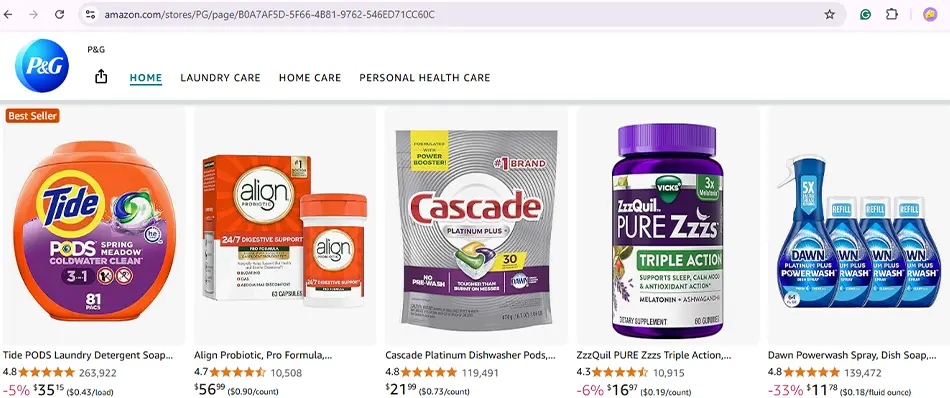
Coca-Cola follows the same pattern. You buy it at a grocery store, a convenience chain, or a vending machine, all B2C intermediaries. More brand examples that operate similarly include Nestle, Unilever, and Campbell.
Examples of D2C Brands
Warby Parker disrupted the eyewear industry by allowing customers to order glasses directly through its website and try them at home, eliminating the need for optician retail entirely. Dollar Shave Club did the same in razors, going direct with a subscription model before being acquired by Unilever for $1 billion.
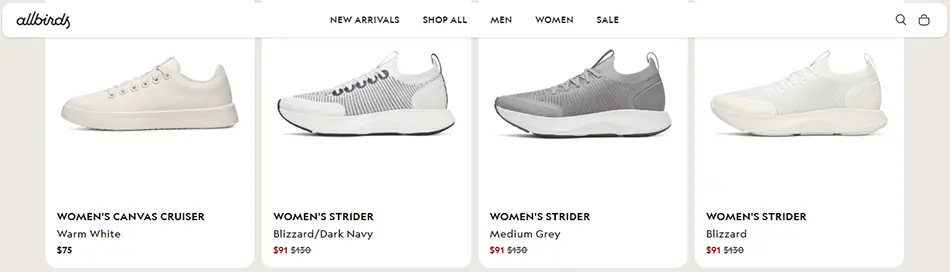
Allbirds built its sustainable shoe brand purely through D2C channels. Casper mattresses, Glossier skincare, and MVMT watches all launched D2C, using digital marketing and brand storytelling to compete without retail distribution.
Brands Successfully Using Hybrid Model (B2C + D2C)
Nike is the clearest example of a brand that runs both. It sells through retailers like Foot Locker and Dick’s Sporting Goods (B2C), while simultaneously operating Nike.com and its own app (D2C). Nike’s D2C segment now accounts for a significant and growing share of its revenue, and it’s where the brand captures the most margin and data.
Here are a few examples of brands using the hybrid model:
| Brand | B2C Channels | D2C Channels |
|---|---|---|
| NikeSportswear | Foot Locker, Dick’s Sporting Goods, Amazon, JD Sports | Nike.com, Nike App, Nike-owned stores |
| AppleConsumer electronics | AT&T, Verizon, T-Mobile, Best Buy, Walmart, Target | Apple.com, Apple Stores (500+ worldwide) |
| Ralph LaurenLuxury apparel | Nordstrom, Macy’s, department stores, and wholesale partners | RalphLauren.com, brand-owned retail & outlet stores |
| LululemonActivewear | Select wholesale partners, Peloton co-brand partnership | Lululemon.com, company-owned stores (~700+) |
| Warby ParkerEyewear | Target shop-in-shops (2025 expansion), select vision retailers | WarbyParker.com, brand-owned retail stores (250+), home try-on program |
| GlossierBeauty | Sephora (US & Canada, since 2023), select retail doors | Glossier.com, Glossier-owned flagship stores |
| PepsiCoFood & beverage | Walmart, Kroger, Costco, Amazon, convenience & gas chains | PantryShop.com, Snacks.com (D2C portals launched 2020) |
| RitualWellness / supplements | Amazon, Target, Whole Foods, Ulta Beauty | Ritual.com (subscription model), brand-owned app |
| L’Oréal USABeauty & personal care | CVS, Walgreens, Ulta, Sephora, Amazon, mass-market retail | Loreal.com, brand-specific DTC sites (Kiehl’s, CeraVe, La Roche-Posay) |
| Samsung USAConsumer electronics | Best Buy, Costco, AT&T, Verizon, T-Mobile, Amazon, Walmart | Samsung.com, Samsung Experience Stores |
Apple sells through Best Buy and carrier stores (B2C), but its own Apple Stores and apple.com are D2C-first. Samsung, L’Oreal, and even PepsiCo have added D2C channels alongside their traditional B2C pathways.
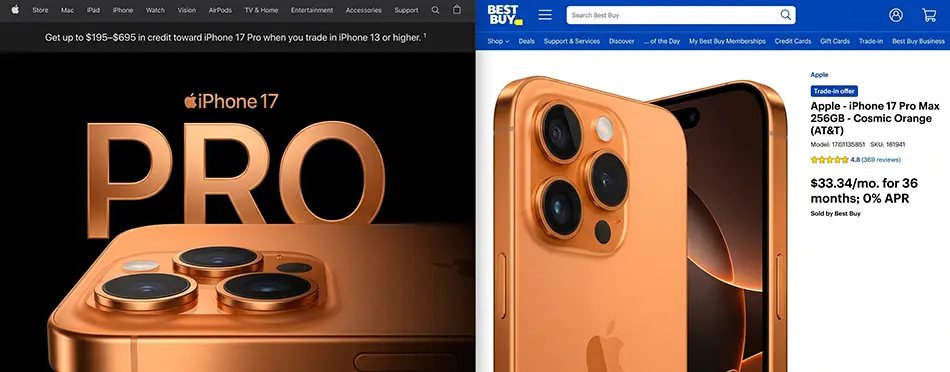
Now that we have learned the differences and reviewed a few examples, it’s time to discuss the advantages and drawbacks of B2C vs. D2C.
Pros and Cons of B2C Vs D2C: No Sugarcoating
Neither model is a universal solution. More reach often means less control, and more control often means slower scale. Knowing what each one trades away helps you pick the path that actually fits your goals, resources, and growth plans.
Benefits of B2C eCommerce
- Faster Market Entry: Your products reach customers within days, not months, when using an existing retail network. There’s no need to build a website or manage fulfillment on your end.
- Lower Acquisition Risk: The platform or retailer already has the audience; you leverage their trust and traffic rather than building yours.
- Economies of Scale: Bulk production and distribution deals reduce per-unit costs, thereby improving price competitiveness.
Limitations of B2C eCommerce
- Limited Brand Control: The retailer sets the rules for how your product appears, which promotions run, and how customer issues are handled.
- No Direct Customer Data: You don’t know who’s buying your product or why, making market research your only substitute for real behavioral data.
- Margin Reduction: Every layer in the supply chain gets a share of your profits. High volume can solve this, but it’s structurally limiting.
Benefits of D2C eCommerce
- Higher Margins: Without multiple layers of intermediaries sharing revenue, your brand generates significantly more net profit per sale.
- Complete Brand Ownership: You can control your brand’s entire persona, customer communication strategies, shipping quality, marketing approaches, and beyond.
- Rich First-party Data: Direct customer relationships generate data that fuels smarter marketing, better products, and stronger retention.
- Pricing Flexibility: Without any MAP (Minimum Advertised Price) agreements or retailer constraints, you can decide the prices on your own terms.
Limitations of D2C eCommerce
- High Customer Acquisition Costs: Building an audience from scratch requires sustained marketing investment. That’s why early-stage CAC can erode margin gains rapidly.
- Operational Complexity: Fulfillment, inventory, customer service, and tech infrastructure are all dependent on you as the brand owner, making it a relatively more ‘difficult to manage’ approach.
- Slower Initial Scale: Without a retailer’s network, reaching mass-market distribution takes longer and more capital.
Still confused about which approach to choose for your business? Let’s clear it up in the next part of the article.
B2C Vs D2C: Which Model Is Actually More Profitable?
D2C wins on margin percentage without a shred of doubt. A product sold through a retailer at wholesale might net 30-40% of the retail price. The same product sold D2C might net 60-70% after direct fulfillment costs.
But margin percentages are only one side of the story. D2C brands bear the burden of customer acquisition costs, which can be substantial in competitive ad markets and in the early stages of a brand. A B2C brand riding a retailer’s traffic may earn less per sale but save substantially on acquisition and brand building.
In the long run, the D2C eCommerce approach tends to be more profitable for brands that succeed in building strong retention. Once acquisition costs are covered, repeat customers generate high-margin revenue with minimal additional spend. B2C eCommerce profitability, by contrast, is largely tied to volume and negotiating power with retail partners.
B2C Vs D2C: How to Know Which Model Fits Your Business Right Now
Choose B2C if you’re in the initial stages and need to validate product-market fit quickly, without the capital burden of building your own channels. B2C is also the right call if your product category relies on:
- Impulse purchasing
- In-store product exploration and discovery
- Widespread geographic distribution that retail networks provide more efficiently
Choose D2C if brand perception, customer loyalty, and repeat purchases are critical to your success. This business model is beneficial when:
- You’re selling a product where brand story matters, such as wellness, lifestyle, premium goods, and subscriptions.
- You have the budget to invest in marketing before profitability.
- Your product has strong repeat purchase potential.
- Your brand’s core value proposition is customization or personalization.
| ? Interesting Read: How to Start an eCommerce Business: Beginner’s Guide |
If you’re building a B2C eCommerce website or launching a D2C storefront, the infrastructure you build should align with the model you choose, or how you plan to combine both.
Can You Run Both? The Case for Hybrid Commerce
Successful brands, in most cases, are increasingly viewing B2C and D2C as complementary channels rather than separate strategies. Let’s understand how.
Understanding Hybrid Commerce
Hybrid commerce means operating B2C and D2C channels simultaneously. For instance, a brand sells through Amazon and Walmart while also running its own branded website. With proper execution, it’s a strategic multiplier.
Benefits of a Dual-Channel Strategy
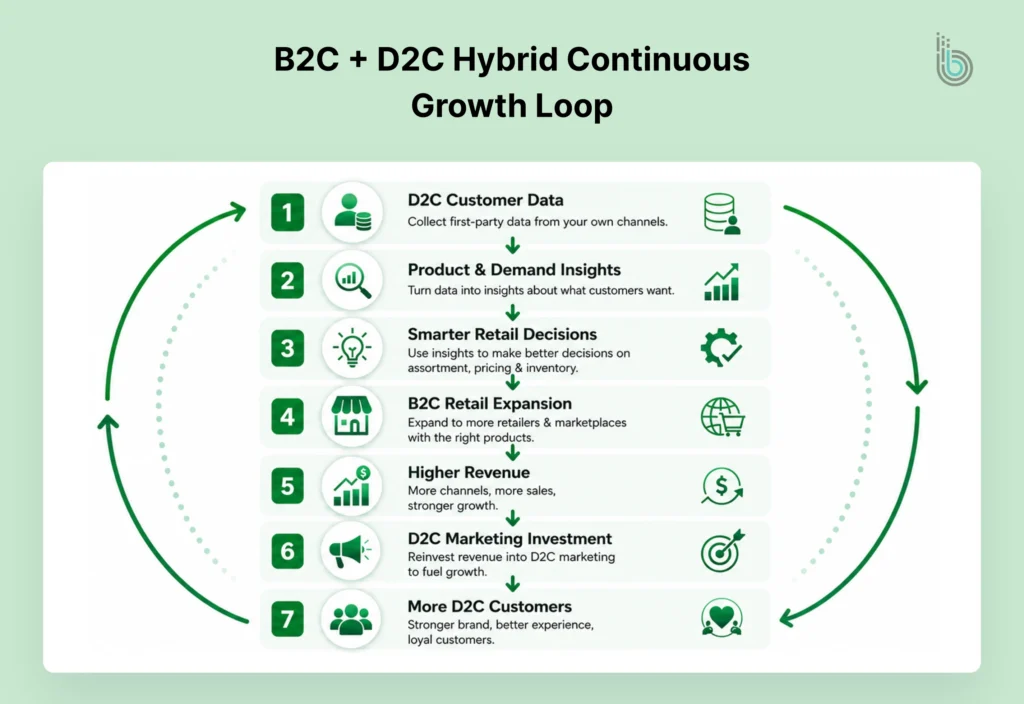
The retailer channel drives volume and reach while the D2C channel drives margin, data, and brand depth. Together, they reduce dependency on any single distribution path. If a marketplace changes its algorithm or fee structure, the D2C channel provides a safety net, and vice versa.
Brands using both also benefit from a feedback loop: D2C data informs which products to push through retail, while B2C retail scale can fund D2C marketing investment.
Common Challenges
Channel conflicts add to the complexity with two distinct fulfillment and customer service pipelines. Retailers may disapprove if your D2C pricing undercuts their shelf price. MAP policies exist partly for this reason.
Inventory allocation becomes difficult to balance. Committing too much to retail leaves your D2C channel understocked, and vice versa. You’ll also need clear internal alignment on which channel gets priority for new product launches or promotional campaigns.
Real-World Hybrid Commerce Examples
Nike’s hybrid approach is a widely studied example that uses retail partners for mass distribution while funneling its most loyal customers toward Nike.com and the Nike app, where it pushes exclusive products and personalized experiences.
L’Oreal operates through department stores and drugstores globally (B2C) while building D2C channels for premium product lines.
When implementing eCommerce marketplace development strategies, many brands are launching a marketplace presence while preserving a direct channel for high-value customer relationships.
B2C Vs D2C: There’s No Universal Winner, Only the Right Fit
If you’re looking for an honest answer, there is no clear winner because neither model is objectively better. They serve different business realities.
- B2C works for brands that need to scale quickly, sell commodity or mass-market products, or don’t yet have the infrastructure or budget to run customer acquisition independently. To summarize, it’s a lower-risk entry point with a ceiling on control and margin.
- D2C works for brands that are building long-term customer equity, have a unique product story, and are willing to invest in self-owned marketing. The flexibility and operational demand are much higher.
The most successful brands today don’t stick with one approach permanently. They start where it makes sense, prove the model, then expand. Nike didn’t launch D2C overnight; it spent decades building the brand through retail before it had the equity to attract customers directly.
If you’re at the stage of deciding which model to work with between B2C vs D2C, the most important question isn’t “which approach is better,” it’s “which approach gives my business the best foundation for the next steps.”
Working with experienced developers who understand both models can make that transition smoother. Whether you’re launching your first storefront or rearchitecting an existing channel, it helps to hire eCommerce developers who’ve built for both B2C and D2C environments.
Wrapping Up
In the B2C vs D2C debate, the two models aren’t rivals; they’re different tools built to solve distinct business challenges. B2C offers scale, reach, and a lower barrier to entry. D2C offers control, data, and better margins over time.
The right model depends on your product, your resources, your timeline, and how much of the customer relationship you actually want to own. For growing brands, the future isn’t always about choosing B2C or D2C; it’s about knowing where each model delivers the most value.
Start with the model that fits your current stage. Build toward the one that fits your future vision.
FAQs
1. Is D2C the same as B2C?

Not exactly, D2C (Direct-to-Consumer) is a subset of B2C (Business-to-Consumer). Both sell to consumers, but D2C cuts out the retailer entirely, while a third party mediates the sale in B2C.
2. What is the biggest difference between B2C and D2C?
Channel ownership. B2C relies on retailers or marketplaces to reach customers; the brand gives up margin, data, and control in exchange. D2C means the brand owns the storefront, the relationship, and the customer data directly.
3. Is Amazon a B2C or D2C business?
Amazon is a B2C marketplace; it’s the intermediary or middleman. Brands selling on Amazon are operating B2C. Amazon itself sells its products (Kindle, Basics line) directly to consumers on its own platform, making it a hybrid operator on both sides.
4. Why are more brands moving to D2C?
Margin, data, and control. Retailers compress margins and withhold customer insights. D2C lets brands own first-party data, set their own pricing, and build direct loyalty, translating into long-term business value.
5. Can a company operate both B2C and D2C models?
Yes, and most mature brands do. Nike, Apple, and L’Oréal all run both. Retail handles mass distribution; the direct channel captures margin, data, and high-value customers. The main risk is channel conflict on pricing.
6. Which model is more profitable, B2C or D2C?
D2C has higher per-unit margins, no middleman share or cut. But profitability depends on CAC (Customer Acquisition Costs). If acquisition costs eat into the margin advantage, D2C loses its edge. B2C wins the game with volume at lower operational complexity.
7. Is B2C better for startups?
Often, yes. B2C gives startups instant access to an existing audience without having to build one from scratch. It lowers entry costs and validates product-market fit more quickly, before a brand has the budget for D2C customer acquisition.
8. What technologies are required for a D2C business?
At minimum: an eCommerce storefront (Shopify, custom-built), a CRM for customer data, an email/SMS marketing platform, and analytics. Scaling D2C involves adding a Customer Data Platform (CDP), subscription management, and 3PL integration for fulfillment.