Quick Summary
- Shopify Standard is best for startups and stores under $1M in annual revenue.
- Shopify Plus unlocks checkout customization, B2B tools, and automation.
- Transaction fee savings on Plus often offset the higher monthly cost.
- Multi-store management and API limits are key differentiators.
- Upgrade when Plus features solve real, current operational problems.
Choosing the wrong Shopify plan can directly drain your profits. Whether you are launching a new store or expanding an established business, the choice between Shopify vs Shopify Plus decides your possibilities, your expenses, and your growth speed.
This comparison guide provides a clear, focused pathway to help you make an informed decision.
What Shopify Actually Is (And Who It’s Built For)
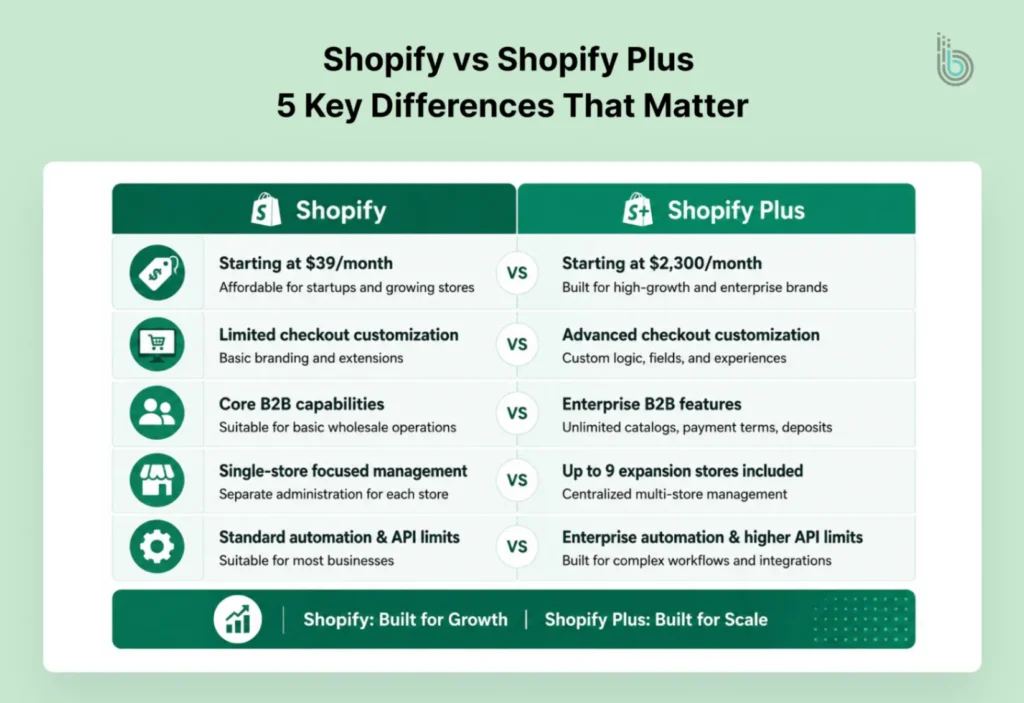
Shopify is a self-service eCommerce platform used by millions of merchants across ~175 countries. It is a comprehensive ecosystem that handles hosting, payment processing, inventory management, order fulfillment, and marketing. With straightforward pricing and no negotiation required, plans range from $39/month for the Basic plan to $399/month for the Advanced plan.
Who Should Use Shopify?
- Startups: Low barrier to entry, fast to launch, predictable monthly costs.
- Small Businesses: Everything needed to run a storefront without developer involvement.
- Growing Online Stores: Solid foundation up to roughly $1M in annual revenue, where standard plan features cover most operational needs.
| ? Interesting Read: Is Shopify a Legit Platform for Sellers & Buyers (The Real Truth) |
Key Benefits of Shopify
- Quick setup with no technical knowledge required
- Access to thousands of apps for extending functionality
- Built-in payment processing via Shopify Payments
- Multi-channel selling across social, marketplaces, and POS
- Reliable uptime with a globally distributed Content Delivery Network (CDN)
Shopify is the right starting point for most businesses, but at a certain scale, the limitations become apparent.
What Is Shopify Plus? (And Who Actually Needs It)
Shopify Plus is Shopify’s enterprise tier, launched in 2014. It runs on the same underlying platform but unlocks features that are not available on standard plans. Starting at $2,300/month, this upgrade includes full checkout customization, native B2B tooling, advanced automation, unlimited staff accounts, higher API limits, and dedicated merchant support.
Who Should Use Shopify Plus?
- Enterprise Brands: Businesses handling significant sales volume that require advanced customization, higher API limits, scalable infrastructure, and dedicated support.
- Direct-to-consumer Brands at Scale: Stores generating substantial monthly revenue and traffic, where advanced checkout capabilities, automation, and operational efficiencies can deliver meaningful ROI.
- Multi-store Operations: Brands managing multiple storefronts, expanding into global markets, or operating both B2B and DTC channels from a centralized backend.
Once associated primarily with small- and mid-sized businesses, Shopify now supports enterprise retailers and global brands such as Reebok, Barnes & Noble, Allbirds, and more. The rise of Shopify Plus has played a key role in that transformation, enabling the platform to meet the demands of high-volume merchants.
| ? Interesting Read: What Is Shopify Plus? Cost, Features & When to Upgrade |
Key Benefits of Shopify Plus
- Checkout Extensibility with full branding and custom logic
- Native B2B features like company profiles, custom catalogs, payment terms
- Shopify Flow for advanced automation without third-party apps
- Up to 9 expansion stores on one account
- Unlimited staff accounts and 500% higher API rate limits
- 99.99% uptime SLA and load-tested capacity of 10,000+ checkouts/minute
- Dedicated Merchant Success Manager
- Launchpad for scheduled product drops and campaign automation
With the basics clear, here’s how Shopify Plus vs Shopify compare side by side.
Shopify Vs Shopify Plus: Quick Comparison Table
| Feature | Shopify (Basic – Advanced) | Shopify Plus |
|---|---|---|
| Monthly Price | $39 – $399/month | From $2,300/month |
| Transaction Fees (non-Shopify Payments) | 0.6% – 2% | 0.2% |
| Staff Accounts | Limited by plan | Unlimited |
| Checkout Customization | Standard checkout extensibility | Advanced checkout extensibility, Functions, and UI extensions |
| Shopify Flow Automation | Included | Advanced automation at enterprise scale |
| B2B Commerce | Core B2B capabilities | Advanced B2B features, catalogs, payment terms, and customer-specific pricing |
| Expansion Stores | Not included | Up to 9 additional stores included |
| API Rate Limits | Standard | Significantly higher |
| Launchpad | Not available | Included |
| POS Pro | Additional cost | Enhanced POS entitlements |
| Support | 24/7 support | Priority support and launch resources |
| Uptime SLA | Standard platform uptime | 99.99% uptime SLA |
| Organization Admin | No | Yes |
| ShopifyQL Notebooks | No | Yes |
| Shopify Audiences | No | Yes (eligible regions only) |
| Custom Themes | Up to 20 | Up to 100 |
| Inventory Locations | Up to 10 | Up to 200 |
| Sandbox/Test Stores | No | Included |
| Multi-Store Management | Limited | Centralized organization management |
| International Expansion | Shopify Markets | Advanced multi-market operations |
| B2B & DTC Management | Separate setup often required | Native management from a single platform |
| Wholesale Pricing & Catalogs | Limited | Advanced and scalable |
Shopify Vs Shopify Plus: Deep Dive into Key Differences
Pricing and Total Cost
Shopify: Pricing Basic starts at $39/month, Shopify plan at $105/month, and Advanced at $399/month. Annual billing saves 25%. Transaction fees on non-Shopify Payments range from 0.6% (Advanced) to 2% (Basic).
Shopify Plus: Pricing Starts at $2,300/month on a 3-year contract and $2,500/month on a 1-year contract. Once monthly revenue surpasses $800K, pricing shifts to a variable model, 0.35% of monthly GMV (3-year) or 0.40% (1-year), capped at $40,000/month. Transaction fees drop to 0.2% on non-Shopify Payments.
Which Offers Better Value Between Shopify Vs Shopify Plus Pricing?
The math changes with scale.
A store generating $10 million in annual sales would pay roughly $63,500 per year on Shopify Advanced when transaction fees and subscription costs are factored in. On Shopify Plus, that same store would pay closer to $47,600 per year.
The difference is primarily driven by the reduction in transaction fees from 0.6% to 0.2% for merchants using third-party payment providers.
| ? Pro Tip: Many Shopify Advanced merchants are already spending $500 – $800/month on third-party apps to replicate Plus features such as checkout customization and automation. The real cost gap is smaller than the sticker price suggests. |
For merchants under $1M in annual revenue, Plus adds cost without proportionate return. The upgrade is often practical above that threshold. But many other aspects need to be considered.
Checkout Customization Capabilities
Shopify: Standard plans support Checkout Extensibility like Shopify’s modern, no-code approach to checkout customization. However, you won’t have enough control, making it difficult to customize logic, layout, and branding. You can add some apps and UI extensions, but you can’t fully rework the checkout experience or implement conditional Shopify shipping or payment logic natively.
Shopify Plus: Full access to Checkout Extensibility APIs and Shopify Functions. You can customize the end-to-end checkout experience without touching the Shopify code, including:
- Custom-branded checkout pages
- A/B testing different layouts
- Conditional logic for payments and shipping
- Post-purchase upsells
- Custom fields (gift messages, delivery notes)
- Server-side business rule customization
Moreover, Shopify Functions replaces Script Editor, which is being retired on June 30, 2026.
The business case for advanced checkout customization is compelling. According to the Baymard Institute’s checkout research, the average cart abandonment rate is 70.19%, with checkout friction remaining one of the biggest contributors to lost sales. Optimizing the checkout experience can therefore directly impact conversion rates and revenue.
Automation and Workflow Management
Shopify: Basic Shopify Flow access is available, but complex, multi-condition, and cross-store workflows are limited. Most stores on standard plans rely on third-party automation apps to fill the gap.
Shopify Plus: Shopify Flow on Plus supports multi-condition workflows (if X and Y and Z, then A), cross-store triggers, scheduled runs, and integration with third-party apps via Flow’s connector API. With the Winter 2026 “Renaissance” Edition, Sidekick AI integration now allows workflows to be created through natural language. Common use cases include fraud flagging, VIP customer tagging, low-inventory alerts, automatic discount generation, and wholesale approval workflows. Merchants report saving 15-20 hours weekly with Shopify Flow automation.
Multi-Store and Global Selling Features
Shopify: Each storefront requires a separate Shopify account, separate billing, and separate management. Without a unified Organization Admin, it becomes difficult to manage multiple stores with multiple logins, multiple data silos, and no centralized reporting.
Shopify Plus: Up to 9 expansion stores are included at no extra platform cost. All stores are managed by a single Organization Admin, with unified reporting, shared API quotas, and granular user permissions across storefronts. Additional stores beyond the included 9 can be added for $250 per month. For brands managing regional storefronts, branded B2B and DTC separations, or market-specific catalogs, this facet alone justifies the upgrade cost.
B2B Commerce Capabilities
Shopify: As of April 2026, Shopify expanded native B2B features to all paid plans, including company profiles, up to 3 catalogs, volume discounts, payment terms, vaulted credit cards, and ACH (US). This is a meaningful shift as it used to be an entirely Plus-exclusive feature.
Shopify Plus: Plus B2B goes beyond. It removes the 3-catalog cap (unlimited catalogs), adds partial payments, deposits, direct catalog-to-company/location assignment, and sales rep permission scoping (Spring 2026 addition). Shopify Flow’s advanced automation handles wholesale approval workflows and reorder triggers at a scale standard plans can’t match.
API Access and Custom Development
Shopify: Standard API rate limits. Works well for most app integrations and moderate custom development. Limitations surface when running real-time ERP sync, high-frequency inventory updates, or complex headless architectures.
Shopify Plus: API rate limits are approximately 500% higher than standard plans. REST and GraphQL resources are exclusive to Plus members. Also, Plus includes the Hydrogen headless framework and Oxygen hosting at no additional cost, the preferred setup for brands building custom storefront experiences. ERP integrations with NetSuite, SAP, and Microsoft Dynamics operate smoothly at Plus API levels, where they’d bottleneck on standard plans during peak traffic.
User Accounts and Team Management
Shopify: Staff account limits vary by plan: Basic allows 2, Shopify plan allows 5, Advanced allows 15. Without any granular organization-level permissions, each store must be managed independently.
Shopify Plus: Unlimited staff accounts with no additional cost. Organization Admin enables centralized management of all stores, with role-based permissions that can be scoped to specific stores, features, or company accounts for B2B sales reps. For growing teams, eliminating per-seat limits overcomes a crucial operational constraint.
Support and Account Management
Shopify: 24/7 support via chat, email, and phone across all standard plans. Response quality is consistent, but there is no dedicated contact, no proactive guidance, and no account-level relationship.
Shopify Plus: Every Plus merchant is assigned a dedicated Merchant Success Manager, an experienced contact who handles onboarding, quarterly reviews, escalation support, and proactive optimization guidance. Additionally, Plus includes access to the Shopify Plus Academy for team training and a dedicated launch engineer during onboarding. The 99.99% uptime SLA (vs. standard’s 99.9%) translates to roughly 8x less potential downtime annually.
When Should You Upgrade from Shopify to Shopify Plus?
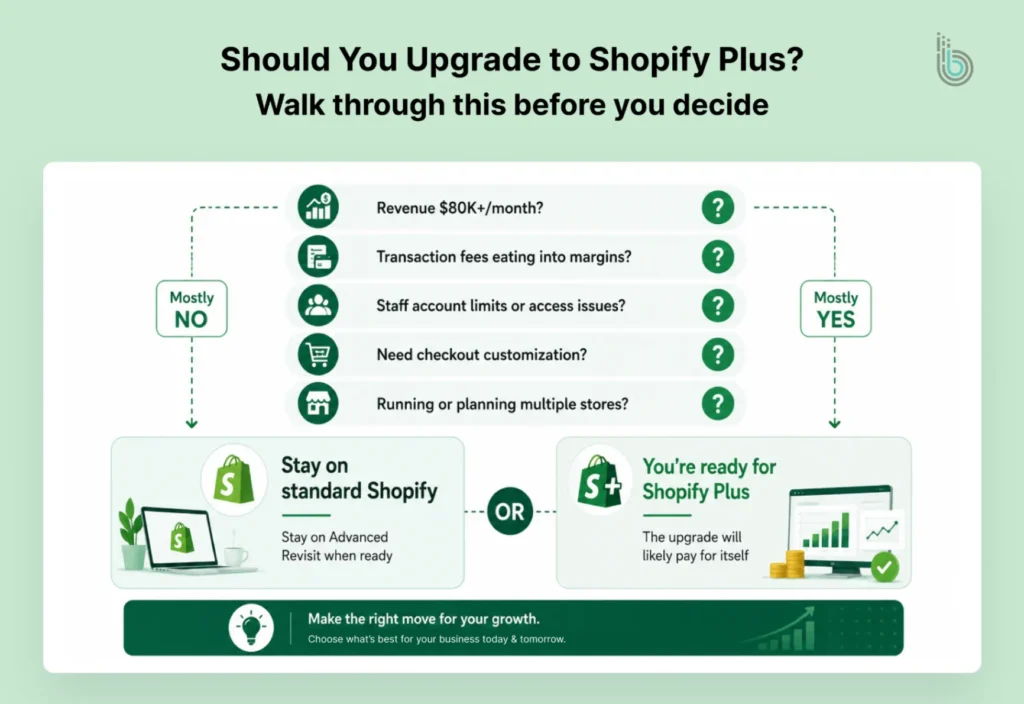
Revenue isn’t the only deciding factor; Shopify Plus delivers the most value when its advanced capabilities solve real operational challenges. These are common signs that your business may be ready for Shopify Plus:
- Monthly revenue consistently ranges from $80K to $100K, and transaction fees have become a significant operating expense.
- Checkout conversion rates are limited by your inability to customize logic, branding, or fields.
- Your team is approaching staff account limits or struggling with permission controls.
- You’re managing (or need to manage) multiple storefronts with unified reporting.
- B2B wholesale operations have outgrown the 3-catalog limit, or need partial payments and deposits.
- Third-party app spend to replicate Plus features is approaching or exceeding $500 – 800/month.
- Traffic spikes caused by flash sales or product drops are bottlenecking store performance.
- ERP, OMS, PIM, or other business-critical integrations are constrained by standard API limits.
- Script Editor is in use, and you need to migrate to Shopify Functions before the June 30, 2026, retirement deadline.
If fewer than two of these apply, staying on Advanced is the smarter financial move, at least for now.
Shopify Advanced Vs Shopify Plus: Which Plan Fits Your Growth Goals?
This is the most common comparison point because Shopify Advanced and Shopify Plus are both positioned for established, growing stores, but they serve fundamentally different operational needs.
Shopify Advanced gives you lower transaction fees than the Basic or Shopify plans (0.6% on non-Shopify Payments), advanced reporting, and third-party-calculated shipping rates. This is the eCommerce ceiling for standard Shopify.
Shopify Plus breaks the ceiling entirely. Charging 8x the monthly cost is justified when your current requirements include checkout customization, native B2B capabilities, expansion stores, enterprise-grade automation, or higher API capacity.
Transaction fees can also become a factor at higher sales volumes. One calculation worth noting: a store processing $1 million in monthly sales through a third-party payment provider would pay approximately $6,000 in transaction fees on Shopify Advanced (0.6%) versus $2,000 on Shopify Plus (0.2%), a difference of about $4,000 per month. Those savings can balance a large portion of the additional cost for the Shopify Plus upgrade.
Beyond cost savings, Shopify Plus helps brands scale without building complex technical infrastructure.
“As a business owner, there are so many moving pieces to start selling a product. You have to find a way to track your inventory. You have to find a way to print labels. You have to find a way to manage your orders. Shopify does all of that, and not only does it do it, but it also hands it to you on a silver platter.”
– Rafael Romis, Founder of Weberous and a Shopify Plus Partner
For brands serious about custom Shopify development at the Advanced or Plus level, it’s important to understand the benefits and drawbacks of each.
Shopify at a Glance: Honest Pros, Real Cons
Standard Shopify is a capable platform for most stores, but understanding where it serves you well and where it falls short saves you from costly workarounds later.
Pros:
- Low entry cost with predictable monthly pricing ($39 – $399/month)
- Set up functional stores that can launch in hours without any technical background
- Massive app ecosystem with 13,000+ integrations covering marketing, SEO, logistics, and more
- Multi-channel selling built in (social commerce, marketplaces, POS)
- No server management with a fully hosted infrastructure that handles performance and security
- Solid uptime and CDN-backed performance for standard store volumes
Cons:
- Checkout customization is restricted with hard limits on logic, layout, and branding
- Low staff account where Basic gets 2, Grow gets 5, Advanced gets 15, forcing plan upgrades for team growth
- Transaction fees on non-Shopify Payments (0.6% – 2%) become a measurable cost at scale
- Enterprise-level functionality often requires third-party apps, adding cost and complexity
- API rate limits create bottlenecks for ERP sync, headless builds, and high-frequency custom integrations
- General 24/7 support with no dedicated account manager or enterprise support resources
Shopify Plus at a Glance: Advantages and Limitations
At $2,300/month, Shopify Plus is a significant commitment and, like any enterprise platform, it comes with genuine strengths and a few real limitations worth knowing up front.
Pros:
- Full checkout customization through Checkout Extensibility and Shopify Functions like branded flows, custom fields, and conditional logic
- Transaction fees drop to 0.2% on non-Shopify Payments (vs. up to 2% on standard plans)
- Native B2B tools reduce app dependency with additional features like company profiles, unlimited catalogs, payment terms, and partial payments
- Unlimited staff accounts with granular, organization-level permission controls
- Up to 9 expansion stores managed under one Organization Admin with unified reporting
- Dedicated Merchant Success Manager and a 99.99% uptime SLA
- Launchpad for scheduling product drops, flash sales, and campaign-specific theme changes
- Significantly higher API rate limits than standard plans, enabling enterprise ERP and headless integrations
- POS Pro is included across all locations for omnichannel retail operations
Cons:
- Stores under $1M in annual revenue gain relatively lower ROI with the $2,300/month base price
- When scaling, revenue-based pricing can increase costs significantly
- Annual or multi-year contracts reduce flexibility if any changes are needed
- Advanced features like Checkout Extensibility and Shopify Flow at scale require developer resources to implement properly
- Unnecessary for businesses without genuine multi-store, high-volume B2B, or checkout customization requirements
Shopify Vs Shopify Plus: Which One Should You Choose?
The difference between Shopify and Shopify Plus depends entirely on your business’s operational needs, not just on revenue. Shopify Advanced is built for growth; Shopify Plus is built for scale. The best option depends on whether your business is facing bottlenecks that Plus is designed to solve.
Choose Standard Shopify: If you’re under $1M annually, your checkout performs well, you don’t have B2B requirements, and your team fits within the staff account limits. It’s a capable platform that doesn’t need to be replaced before your business actually outgrows it.
Choose Shopify Plus: When you want to solve specific, current problems: checkout conversion is being limited by customization constraints, multi-store management is creating operational chaos, B2B complexity has exceeded what apps can handle, or transaction fee savings at your volume justify the subscription jump.
The Shopify vs Shopify Plus decision does not depend on any single facet. The upgrade is worth it only when the exclusive features of Plus deliver sufficient operational efficiency and revenue gains to cover the extra costs. For many businesses, the upgrade pays for itself sooner than expected.
If you’re evaluating Shopify Plus development for your store or looking to build a Shopify store from scratch, consulting with experts is always the most practical first step. It may seem complex at first, but the decision flow is simple: Understand where your business is today, where you want it to go, and choose the platform that can support that journey.
Frequently Asked Questions
1. Is Shopify Plus worth it?

At $80K – $100K+/month in revenue, yes. Transaction fee savings alone (0.2% vs up to 2%) can offset the subscription cost. Below that threshold, the ROI rarely justifies the $2,300/month entry price.
2. What is the difference between Shopify and Shopify Plus?
Shopify is a self-service eCommerce platform with fixed features and plan limits. Plus adds full checkout customization, unlimited staff accounts, native B2B, advanced automation, expansion stores, and a dedicated Merchant Success Manager.
3. Shopify Advanced vs Shopify Plus: which is better?
Advanced is the smarter spend with a business under $800K/month. Above that, Plus wins on transaction fee savings, checkout control, and operational features. At $1M/month, Plus saves roughly $4,000/month in fees alone.
4. Can I upgrade from Shopify to Shopify Plus later?
Yes, anytime. Your store data, products, and theme migrate seamlessly. Shopify assigns a launch engineer to manage the transition. Most upgrades are completed without any storefront downtime.
5. Does Shopify Plus increase sales?
Not directly, it removes conversion bottlenecks. Checkout customization, faster load capacity (10,000+ checkouts/minute), and A/B testing capabilities create conditions for higher conversion. Results depend entirely on how well you implement them.
6. Is Shopify Plus only for enterprise businesses?
No. High-growth DTC brands, B2B wholesalers, and multi-store operators use Plus well before reaching enterprise scale. The deciding factor is whether Plus features solve current operational problems, not company size.
7. What revenue level should I upgrade to Shopify Plus?
The practical threshold is $80K – $100K/month consistently. At $1M+/month annually, transaction fee reductions on third-party payments typically cover a significant portion of the Plus subscription cost.
8. Does Shopify Plus include Shopify Flow?
Yes, at enterprise scale. Plus unlocks multi-condition workflows, cross-store automation, scheduled triggers, and third-party app connectors – capabilities that go well beyond the basic Flow access on standard plans.
9. Is Shopify Plus better for B2B commerce?
Significantly. Plus offers unlimited catalogs, partial payments, deposits, payment terms, sales-rep permissions, and wholesale-approval automation via Flow. Standard Shopify caps B2B at 3 catalogs with no partial payment support.
10. Can Shopify Plus manage multiple stores?
Yes. Up to 9 expansion stores can be managed by a single Organization Admin, with unified reporting, shared API quotas, and role-based permissions. Additional stores beyond 9 cost $250 per month.