
Quick Summary
- A Shopify affiliate program pays partners only when they drive real sales.
- Third-party apps like UpPromote and Tapfiliate handle all tracking and payouts.
- Commission rates should sit between 5 to 15% for physical and 20 to 40% for digital.
- Affiliates and referral programs solve different problems; many brands run both.
- Clean tracking setup and consistent communication determine program success.
For eCommerce brands today, affiliate marketing is one of the lowest-risk growth channels. Basically, you pay the affiliate partners directly whenever a sale occurs. By partnering with affiliates who already have your audience’s trust, this marketing approach puts the brand’s growth on autopilot for Shopify store owners.
This is an end-to-end guide that covers everything from how the Shopify affiliate program works to building a recruitment strategy. Let’s begin.
What Is a Shopify Affiliate Program?
In a Shopify affiliate program, external partners earn commission each time they drive sales to your store. These external partners include:
- Bloggers
- Influencers
- Content Creators
- Niche Websites
Each affiliate gets a unique tracking link, and when someone clicks it and makes a purchase, the affiliate is credited and paid.
In this performance-based marketing approach, you spend money only when revenue is generated. Although Shopify doesn’t offer a built-in affiliate management system, you can choose third-party apps from the Shopify App Store. These apps handle tracking, commissions, payouts, and affiliate portals.
| ? Interesting Read: How Can I Get a Prebuilt Shopify Store: Best Place to Buy One |
How Does the Shopify Affiliate Program Work?
An affiliate program is a straightforward marketing technique in which every click is tracked, and a fraction of each sale goes to the affiliate for driving the purchase.
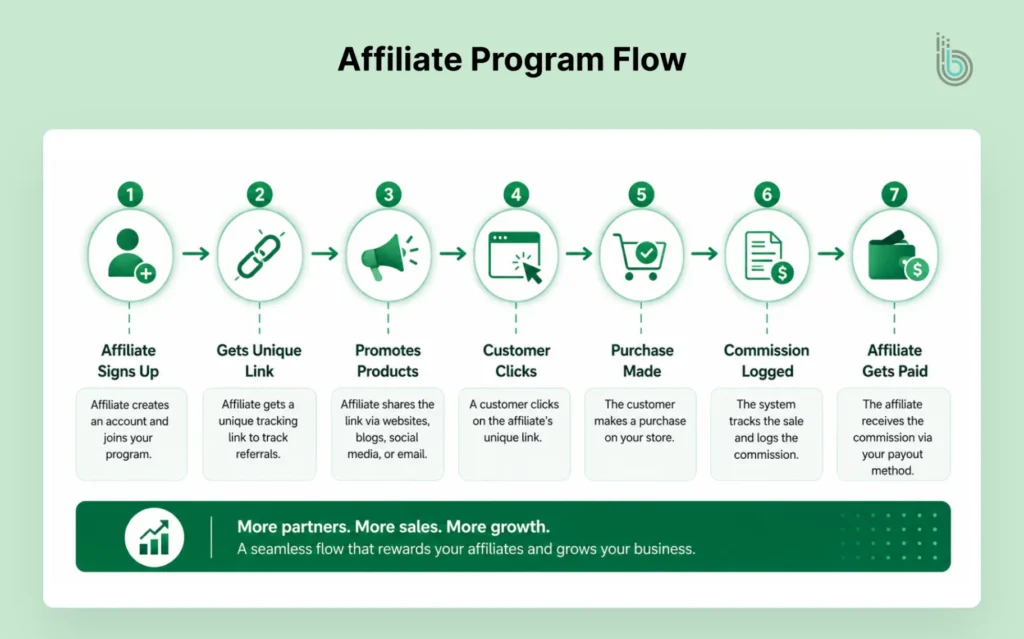
Here’s the basic flow:
Affiliate registers via your signup page → The app generates a unique tracking link for that affiliate → The affiliate promotes your products/services across channels → The customer clicks the link, lands on your Shopify store → The purchase is made and tracked back to the affiliate → Commission is logged and queued for payout → The Affiliate gets paid for each sale.
The purpose of an affiliate app is to manage the relationship between your Shopify store and your partners. Apps allow you to control cookie duration, commission rates, and payout schedules while recording every touchpoint, preventing double-counting, and automating payouts.
Why Running an Affiliate Program on Shopify Pays Off
Revenue increase is the surface-level benefit. A well-planned and well-run affiliate program directly accelerates your brand’s growth. Here’s where the real value lies:
Performance-Based Spend, No Wasted Budget
Your ad spend is not wasted on impressions or non-converting clicks. Payment is triggered only when a sale closes. Every dollar spent is tied to real revenue, making Shopify affiliate marketing one of the most capital-efficient channels in eCommerce.
Customer Acquisition at a Fraction of the Cost
The affiliates you partner with do all the work, from audience building to content creation. This results in significantly lower customer acquisition costs compared with paid social ads, PPC campaigns, or other methods.
Credibility Through Real Voices
Affiliate creators already have a follower base that engages with them and trusts their choices and opinions. That’s exactly why a recommendation from a trusted creator carries more impact than a display ad.
Distribution Across Channels You Don’t Own
Affiliates promote your brand across new channels, including email newsletters, YouTube reviews, Quora answers, niche blogs, podcast mentions, etc. Your affiliate partners help your products reach new audiences and platforms without needing to start a new profile on a new channel from scratch.
Retention Effects Through Partner Networks
Your affiliate partners are earning directly through the program, making it beneficial for them to recommend your products. Rather than a one-time mention, this approach translates it into long-term advocacy.
User-Generated Content (UGC) at Scale
Affiliate-driven content like reviews, unboxing videos, and tutorials can also serve as organic UGC. This delivers compounding value, enhances brand reputation, and drives continuous traffic without any upfront investment, because your dollar is spent only when the traffic converts.
Affiliate Program Vs Referral Program: Know the Difference
Most brand owners confuse these two approaches, but they serve different purposes. Here’s a quick overview:
| Feature | Affiliate Program | Referral Program |
|---|---|---|
| Audience | Influencers, creators, publishers | Existing customers |
| Rewards | Cash commission on sales | Discounts, credits, freebies |
| Goal | Revenue growth, new audiences | Customer retention, word-of-mouth |
| Tracking | Affiliate links, cookies | Referral codes or links |
| Scale | Unlimited external partners | Tied to the existing customer base |
When should you set up an affiliate program on Shopify?
If you want to acquire a new customer base, affiliates are an excellent way to expand your reach to new audience segments.
When do referral programs work better?
If you are already satisfied with your loyal customer base, referral programs can incentivize word-of-mouth within your audience. This is a more personal approach with lower overhead.
Why do many Shopify brands run both?
Both of these approaches are effective in different areas. Affiliate partnerships work for the top of the funnel, while referrals improve loyalty at the bottom of the funnel, creating a complete customer acquisition-to-retention pipeline.
How to Create an Affiliate Program on Shopify: Step-by-Step Process
Building a Shopify affiliate program isn’t complicated, but understanding the chronology saves you from rework later.
Step 1: Lock Down Your Goals First
Is your primary objective to grow revenue, reach new audiences, or build niche-specific brand awareness? Your goal decides your affiliate type, performance benchmarks, and commission structure. Skipping this step leads to misaligned programs with unsatisfactory results.
Step 2: Design Your Commission Structure
The two common commission models are as follows:
- Percentage-based (a cut of each sale)
- Flat-rate (a fixed amount per conversion)
Depending on the margins, the starting rate for most Shopify stores is 10 to 30% commission on digital products and 5 to 15% on physical goods. You can incentivize growth with a tier-based system, paying higher commissions to top performers.
Step 3: Pick the Right App for Your Store Size
There is no universal app that works for everyone. Here’s a quick overview for you to match the apps with your current scale and goals:
| App | Best For | Key Features |
|---|---|---|
| UpPromote | Beginners | Easy onboarding, built-in affiliate marketplace |
| ReferralCandy | Referral + affiliate combo | Automated rewards, Shopify integration |
| Tapfiliate | Scaling brands | Advanced tracking, multi-channel attribution |
| Affiliatly | Small stores on a budget | Affordable pricing, simple setup |
| Shopify Collabs | Creator partnerships | Native Shopify integration, no extra cost |
For official program details, visit Shopify Affiliates and browse affiliate-related tools on the Shopify App Store.
Step 4: Install and Configure the App
Once you’ve selected and installed the app, connect it with your Shopify store and configure commission rules, cookie window, and payout thresholds. Also, set up email notifications for affiliates so they stay updated on their commission earnings.
Step 5: Build Your Affiliate Registration Page
Don’t create a vague sign-up page, as it’s the front door to your recruitment. Clearly mention commission rates, payment terms, payout method, and who would be best for your program.
Step 6: Configure Tracking Correctly
Most apps generate tracking links automatically; you just need to ensure the attribution window aligns with your typical buyer journey. For example, extend the cookie duration for higher-ticket products. Test links before going live, as broken tracking is the fastest way to lose affiliates.
Step 7: Set Up Payouts
Decide your payout schedule: weekly, biweekly, or monthly. Clearly defined payout terms prevent confusion and disputes. Offer PayPal as a minimum; some affiliates in the US will also want direct bank transfer. Set a minimum threshold (e.g., $50) to reduce transaction overhead.
Now that we understand how to create an affiliate program on Shopify, let’s take a closer look at some of the top affiliate apps.
Best Shopify Affiliate Program Apps in 2026
Let’s analyze the top Shopify apps for affiliates and where each one actually makes sense.
UpPromote
As the best starting point for new eCommerce stores, UpPromote is one of the most widely used affiliate apps on Shopify. Key features include a strong onboarding flow, a built-in affiliate marketplace for discovery, and solid automation for commission management.
ReferralCandy
Blending affiliate and referral mechanics in one platform, ReferralCandy is the top choice for brands that want to run referral campaigns alongside an affiliate setup. Automated reward delivery and a clean affiliate dashboard make it easy to manage.
Tapfiliate
Built for scaling stores, Tapfiliate handles multi-channel attribution easily. Get a unified platform for tracking affiliates, influencers, and partners, with robust API access and Shopify integrations for complex setups.
Shopify Collabs
As a natively integrated, creator-focused tool, Shopify Collabs is free for Shopify merchants. It is specifically designed for straightforward partnerships with content creators and influencers, but is limited in advanced commission logic.
| ? Interesting Read: How Shopify Collabs Works (& How It Benefits the Brands & Creators) |
Affiliatly
Lean, affordable, and functional without any bloat. Affiliatly covers the core use cases, tracking, commissions, and payouts at a price that best fits smaller stores. However, it lacks some automation depth compared to other apps. But for basic Shopify affiliate programs, it works perfectly.
Here’s a quick overview of the above-mentioned Shopify apps:
| App | Free Plan | Tracking | Automation | Best For |
|---|---|---|---|---|
| UpPromote | Yes (limited) | Link + coupon | Strong | Beginners |
| ReferralCandy | Trial only | Referral + affiliate | Strong | Referral/affiliate combo |
| Tapfiliate | No | Multi-channel | Advanced | Scaling brands |
| Shopify Collabs | Yes | Link-based | Basic | Creator partnerships |
| Affiliatly | Trial only | Link-based | Moderate | Budget stores |
Recruiting and Managing Affiliates That Actually Perform
Building a Shopify affiliate program is step one. Driving real results depends on getting the right people into it and keeping them active.
Start with product or brand-aligned outreach. Your best early affiliates are often already in your ecosystem: loyal customers, brand fans, or niche creators who’ve mentioned your product. Reach out directly with a personalized ask.
Qualify before you approve. Not every applicant is worth onboarding. Check their audience size, niche relevance, and content quality. A smaller creator with 5,000 highly engaged followers often outperforms a 100k account with passive or scattered reach.
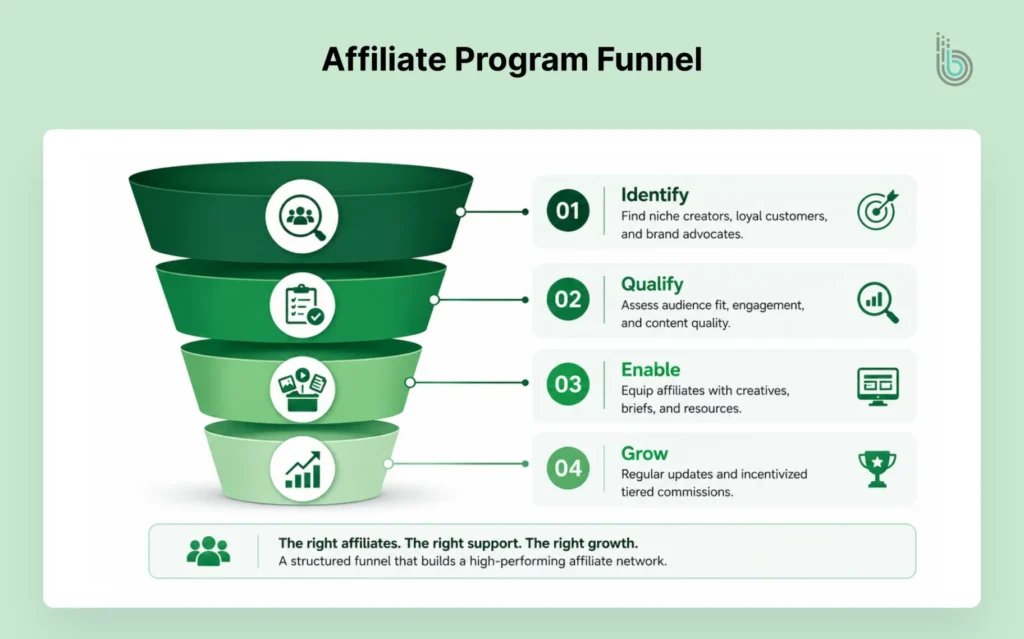
Give affiliates what they need to succeed. Provide ready-made creatives: banners, product photos, and copy snippets. Affiliates with better assets and briefs convert more effectively.
Communicate consistently. Don’t keep your Shopify affiliate programs silent. Send monthly updates on top performers, new products, or seasonal campaigns to keep affiliates engaged and active in promotions.
Segment and incentivize top performers. Apply a tiered commission system, offering higher rates to high-volume affiliates. With a sense of competition and rewards, it raises performance standards for your affiliates.
Let’s move on to the common pitfalls eCommerce store owners face when creating Shopify affiliate programs.
Common Mistakes That Quietly Kill Shopify Affiliate Programs
There are predictable, avoidable reasons behind a failed Shopify affiliate program. Here’s what to look out for:
Misaligned Commission Rates
If you set the commissions too low, it gives the affiliates no incentive. Whole setting them too high ruins your margins. Calculate your break-even cost per acquisition first, then set commissions within that ceiling. Revisit quarterly as your costs and profits change.
Going Silent After Approval
Without a basic onboarding sequence (welcome email, resource kit, first-month check-in, and follow-ups), your affiliates may go dormant. Treat affiliate communication like customer retention.
With only about one-tenth of affiliate content including disclosure statements, merchants should provide clear onboarding, disclosure guidelines, and compliance expectations to help affiliates promote products transparently.
Error-Prone Tracking Setup
Any error in tracking results in lost commissions, which in turn erodes trust among affiliates. Configure and test tracking links before launch and verify that purchases are attributed correctly.
No Fraud Protection in Place
Shopify affiliate programs may face many profit-draining issues if you’re not careful, including coupon stacking, self-referrals, and cookie stuffing. Most apps have built-in fraud detection; you just need to make sure it’s enabled. Lastly, set rules to prevent the same customer from being attributed to multiple affiliates within a single session.
Friction-Heavy Signup Flows
You’re likely to lose potential affiliates if your application takes more than five minutes. Ask only what you need for approval; additional information can be collected during onboarding.
Short Attribution Windows
There are specific cookie durations that should be set for different product types: 7 days for impulse-buy products and 30 to 90 days for high-ticket items. It’s both unfair and detrimental to retention when an affiliate loses credit for purchases they influenced.
Ignoring Disclosure Requirements
Affiliates and brands should clearly disclose their relationship whenever they earn commissions from recommendations. The FTC requires material connections between endorsers and advertisers to be disclosed clearly and conspicuously.
This brings us to the end. We have discussed the benefits, process, strategies, and common mistakes; now it’s time to bring it all together.
Bottom Line
A Shopify affiliate program is one of the few marketing channels where your cost is always proportional to your return. With the right commission structure, a capable app, precise tracking, and active affiliate communication, the returns compound over time.
Start focused. Pick one app, recruit a small group of well-matched affiliates, and optimize from there. True success in affiliate marketing isn’t determined by the scale or complexity of the program. Instead, it comes from mastering the basics and putting them into action.
If you need additional guidance, you can consult with our Shopify eCommerce development experts.
Frequently Asked Questions
1. Does Shopify have its own affiliate program?

No, Shopify doesn’t include built-in affiliate management for merchants. To create and manage an affiliate program for your store, you’ll need an affiliate app such as UpPromote, Shopify Collabs, or Tapfiliate.
2. How much commission should I offer affiliates?
Physical products: 5 to 15%. Digital products: 20 to 40%. Calculate your profit margin first, then set the commission below your break-even Cost Per Acquisition.
3. Which is the best Shopify affiliate app?
Depends on your current scale and needs. Beginners: UpPromote. Budget stores: Affiliatly. Creator partnerships: Shopify Collabs (free). Scaling brands: Tapfiliate. Referral + affiliate combo: ReferralCandy. There’s no single winner.
4. Can I run referral and affiliate programs together?
Yes, and many Shopify stores do. Affiliates bring in new audiences; referral programs activate your existing customers. Apps like ReferralCandy handle both. They solve different problems and don’t compete with each other.
5. How are affiliate sales tracked on Shopify?
Through unique tracking links generated by your affiliate app. When a customer clicks the link and makes a purchase within the cookie window, the sale is attributed to that affiliate. Most apps also support coupon-based tracking as a backup.
6. Is Shopify Collabs free?
Yes. Shopify Collabs is free for Shopify merchants. It’s built natively into the platform and designed for creator and influencer partnerships. Limitations exist on advanced commission logic, but for straightforward programs, there’s no added cost.
7. Can small Shopify stores start affiliate programs?
Absolutely. Apps like Affiliatly are priced for small stores, and Shopify Collabs is free. Start with 5 to 10 niche affiliates rather than chasing scale. A focused small program outperforms a bloated one with low-engagement partners.
8. What is the best cookie duration for affiliate tracking?
30 days is the standard starting point. For higher-ticket or considered purchases, go 60 to 90 days. Shorter windows mean affiliates don’t get their cut for the purchases they made possible. Match duration to your average buyer decision timeline.