Composable Commerce: A Complete Guide for eCommerce Business Owners
Quick Summary
Composable commerce is a unique way to build eCommerce stores by selecting tech components from different vendors and connecting them via APIs.
With composable commerce, you can ensure robust flexibility, create unparalleled user experiences, and make your store future-proof.
It offers faster innovation for businesses, better performance for development teams, and omnichannel experiences for marketers.
AI-powered personalization, edge computing, and low-code integration tools are the top trends you should look for when considering a composable development approach.
With rising competition and an ever-changing digital commerce landscape, we see new trends almost every year. One of the industry’s leading trends is composable commerce, and it’s here to stay.
Composable commerce allows you to create efficient eCommerce solutions by combining different technologies. This offers immense flexibility and scalability to businesses. That’s why 80% of enterprises have already adopted or are considering using a composable commerce approach.
If you are not leveraging a composable architecture in your eCommerce business but want to, then this is the right place for you. Here, we are going to explore the fundamentals of composable commerce, how it works, its benefits, and how it differs from traditional commerce.
What is Composable Commerce?
Composable commerce is a modern development approach to creating eCommerce tech stacks by combining best-of-breed components. You can select different tech components for different business functions and integrate them into your store via APIs. It follows the MACH (Microservices, API-first, Cloud-native, and Headless) architecture.
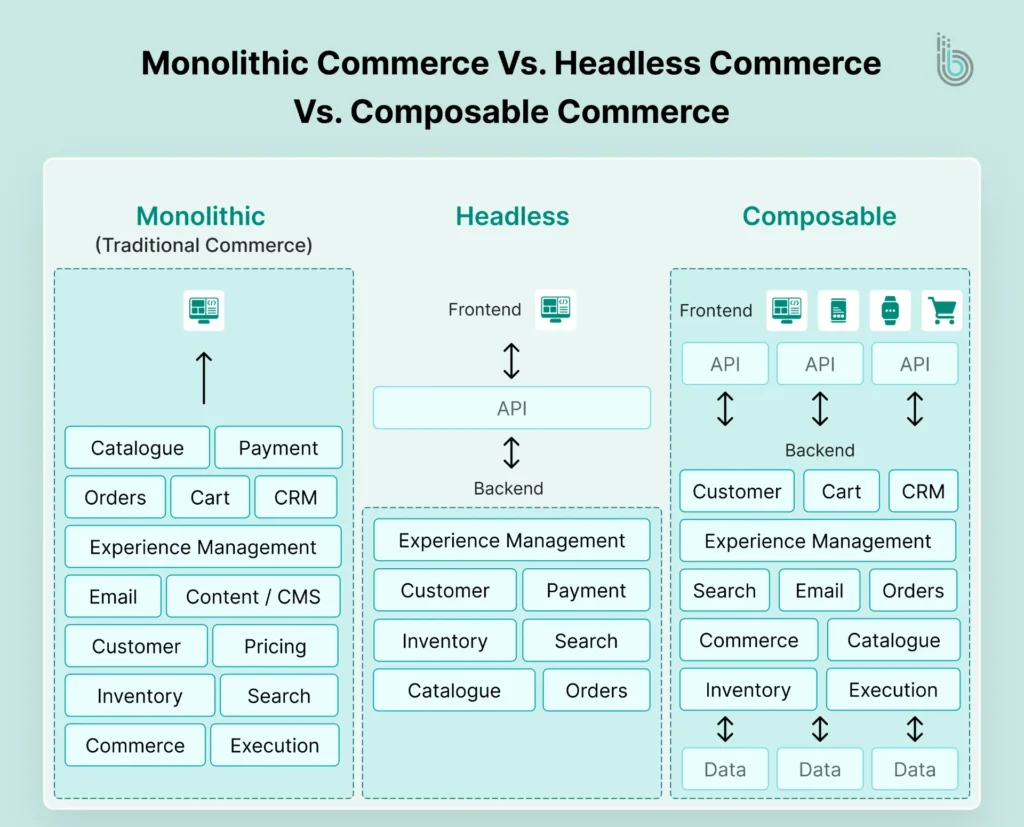
While composable commerce may sound similar to headless commerce, it’s not. Headless commerce separates the frontend from the backend, so you can leverage the power of two technologies. Composable commerce integrates components to deliver the best of each world.
Use Cases
Composable architecture is suitable for eCommerce brands that operate across multiple digital commerce channels and need fast performance. Here are some ideal use cases:
Retailers & D2C Brands: Modern fashion and accessories brands need tailored customer journeys to ensure maximum conversions. Composable architecture can help set up custom experiences and offer personalized product recommendations.
Enterprises with Large Portfolios: Organizations or large-scale enterprises that own multiple brands can manage operations easily.
Wholesalers & Distributors: Wholesalers often handle a large product catalog and numerous orders. With composable commerce, they can manage bulk ordering, apply dynamic pricing, and store vendor/customer data in one place.
Understanding MACH Architecture
Headless and composable architectures were popularized by the MACH Alliance in 2020. Since then, both architectures have revolutionized the industry.
MACH is an acronym for Microservices, API-First, Cloud-Native, and Headless. These are 4 core principles of headless and composable architectures. Here’s what they mean:
Microservices: Independent software modules are called microservices. They are created by different vendors to perform specific eCommerce tasks, such as product catalogs, payments, and logins. Vendors often combine different microservices and sell them as a bundle (also called “packaged business capability”).
API-First: The core of a composable approach is connecting microservices and making them work together. APIs make that possible here.
Cloud-Native: Composable architectures are popular for their scalability. This scalability comes from using cloud infrastructure. So, whenever demand surges, cloud services can provide you with additional resources instantly.
Headless: A headless architecture separates the head (frontend) from the body (backend). So, you can create a unique digital experience across web, mobile, and other devices while using the same backend tech stack.
How Does Composable Commerce Work?
Composable architecture works by breaking down different eCommerce functions into smaller services. These services are like blocks that can be assembled. Every service communicates with the others via APIs. Here’s a detailed explanation of how it works:
1. Choose Technology Components
Monolithic architecture restricts you to a single technology or platform, limiting growth. But a composable architecture allows you to choose different solutions for every requirement.]
The first step in developing a composable eCommerce store is choosing the right services for every function. Here are some critical functions you need to consider:
Inventory Management: Track and update inventory levels in real-time.
Order Processing: Manage the entire order lifecycle, from order placement to fulfillment and returns.
Payment Processing: Manage all payment-related tasks easily.
Shopping Cart & Checkout: Handle all tasks related to shopping cart and checkout, like adding items to the cart, calculating shipping charges, etc.
2. Connect Services Via APIs
APIs are the soul of the composable commerce architecture. They enable communication between independent services in a composable architecture.
Use API orchestration to integrate multiple services and ensure smooth data exchange between components. You can rely on API gateways or middleware solutions to handle authentication, permissions, and data synchronization.
3. Ensure Powerful Security Measures
Your composable commerce store will include microservices from various vendors, so a strong security solution is necessary to prevent fraud and secure customer data. Generally, eCommerce store owners integrate single sign-on to implement authentication across different platforms and multi-factor authentication to prevent fraudulent transactions.
A centralized Customer Identity and Access Management (CIAM) system can help you manage user identities, profiles, and access permissions.
Benefits of Composable Commerce
Flexibility and scalability are the two major advantages of using a composable eCommerce architecture. However, the concept offers something for everyone. Here’s how different parties can benefit from a composable solution:
Benefits for Business Owners
Business owners look for scalability when looking for an eCommerce solution. Composable architecture fits best here. Apart from this, here are some top benefits business owners can get:
Faster Innovation: Composable commerce breaks traditional monolithic architecture into independent services. This helps you experiment and deploy new features without affecting the whole system.
Reduced Vendor Dependency: With a composable platform, you can replace traditional “all-in-one” systems with a “best-of-breed” approach. Instead of relying on a single vendor for all functionalities, you can combine products from different vendors. You don’t need to be dependent on one vendor.
Future-Proof Architecture: As new technologies and systems are introduced to the market, you need to ensure your online store stays aligned. A composable architecture is suitable here because it allows you to replace or upgrade specific components without disrupting the entire system.
Benefits for Developers
Composable architecture can help development teams boost productivity and reuse code blocks. Here are some other advantages:
Independent Deployments: Developers can integrate and deploy individual components or services in composable stores. They don’t need to deploy the entire application, saving time.
Better Performance: Composable architecture improves developer performance as it allows faster deployment via reusable, modular components.
Cloud Elasticity: As composable commerce contains various services for each function, developers can easily leverage cloud elasticity to handle traffic spikes without manual intervention.
Benefits for Marketers
The “best-of-breed” technology approach and the flexibility of composable commerce help marketers achieve faster time-to-market and optimized speed. Here are some other benefits they can get:
Omnichannel Experiences: With different tech components, marketers can create unique customer experiences across web, mobile, and other devices. A composable commerce solution allows them to deliver robust omnichannel experiences while maintaining high-speed performance.
Personalization: Marketing teams can access customer data in real time with composable commerce. Additionally, they can integrate different CRMs, CDPs, and AI tools to personalize experiences based on customer needs.
Faster Experimentation: The modular, API-driven approach of composable architecture helps you test new channels and tools faster than traditional systems. So, you can try multiple options without affecting the whole system.
Composable Commerce Vs. Traditional Commerce
Composable and traditional monolithic architectures differ significantly. They both have their own advantages and disadvantages. Comparing them will help you choose the right solution for your eCommerce store.
To help you, we have given a detailed comparison of both concepts here:
Architecture
A composable architecture consists of various autonomous services (microservices). Every service supports a particular eCommerce action.
A monolithic eCommerce platform contains everything under one roof. You can ensure centralized management of different functions.
Verdict: For easier operations management, you can consider a monolithic architecture, but it may limit scalability and innovation.
Flexibility & Scalability
Composable commerce is a cloud-native architecture, so it can provide additional resources during peak traffic hours. You don’t need to manage servers manually or handle system crashes.
A traditional commerce platform usually requires an on-premise setup, which is difficult to scale. Additionally, on-site server setup will require significant physical space.
Verdict: Composable architecture is the best approach to ensure complete flexibility and robust scalability as needed.
User Experience
Composable architecture separates the user interface from the operations. So, you can adapt your services based on user preferences without affecting other workflows.
In monolithic architecture, you have to use the built-in features offered by the platform. Here, you have limited freedom to create unique solutions.
Verdict: To create exceptional user experiences across different customer touch points, consider using a composable architecture.
Composable Commerce Trends
Given the benefits of composable architecture, many businesses are switching to it. It is becoming a mainstream ecosystem for eCommerce brands.
As more businesses adopt it, we see new innovations introduced in composable commerce every year. Here are some top trends you should consider:
AI-driven Personalization: As the competition grows in every industry, AI personalization has become a norm. It’s not just a “nice-to-have” today. By integrating multiple generative AI tools and workflows into one place, you can deliver hyper-personalized experiences to customers.
Edge Computing: Edge computing reduces latency and improves page load times. It helps improve conversions and revenue.
Low-code Integration Tools: Low-code integration tools are best suited for feature enhancements in eCommerce. Even non-technical users can integrate and customize these tools, ensuring faster time-to-market.
If you want to build a composable eCommerce store along with implementing the latest trends, BrainSpate can help. Our experts specialize in creating custom headless and composable architectures. Contact us for eCommerce consulting services and make the right decisions before investing in composable architecture!
Composable commerce is a revolutionary innovation that offers a smarter, faster way to deliver exceptional customer experiences. Additionally, it provides full control over your tech stack and functionality.
Using composable architecture will help you ensure fast load times, upgrade systems without hassle, roll out new features rapidly, and stay ahead in the market. It’s the future, and implementing it now will help you make your business future-proof.
FAQs
Q1. How does composable commerce differ from traditional eCommerce platforms?
Traditional (monolithic) eCommerce platforms offer a single, all-in-one suite for every task. Composable commerce uses a modular architecture in which multiple technology components are integrated to support different business functions.
Q2. Why is composable commerce becoming popular?
Composable commerce is gaining popularity because it enables businesses to integrate various microservices in one place and ensure faster innovation.
Q3. What are the challenges of implementing composable commerce?
There are many challenges in implementing composable commerce, such as higher cost, complex integration processes, and the need for expert developers.
Q4. How to choose the right composable commerce tools?
When choosing tools for a composable eCommerce store, look for the vendor’s ecosystem of integrations, their industry experience, and ability to support future migration activities.
Q5. Who should consider using composable commerce?
Composable commerce is best suited for businesses that require high flexibility, speed, and freedom of customization. Companies experiencing traffic surges or considering expansion into new markets should implement a composable architecture.