Disconnected systems often slow down order fulfillment and inventory management and can even impact the customer experience. That is especially true if you are scaling up your eCommerce operations. Integrating your eCommerce website with SAP could solve that.
The primary purpose of this integration is to synchronize critical data in real time to improve operational efficiency and deliver a unified customer experience.
This blog focuses on the eCommerce integration with SAP, its benefits, types, and the best approach. But first, an overview of what SAP is.
Brief Overview of SAP
SAP is a global leader in ERP solutions. You can use it to manage core business functions like finance, supply chain, inventory management, manufacturing, procurement, HR, and customer data within a unified database. It unifies data for real-time visibility, improved operational control, and data-driven decision-making.
Key Features of SAP
Enterprise Resource Planning: Unifies core business operations such as product procurement, inventory management, supply chain, and finance.
Real-time Data Processing: You have instant access to accurate business data for faster decisions.
Scalable Architecture: With SAP, you can scale up the business without disrupting the existing operations.
Advanced Analytics & Reporting: Includes a built-in analytics dashboard and reports actionable insights.
Customer Data Management: Offers a unified view of customer information across the sales channels.
Automation & Workflow Management: Reduces manual tasks by automating business processes.
Financial Management: Provides accurate accounting, compliance,and financial transparency.
eCommerce businesses can use platforms like SAP S/4HANA for complex, high-volume operations.
Benefits of eCommerce Integration with SAP
Integrating SAP within your eCommerce website automates the data flow and reduces errors from manual data entry. Plus, you get real-time inventory sync, so there are no stockouts or overstockings. Let’s look at these benefits and more in detail.
B2B vs B2C eCommerce With SAP
When it comes to using SAP, the difference between B2B and B2C isn’t just about the end-user. There are some fundamental differences based on the data model, workflow complexity, and more.
For B2B, SAP ensures contract-based pricing, bulk ordering, customer-specific catalogs, and approval workflows. With the SAP Business One eCommerce integration, B2B businesses can get real-time inventory changes, negotiated pricing, credit limits, and recurring orders. All in all, they get better operational efficiency and seamless backend automation.
B2C eCommerce, on the other hand, is driven by scale, performance, and customer experience. With the eCommerce SAP integration, B2C businesses can manage high-volume orders, real-time inventory, stock updates, dynamic pricing, and faster fulfillment.
You can deliver a smooth, personalized shopping journey while ensuring well-synchronized backend processes, such as inventory and logistics.
Basically, B2B prioritizes complexity and control, while B2C prioritizes volume, agility, and customer experience. And SAP integration can ensure the best results for both.
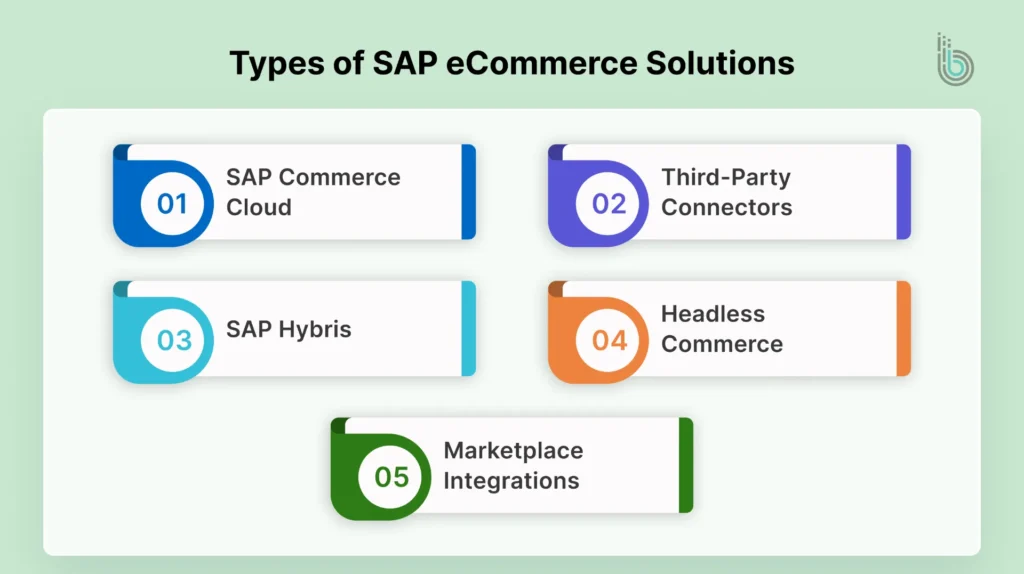
Types of SAP eCommerce Solutions
Choosing an SAP eCommerce solution feels like picking shoes–what works for one business might be uncomfortable for another. Let me walk you through the options that have worked for different companies.
SAP Commerce Cloud (The All-in-One Option)
SAP Commerce Cloud is a flagship platform that handles everything from product listings to checkout. I like it because it connects seamlessly with other SAP systems. A client who switched to it cut their order processing time from hours to minutes. But fair warning – it’s a big commitment that works best for established businesses.
Third-Party Connectors (The Flexible Choice)
If you’re happy with Shopify or WooCommerce but need SAP integration, this is your path. We helped a boutique retailer with Shopify integration with SAP in about 6 weeks. They kept their familiar interface while automating inventory updates. You’ll need some technical help, but it’s more affordable than rebuilding your whole store.
SAP Hybris (For Complex B2B Needs)
Though now part of Commerce Cloud, Hybris still powers many B2B operations. One manufacturing client uses it to handle customized product configurations and tiered pricing for distributors. It’s robust but can feel overwhelming if you don’t need all its features.
Headless eCommerce (The Tech-Savvy Approach)
Headless eCommerce delivered wonders for a client seeking a unique customer experience. They kept SAP as the backbone but built a blazing-fast custom storefront. It’s like having a sports car body on a reliable engine. Just be ready for higher development and maintenance costs.
A client selling on Amazon and their own site used this to stop overselling. Now, when an item sells anywhere, SAP updates all channels instantly. It eliminated those embarrassing “Sorry, we are out of stock” emails.
There’s no perfect solution – just what’s perfect for your situation. Start by listing your must-haves and nice-to-haves. Most businesses we work with begin with integrations to their existing store, then evolve as they grow.
Keep checking in to ensure everything continues to work as your business grows. And if you want professional help with that, hire dedicated eCommerce developers.
Types of SAP ERPs for eCommerce Integration
If you’re running an online store and using SAP in the background, knowing which ERP version you have matters a lot. Not all SAP systems work the same way with eCommerce platforms.
Some are built for big enterprises, others suit small businesses better. Let’s break down the most common SAP ERPs used for integration in simple terms.
SAP ECC eCommerce Integration
This is the older but still widely used version of SAP’s ERP system. It handles core functions like finance, inventory, and order management. Many businesses stick with it because it works well for complex operations. If your company isn’t ready to upgrade yet, this is probably what you’re using.
S/4HANA eCommerce Integration
This is SAP’s modern ERP system built for speed and real-time data processing. It’s designed with digital transformation in mind, making it a solid match for today’s eCommerce needs. Companies upgrading often choose this for smoother, faster integrations. If you want future-proof tech, this one’s worth considering.
SAP Business One (B1) eCommerce Integration
Smaller businesses usually go with SAP B1 because it’s more affordable and easier to manage. While not as powerful as ECC or S/4HANA, it still supports basic eCommerce connections. If you’re a mid-sized company selling online without huge complexity, this might be your best fit.
Choosing the right SAP ERP depends on where your business is and where it’s headed. Whether it’s the power of ECC, the speed of S/4HANA, or the simplicity of SAP B1, there’s a solution that fits your eCommerce goals. The key is finding the right balance between functionality, cost, and future growth.
Each of these platforms has its own strengths when connecting to SAP. So get our eCommerce consulting agency, and we’ll help you pick the right solution that matches your business size, technical resources, and how deeply you need to integrate with SAP.
Wrap It Up
Connecting your online store to SAP changes how your business runs—for the better. Imagine never having to manually update inventory between systems. The automation saves time while giving you more accurate data to work with.
It’s true that setting up the integration takes some effort upfront. But once it’s running, you’ll notice the difference immediately: fewer mistakes and more time to focus on growth. For businesses scaling up, this connection often becomes essential rather than optional.
Ready to streamline your operations with seamless SAP eCommerce integration? Connect with us today!
FAQs on eCommerce Integration with SAP
Q1. What is SAP integration in eCommerce?
SAP integration connects your online store with your backend ERP system. It keeps your inventory, orders, and customer data in sync. This helps automate workflows and reduce manual work. Basically, it makes your systems talk to each other.
Q2. Why should I connect my eCommerce store to SAP?
u003cbru003eIf your store and SAP aren’t connected, you’re likely doing double work. Integration saves time and avoids errors by syncing key data. It also improves order accuracy and customer experience. Everything runs smoother with fewer surprises.
Q3. Which SAP systems work best with eCommerce platforms?
It depends on your business size and setup. SAP S/4HANA is great for large enterprises. SAP Business One fits small to mid-sized companies. SAP ECC still works for many, but is being phased out for newer solutions.
Q4. Can SAP handle multiple eCommerce channels?
Yes, and that’s one of its biggest strengths. Whether you’re selling on your website, Amazon, or retail, SAP can pull it all together. It keeps your operations centralized and less chaotic.
Q5. Do I need coding knowledge to integrate SAP?
u003cbru003eNot always. If you use a middleware or pre-built connector, the heavy lifting is done for you. But for custom workflows or advanced setups, some technical help is needed. A tech partner can make it smoother.