Imagine a customer likes an ad for your product and clicks on the link to buy it, but your site says the item is “Out of stock”. That is not a good impression for your business. That’s why you need eCommerce data management.
eCommerce data management collects, unifies, and governs all product, customer, and operational information across the channels. With the data collected and unified, you can ensure personalized marketing, reliable inventory tracking, and seamless customer experiences.
With this blog, we’ll explore what eCommerce data management is, its key types, benefits, challenges, integration, and more.
What is eCommerce Data Management?
eCommerce data management is the method of collecting, validating, and leveraging all data and information generated by an eCommerce business. It covers data points like:
Product Information: Details like SKUs, descriptions, images, specifications, and pricing.
Customer Data: Information from purchases, accounts, and behavior, such as browsing history and cart activity.
Transactional Data: Records of orders, returns, and payment histories.
Operational Data: Inventory levels, supply chain logistics, and fulfillment statuses.
Data management unifies these key data points into a single, accurate source of information. This information helps with personalized marketing, inventory forecasting, seamless customer checkout experiences, and much more.
Why eCommerce Data Management Matters
eCommerce data management is a competitive strategy rather than just a backend technicality. Managing product data, customer data, and more effectively has a direct impact on the revenue, customer loyalty, and operational efficiency.
Proper data management helps create hyper-personalized marketing campaigns focused on conversions. With it, customers can get accurate product details, relevant recommendations, and a seamless checkout process.
Data management also serves as the operational foundation for business intelligence. Clean, unified data offers accurate forecasting, strategic inventory allocation, and a way to identify profitable trends and eCommerce business ideas.
Conversely, poor data management results in costly fulfillment errors, misleading financial reports, and a fractured customer experience.
All in all, this critical backend process turns raw information into a strategic business asset. But what kind of eCommerce data is managed through this process?
Types of eCommerce Data Management
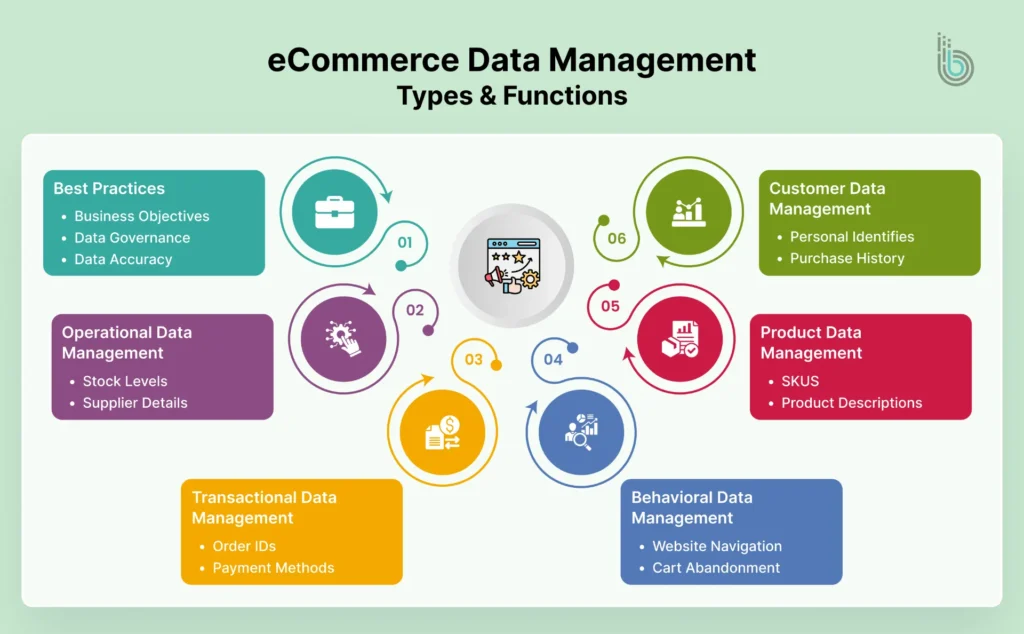
For perfect eCommerce data management, you first need to understand the different types of information your business handles. Here are the core types of eCommerce data:
Customer Data Management
With customer data management, you collect and centralize all the information related to your customers. In eCommerce, it goes beyond basic contact details and creates comprehensive buyer profiles.
Key Highlights
Personal identifiers (Name, Email, etc.)
Contact information
Purchase history
Communication preferences
Customer service interactions
Primary Use: With it, you can do personalized marketing, run targeted loyalty programs, and offer superior customer support.
Product Data Management
eCommerce product data management unifies and manages all available information describing the products in your inventory. For this type of data management, accuracy and consistency are non-negotiable.
Key Highlights
Stock Keeping Units (SKUs)
Product titles and descriptions
High-quality images and videos
Product specifications (size, color, weight, material, and more)
Product pricing
Inventory levels
Primary Use: Product data management ensures a trustworthy shopping experience. It powers site search, filters, and feeds product listings across all sales channels.
Transactional Data Management
This category covers the customer from a financial standpoint. It tracks the entire financial record of a purchase, from the order placement to the final fulfillment.
Key Highlights
Order IDs
Timestamps
Products purchased
Product Quantities
Product Prices
Payment methods
Taxes & shipping
Order status
Primary Use: This category is critical for financial reporting, revenue tracking, and sales trend analysis. You can also manage the post-purchase customer journey.
Behavioral Data Management
This data showcases how users interact with your digital storefront before purchasing a product. It also helps you understand why they are switching to your competitors. You can uncover the intent and potential friction points.
Key Highlights
Website navigation paths
Pages visited
Products viewed
Time on site
Click-through rates
Cart abandonment triggers
Primary Use: With this category, you can explore website UI/UX improvements and drive retargeting campaigns. It can help optimize the conversion funnel.
Operational Data Management
In this category, you handle the backend information to keep your business running smoothly. It’s often integrated with inventory and supply chain systems.
Key Highlights
Real-time stock levels
Supplier details
Shipping carrier information
Warehouse storage locations
Delivery tracking
Primary Use: With this management, you can prevent overselling, optimize inventory turnover, and streamline eCommerce fulfillment. Plus, it provides accurate delivery estimates to customers.
These data types ensure your store is ready from all data perspectives. But to get this data accurately, it’s important to understand eCommerce analytics and leverage it for your store.
Top Tools for eCommerce Data Management
To analyze, centralize, and protect the valuable eCommerce data points showcased in the previous section, you will need some top tools. They can help your business streamline its operations. Let’s look at the leading solutions one by one.
Customer Data Platforms (CDPs) & CRM Tools
A CDP creates a unified customer database by collecting data from every touchpoint. Marketing professionals use it to assemble behavioral data into a single customer profile.
Key Features
Real-time Segmentation: These tools dynamically group customers based on their immediate actions and attributes.
360-Degree Customer View: These tools unify data from web, mobile, email, and POS into a single profile.
Cross-channel Activation: With these tools, you can export segments to email tools, advertising platforms, and even helpdesk software.
Used for: With CDP tools, businesses can understand the complete journey of each customer. That helps deliver hyper-personalized marketing and customer experiences.
Top CDP & CRM Tools: HubSpot, Salesforce, and Twilio Segment.
Product Information Management (PIM) Systems
An eCommerce PIM system acts as the single source of product information. It centralizes sales, marketing, and technical data for accuracy and consistency across all sales channels.
Key Features
Channel-specific Optimization: Optimize product descriptions, images, and specs tailored for marketplaces.
Centralized Product Hub: A single repository for all product data, taxonomy, and digital assets.
Automated Workflows: Streamline the process of approving, updating, and syndicating product information.
Used for: With these tools, you can manage complex catalogs and speed up the time-to-market for new products. And you can ensure a consistent branding experience across all sales channels.
Top PIM Tools: Pimcore, Akeneo.
Data Integration & ETL (Extract, Transform, Load) Tools
Data integration tools automate the process of extracting data from disparate sources. That transforms it into a clean, uniform format and loads it into a central database.
Key Features
Data Transformation Engine: Standardizes, cleans, and blends data from different sources.
Connector Library: Pre-built integrations for popular eCommerce platforms, CRMs, and networks.
Scheduled Automation: Runs data syncs on a regular schedule without manual intervention.
Used for: Breaking data silos by automating reporting and creating a reliable foundation for analytics and business intelligence.
Top Data Integration Tools: Fivetran, Stitch Data.
Data Security & Compliance Tools
Data security and compliance tools protect sensitive customer and business data. They also ensure adherence to legal and regulatory standards like GDPR, CCPA, HIPAA, and PCI DSS.
Key Features
Access Control & Auditing: Tracks all data access and manages user permissions.
Encryption & Tokenization: Secures data both at rest and in transit.
Compliance Automation: Scans for potential compliance violations and remediates them.
Used for: These tools help manage data security and privacy to build customer trust, prevent costly data breaches, and avoid legal penalties.
Top Data Security Tools: Vanta, OneTrust.
eCommerce Analytics & BI (Business Intelligence) Tools
eCommerce analytics and BI tools transform your unified data into actionable visual insights for eCommerce business intelligence. Beyond the basic reports, these tools deeply analyze performance, trends, and customer behavior.
Key Features
Ad-Hoc Reporting: Users can ask complex questions of their data without technical expertise.
Interactive Dashboard: Customizable views of KPIs (key performance indicators) like customer lifetime value (CLV) and conversion funnels.
Predictive Analytics: Forecasts sales, demand, and customer churn using historical data.
Used for: With analytics and BI tools, businesses move from reactive reporting to proactive decision-making. They can identify growth opportunities and operational inefficiencies.
Top Analytics & BI Tools: Google Analytics, Looker, and Tableau.
If enormous amounts of data are troubling you in managing your store, our eCommerce management services can help unify, clean, and use it for ultimate growth.
Best Practices for eCommerce Data Management
Using the right tool, like the ones shown above, is only half the battle won. You need to implement the proper practices to unlock the data’s actual value and make it a reliable asset.
Determine Business Objectives & Goals
First and foremost, align your data strategy with particular business goals. Are you trying to reduce cart abandonment, improve customer retention, or increase AOV (average order value)?
Defining these objectives first dictates what data to collect and how to organize it. The value you get from the data depends on the metrics you track.
Establish a Data Governance System
A data governance framework is the rulebook for your data ecosystem. It creates clear policies and procedures for how data is collected, stored, formatted, accessed, and used across the organization.
This system is how you maintain data quality, ensure regulatory compliance, and build a single source of truth.
Ensure Data Accuracy & Consistency
Customers won’t trust your e-store if product details, pricing, or inventory levels are inaccurate. Plus, these will result in operational failures.
So implement automated validation rules, conduct regular data audits, and enforce standardized formats across the channels. It can help maintain a consistent and reliable customer experience.
Appoint Data Stewards
Data stewards ensure the quality and integrity of specific data domains like product info, customer data, or transactional records. They assign accountability, so the data isn’t “everyone’s problem and no one’s responsibility.”
Use a Data Management Tool
You must avoid chaotic spreadsheets and siloed systems. For that, you can invest in a dedicated tool like a PIM or MDM (Master Data Management) system. They provide a central hub to consolidate, enrich, and control all product and customer information.
With these practices, you transform data from a passive record into a dynamic factor for growth and customer satisfaction.
eCommerce data management isn’t just about storing information. You need to use the right data and information at the right time for the right purpose. That’s why the future revolves around AI-driven autonomous systems. These systems help with proactive inventory management, optimized product content, and hyper-personalized buyer journeys.
What you need to do is unify data streams and create a single, dynamic customer view across the touchpoints. This trend shifts data management from a reactive maintenance task to a core strategic function. All this means active decision-making and deeper customer relationships.
FAQs on eCommerce Data Management
Q1. What is the primary goal of eCommerce data management?
The primary goal is to create a single, accurate source of all business information. The unified data helps with personalized customer experiences, reliable operations, and data-driven strategies.
Q2. How does poor data management impact customers directly?
Poor data management can lead to incorrect pricing and outdated stock information, which negatively affects the customer experience. This may lead to order cancellations, inconsistent product details, and irrelevant marketing messages.
Q3. Is data encryption a standard feature in eCommerce data management systems?
Yes, data encryption is a fundamental security feature in any reputable eCommerce data management platform. It doesn’t matter if the data is in transit or at rest. This feature is essential for protecting sensitive customer and payment information.