The global eCommerce market is expected to reach around $8 trillion by 2027. Yet, the majority of retailers fail within the first few months of their launch. This is because starting a successful eCommerce business requires more than just a storefront. You need to align the supply chain logistics, customer acquisitions, and the technical infrastructure.
The main goal of your eCommerce setup is to eliminate friction points in the online buying process. It should effectively bridge the gap between consumer demand and supply chain logistics.
This blog will show you how to start an eCommerce business, including choosing the right model, selecting products, and making it profitable. Let’s begin.
Why Start an eCommerce Business in 2026?
The eCommerce business model has existed for decades. In recent years, however, it has surpassed the trillion-dollar mark in market value, driven by a massive customer base fueled by convenience and advanced technologies.
Today, consumers can purchase products anytime and from anywhere. eCommerce offers this convenience and strives to deliver more personalized experiences by leveraging AI, AR, and advanced analytics.
Additionally, it’s easier to scale up an eCommerce website with new products and larger operations—without the massive physical expansion and overheads costs typically involved.
How to Start an eCommerce Business?
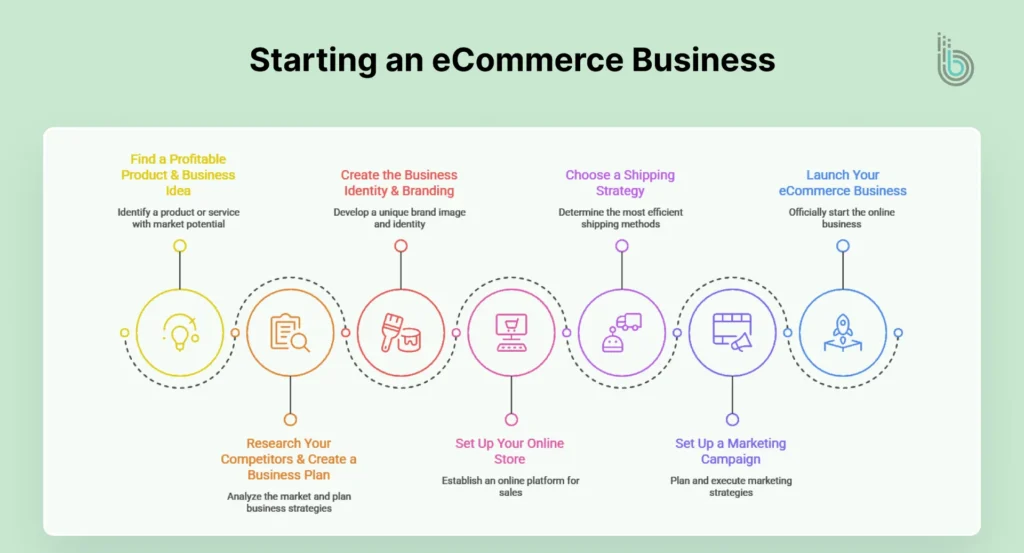
Starting an eCommerce business involves researching the products and your target audience, creating a business plan, building your online store, and launching it. This is how every business, no matter how big or small, beings selling its products and services online.
Find a Profitable Product and Business Idea
First, you need to decide what products to sell. Identify market gaps and address problems with new products. Of course, ensure you can make a profit. Here are some key points.
Select a Product
Solve a Problem or Target a Niche: Offer a product that solves a problem simplifies life, or cater to a passionate audience with a niche product.
Use Analysis Tools: Utilize tools like Google Trends and Amazon Movers and Shakers to discover popular products. Focus on products with rising popularity.
See if the product is profitable: Choose at least 3-4 products and analyze them based on several factors, such as:
Shipping: Is the product small and light to reduce shipping costs?
Cost: Can you source or manufacture it affordably?
Demand: Is there strong demand for it among the general public?
Profits: Can you sell the product for about 2.5 to 3 times its cost?
Start with a single product or a small, curated collection. Based on your findings, you can scale up.
Select a Business Idea
After choosing your product, you need to decide on an eCommerce business model. Do you want to set up your own store, work as an affiliate, or dropship the products? Also, will you sell the product B2B, B2C, or D2C?
Dropshipping is an eCommerce method where you sell products without holding inventory. Orders placed in your store are forwarded to the supplier, who ships directly to the customer. Popular dropshipping platforms include Shopify Collective, DropCommerce, and AI Dropship.
Alternatively, you can sell your products online through your own store (we’ll cover setup in a later step).
Research Your Competitors & Create a Business Plan
After selecting your products and business ideas, research your competitors to develop a comprehensive business plan.
Research Your Competitors
Competitive analysis involves understanding your competitors’ strengths and weaknesses while evaluating your own opportunities and threats. To Do this, gather and analyze data on competitor products, pricing, marketing, and distribution strategies, and customer base.
Several analysis approaches are popular, including:
SWOT Analysis: Analyze competitors’ strengths and weaknesses relative to your business to identify areas for improvement.
Porter’s Five Forces: This strategy helps assess whether your product is viable in the long term by considering five forces: competitive rivalry, new entrants, buyers’ bargaining power, suppliers’ bargaining power, and substitute products.
Strategic Group Analysis: Understand market segments based on price and product range. This analysis helps identify potential market gaps.
Create a Business Plan
After the research, you create a business plan highlighting what to focus on and when. You can also show your investors the core value of your brand.
To create the best eCommerce business plan, you:
Choose the business plan format.
Think about your audience.
Write a company overview.
List your products and services.
Do a market analysis.
Create a marketing campaign plan.
Plan the logistics and operations.
Create a financial plan.
Draft an executive summary.
With a good business plan, you can evaluate your business ideas and clarify your competitive advantage.
Create the Business Identity & Branding
Your business identity and branding include your name, visual design, and logo.
Business Name: Choose a unique business name that is easy to spell and relevant to your niche. Also, ensure a relared domain name is available.
Domain: Use platforms like GoDaddy, Hostinger, or others to find the best suited domain name for your eCommerce business.
Logo & Visuals: Tools like Canva can help you create a simple, professional logo using 2-3 colors and 1-2 fonts.
Color Palette & Fonts: Select 2-3 colors and 2 fonts that reflect your brand’s personality whether modern, rugged, luxurious, or something else.
Voice & Tone: Decide how you will communicate in your marketing messages. Will your tone be professional, friendly, inspirational, or another style?
After finalizing your name, logo, and domain, register your business and understand the associated taxes.
Set Up Your Online Store
After completing the planning and design stages, set up your online store—an easy-to-use, secure digital storefront. Optimize it for conversion, speed, and mobile responsiveness. Here’s how to start your store.
Find a target audience: First, identify the audience most likely to buy your product.
Source the products: Once your product is finalized, manufacture it or source it from wholesalers or a supplier networks like Collective.
Choose an eCommerce platform: Some of the top eCommerce development platforms are Shopify, Wix, BigCommerce and Magento. Choose between them based on ease of use, design options, scalability, performance, security, and pricing.
Set up the store basics: Start by filling out the domain address, selecting a theme or template, setting up user-friendly navigation, and creating a logo and other design elements.
Add your products: Locate the section to add the products on the platform and enter their key details.
Set up your checkout and shipping: Choose a payment service provider that balances transaction fees and features. Customize the checkout process, select a shipping carrier, and configure taxes.
Make your store live: After the setup process is complete, test the store and launch it with a limited number of products.
Key pages to set up include the Homepage, product pages, About Us page, FAQs/Shipping Info page, and a secure checkout page. After setting up your store, proceed to develop your shipping strategies.
Choose a Shipping Strategy
When it comes to shipping and fulfillment, you have two options: hold inventory or adopt dropshipping.
Hold Inventory: You store, pack, and ship the product yourself. This offers better control over quality and speed, but involves higher upfront costs.
Dropshipping: You don’t hold inventory. Orders are shipped directly to the customers by the supplier. This reduces risks and costs but results in slimmer margins and less control.
After selecting a shipping strategy, it’s time to set rates. You can offer free shipping, choose a flat rate, or calculate real-time carrier rates based on weight and destination at checkout.
Some of the top carriers include USPS, UPS, FedEx, eKart, Amazon Shipping, and more.
Set Up a Marketing Campaign
Now that everything is ready, you need to set up a pre-launch marketing campaign to generate early buzz. Here are a few strategies:
Build an Email List: Add a “Launch Soon” sign-up form on your website and offer a discount code to early subscribers.
Create a Social Media Presence: Open accounts under your brand name. Start posting BTS (behind-the-scenes) content, product teasers, and countdowns.
Prepare Initial Content: Write a few blog posts and create videos addressing a pain point and how your product solves it. Ensure all written content follows SEO guidelines.
Plan Your First Offers: Consider limited-time offers to drive initial sales, or set up a referral program to encourage customer recommendations.
For the best results, you can budget for paid ads on Instagram, Facebook, or TikTok, targeting your ideal customers to drive traffic at launch.
Launch Your eCommerce Business
Once your eCommerce business and its marketing strategy are ready, launch your store and make your first sale. Here’s your pre-launch checklist:
Test the entire purchase flow yourself and have a third party try it as well.
Ensure all links work and pages load quickly.
Set up eCommerce analytics (through Meta Pixel and Google Analytics) to track visitors.
Your store is ready now ready to go public. Send the launch email to your list, post on all social channels, and run your planned ads.
Remember, first impression matter. Your first customers should received excellent service, prompt answers to their questions, fast shipping, and positive reviews.
Success in eCommerce comes from continuous store optimization and maintenance. So you can hire our eCommerce development services to achieve the best results.
Turn your eCommerce idea into a high-performing online store with BrainSpate.
Work doesn’t stop once your eCommerce business is up and running. You need to implement a few key tips and practices to ensure its success.
Choose and Sell an In-Demand Product
Test multiple product ideas before fully investing. Use tools like Google Trends and Amazon Movers and Shakers to identify trending products. Ensure your chosen product solves a common problem or meets a niche-based demand.
Choose the Right eCommerce Platform
Select the most suitable eCommerce platform for your store by considering important factors such as:
Business requirements
Budget and costs
Ease of use
Scalability
Customization
Features
Integrations
Security & compliance
Support
Mobile-responsiveness & Performance
Some of the best eCommerce platforms include Shopify, WooCommerce, BigCommerce, Magento, and Squarespace.
Design the eStore to be Mobile-Responsive
Today, most eCommerce traffic comes from mobile devices because they offer greater convenience. Ensure the site looks good and functions well on mobile devices. This means fast loading, easy navigation, readable content, and thumb-friendly buttons. If there are issues with these elements can directly affect bounce rates, conversions, and search visibility.
Keep the Design Simple and Clear
Maintain a simple, minimal design free from clutter and unnecessary distractions. Modern customers prefer clean layouts with clear CTAs, helping them focus on products and purchasing decisions.
Use Schema Markup for Increased Search Visibility
With schema markups, search engines understand what your content and visuals, enabling rich results in the SERPs. These results include product ratings, prices, availability, and more This enhances search visibility, improves click-through rates, and helps you compete more effectively without excessive ad spending.
Implement A/B Testing for Better Conversion Rates
A/B testing can be a great way to experiment with different variations of product pages, marketing copies, layouts, checkout flows, etc. With data from these tests, you can make more informed decisions and improve conversions incrementally.
Keep the Checkout Flow Simple (One-Click Checkout is Preferable)
A complex checkout process may lead to more cart abandonment. So you need to simplify by using minimal form fields and supporting multiple payment methods. What might be even better is a one-click checkout. Try to narrow the gap between intent and purchase to boost conversion rates.
Don’t Rush the Launch
Starting an eCommerce business is no small feat. Even after the development, you need time to test functionality, payment flows, usability, and order fulfillment. Rushing this process may result in broken experiences and damaging credibility. Try a soft launch or a limited rollout to fix the issues before scaling traffic.
You Won’t Be Profitable Right Away
You need to understand that businesses don’t yield profits right away. In the early stages, you’ll have to invest in development, design, marketing, customer acquisition, and more. These will pay off later on. Initially, you should focus on learning and continuous optimization. To start with, the aim should be customer retention rather than immediate profits.
If you are not getting the results you expected, even after implementing all the right practices, get our eCommerce consulting services. We’ll analyze your business and recommend the best tips for the same.
Conclusion
Starting an eCommerce business is going to be an exciting journey. It’ll go from choosing your product and business model to store design and development, to launch, and to marketing. But for the best results, you will need a solid plan that lays out every aspect of the business, from the brand particulars and design technicalities to the products themselves.
Moving from planning to execution will require the right tools and guidance; it can make all the difference. So if you’re ready to bring your ideas to life, BrainSpate’s dedicated eCommerce services are what you need. We’ll help you build, launch, and grow your business the right way.
FAQs on eCommerce Businesses
Q1. How much does it cost to start an eCommerce business?
The cost of an eCommerce store will depend on platform fees, domain/hosting, marketing, payment transaction fees, legal fees, and the cost of sourcing inventory. A lean eCommerce business can be started with around $1000 (costs may fluctuate over time). But more advanced, professional stores will go beyond $5000, with higher ongoing expenses.
Q2. How long does it take to start an eCommerce business?
Launching an eCommerce business may take anywhere from a few weeks to months. But to make it profitable, you need around 1 to 3 years. The timeline will likely depend on the complexity, product, marketing, resources, and more.
Q3. What are the types of eCommerce Businesses?
A few of the main types of eCommerce are B2B (Business-to-Business), B2C (Business-to-Consumer), C2C (Consumer-to-Consumer), C2B (Consumer-to-Business), and D2C (Direct-to-Consumer).