Sellfy vs Shopify: Detailed Comparison for Online Store Owners in 2026
Quick Summary
While Sellfy and Shopify are both e-commerce platforms, the choice depends on your product type. Sellfy is for selling digital products (like e-books, music, and online courses), print-on-demand items, and more. Shopify is a more scalable platform for selling physical and digital products and services on a more unique-looking store.
Are you a creator or influencer trying to up your game with the audience? Selling cool, trendy merchandise can be a surefire way to do it. You need a website suitable for both POD (print-on-demand) and subscription models. This way, you can sell your merch and offer exclusive members-only content. That’s where a platform like Sellfy comes in.
Sellfy is an outstanding platform for setting up a quick eStore and selling subscriptions, digital products, and print-on-demand items. But when you want to sell anything online, isn’t Shopify the first platform to consider? Well, yes, thanks to Shopify’s user-friendliness and advanced features. But how do these two platforms differ?
This blog compares Sellfy vs Shopify on key factors and offers insights on which is better in which cases. But first, let’s look at what these platforms are and how they compare one-to-one.
Sellfy vs Shopify: Comparison Table
Factor
Sellfy
Shopify
Pricing
Starts from $22 per month.
Starts from $29.
Transaction Fees
No transaction fees.
Starts from 0.6%.
Ease of Use
Simple and beginner-friendly.
Easy to use but has a steeper learning curve for beginners.
Digital Products
Dedicated platform for selling digital products.
Can sell digital products but requires add-on extensions.
Design & Customization
Customization is limited; not as many themes as compared to Shopify.
Higher number of themes and custom coding for design personalization.
Payment Processing
PayPal and Stripe (options are limited).
Over 100 payment gateways are available and supported.
Marketing & SEO
Built-in tools for email marketing and discounts.
Built-in tools available for email marketing, social media integration, and more.
What is Sellfy?
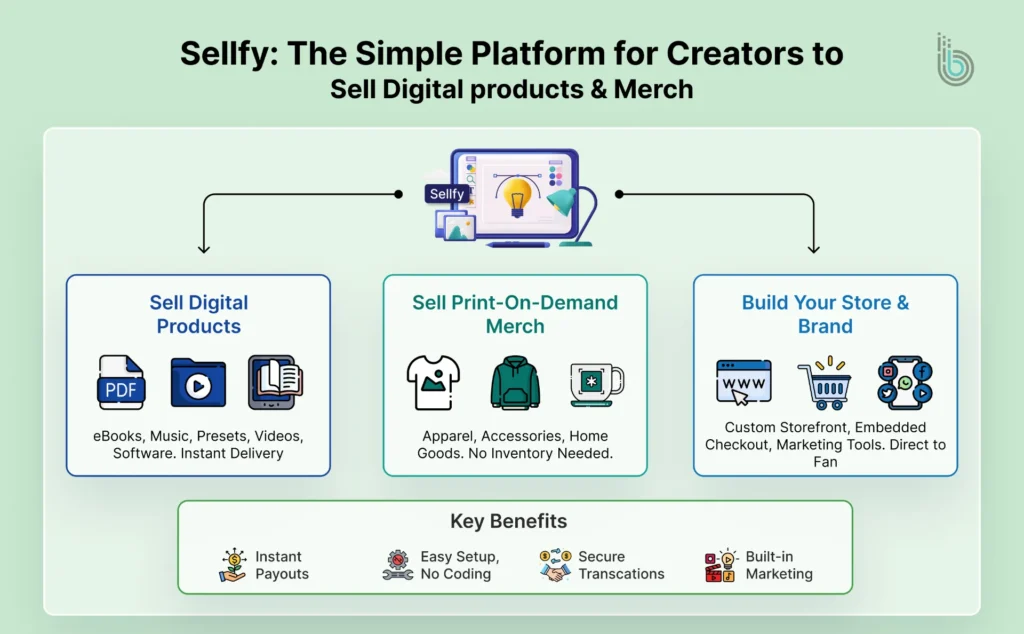
Sellfy is an all-in-one e-commerce platform perfect for selling digital products, subscriptions, and print-on-demand items. With Sellfy, individual creators, influencers, and freelancers can set up professional e-commerce stores to sell their offerings to their target audience in no time.
Unlike some of the other top e-commerce platforms, you don’t need a separate hosting for your Sellfy-based store.
This platform offers a drag-and-drop builder, automatic delivery for digital products, and basic marketing tools. If you are looking to start an e-store with minimal setup and reach your target consumers, Sellfy is a suitable option.
Key Features of Sellfy
Here are a few key features of Sellfy and how they help your online store.
Digital Products: Sellfy is a suitable platform for selling videos, eBooks, software, music, and more, with secure delivery.
Subscriptions: You can sell recurring, members-only content to your core audience.
Print-on-Demand: It’s a good platform for POD, so you can sell custom-designed mugs, bags, T-shirts, hats, and more.
Built-in Marketing Tools: It offers tools for email marketing, affiliate marketing, upselling, and more.
Advanced Built-in Analytics: Sellfy offers a dashboard to track and analyze your marketing results and more.
Abandoned Cart Recovery: With Sellfy, you can reduce abandoned carts by emailing customers who leave items in their carts.
Discount Codes & Upsells: You can increase average order value with discount codes and upselling to higher-value related products.
Customized & Hosted Storefront: Sellfy lets you create a completely customized storefront with built-in hosting. While you can personalize it with built-in themes, many brands utilize professional eCommerce web design services to create truly unique, custom designs tailored to their specific business needs.
Pros & Cons of Sellfy
Pros of Sellfy
Cons of Sellfy
✓ User-friendly setup and easy to use interface, even for the beginners. ✓ Perfect for creators and influencers trying to sell digital products and print-on-demand items. ✓ Secure built-in hosting and faster delivery for digital products. ✓ No transaction fees.
✗ Design and layout customization is limited as compared to Shopify. ✗ Basic e-commerce features suitable only for entry-level brands and creators. Shopify is better for larger entities. ✗ Not too many apps available for adding features and functionalities to the store. ✗ Limited payment options.
What is Shopify?
Shopify is arguably the biggest e-commerce development platform, with just under 30% market share (combined with Shopify Plus). This popularity stems from the advanced features Shopify offers for building fully functional online stores in no time.
With Shopify, you can manage your product catalog, handle payments and shipping, manage marketing and pricing, and much more. And all this can be handled while Shopify remains scalable and flexible for a growing store.
It has a steeper learning curve, which can be a little staggering for beginners. Those who prefer a more straightforward setup would go with Sellfy.
Key Features of Shopify
Here are a few key features of Sellfy and how they help your online store.
Drag-and-Drop Builder: Shopify is a drag-and-drop platform, so you can use the themes to create customized stores with ease.
Multichannel E-commerce: With Shopify, you can manage multichannel e-commerce operations. That includes social media, e-store, B2B marketplaces, and in-person (with Shopify POS).
Shopify Magic: Based on your given info, Magic provides content suggestions for product descriptions, customer emails, etc.
Sidekick: Sidekick is another AI assistant in Shopify that helps you build and manage an online store.
Payment Processing: You can integrate Shopify with multiple payment gateways for a smoother checkout experience.
Inventory Management: Shopify makes it easier to track and manage the stock levels across your online store and physical outlets.
Shipping Automation: This platform integrates shipping and label printing, with multiple carrier options, to streamline operations.
Analytics & Reporting: Shopify offers built-in analytics for real-time insights (e.g., sales, traffic, customer behavior) to optimize the store.
App Store: Shopify’s app store has thousands of apps to extend the store functionality and add new features.
Pros & Cons of Shopify
Pros of Shopify
Cons of Shopify
✓ Offers multichannel e-commerce, including physical stores, online marketplace, POS, social media, etc. ✓ Shopify app store includes thousands of apps and extensions to add new features to the store. ✓ There are hundreds, if not thousands, of themes available for Shopify. So you can design your store however you want. ✓ Offers advanced built-in tools for marketing and automation.
✗ Shopify has a stiffer learning curve for the beginners. ✗ More customizable apps and themes are often paid, which can add up your costs fairly quickly. ✗ Customization beyond built-in tools and apps requires coding know-how. ✗ Will have to pay transaction fees unless you use Shopify Payments.
So, do you think Shopify is suitable for your business enterprise? Then get our professional Shopify development services.
Detailed Differences Between Sellfy and Shopify
Now that you know what Sellfy and Shopify are, let’s compare them on some key factors one by one.
Ease of Use
Sellfy is an easy-to-use drag-and-drop ecommerce website builder. You can set up the online store and start selling your products in minutes. That too, without coding and with very minimal configuration (though that might be a downside for some). It’s ideal for creators and influencers looking for quick launches.
Shopify, on the other hand, has a steeper learning curve, but it still offers intuitive onboarding and an extensive dashboard. The complexity comes when you manage inventory, staff accounts, and multichannel e-commerce.
Verdict: Sellfy is a more user-friendly platform and offers faster setup.
Pricing
Sellfy pricing starts from $22 per month for the starter plan and goes up to $119 per month for the premium plan. Even with the lower-tier plans, you can have an unlimited number of products in your store, but there’s a $10k cap on sales and revenue per year.
Plus, there are no transaction fees, no matter the plan you choose. So the cost factor is limited to the selected plan.
Shopify pricing starts at $29 per month for the Basic plan and scales to custom pricing for Shopify Plus based on enterprise requirements. Shopify Plus pricing is available upon request. Unless you are using Shopify Payments, you will have to pay transaction fees, starting from 0.6%.
Moreover, integrating advanced features into your Shopify store will require premium apps, which will increase costs.
Verdict: For basic e-commerce stores, Sellfy is a more affordable option. While Shopify can be pricier, it’s also more scalable and customizable.
Design Customization
Sellfy offers a straightforward, theme-aided customization, but it’s limited to that. No coding is excellent for beginners, but it also means limited customization. With this platform, you focus on the core presentation rather than deep design flexibility.
Shopify, however, offers a wide variety of themes, and you can further personalize the design with our Shopify liquid cheat sheet. It ensures better control over design for building a unique storefront.
Verdict: Shopify is much better than Sellfy for design customization.
Digital Products
Sellfy is a dedicated platform for selling digital products, offering outstanding features. Like, file storage, instant delivery, PDF stamping, and built-in music and video previews. With this platform, you can easily handle subscriptions and instant downloads.
Shopify, on the contrary, is the top e-commerce platform that you can use to sell all kinds of products and services. But to sell digital products, you install a third-party app like Easy Digital Downloads. While it adds advanced features, it also means higher cost and complexity.
Verdict: Sellfy is better suited for selling digital products, as it’s natively optimized.
Payment Processing
Sellfy supports a range of top payment gateways, and no matter which plan you choose, there are no transaction fees. While payment transactions are streamlined, there are fewer gateway options available than on Shopify.
But with Shopify, there are over 100 payment gateways to choose from. However, regardless of the plan, transaction fees apply, starting at 0.6%. Plus, there’s Shopify Payments, this platform’s proprietary gateway option. Using it would incur ZERO transaction fees.
Verdict: Even though you have to pay transaction fees, Shopify is better for payment processing, thanks to more options.
Marketing & SEO
Sellfy offers built-in tools for upselling, discount codes, and email marketing. You can also integrate social media and SEO fundamentals to make your storefront ready for discovery and engagement.
Shopify, however, is well optimized for advanced SEO, social media, and other eCommerce marketing strategies. It’s suitable for building a scalable marketing campaign and optimizing it through analytics. Shopify can help you truly create an omnichannel approach.
Verdict: Shopify is more advanced for marketing tools and strategies.
Support & Security
Sellfy offers reliable customer support via live chat, emails, and a help centre. The platform manages security, hosting, and SSL so that you can focus on the core operations.
Shopify, however, offers 24/7 support through multiple channels. And, security-wise, you have PCI DSS Level 1 compliance, automatic updates, and SSL encryption. Your Shopify store will scale effectively and reliably.
Verdict: Shopify is more secure and better supported for both basic and enterprise-grade stores.
Based on this comparison, you’ll find that Sellfy is a suitable platform for beginners, such as creators and influencers. They can diversify by selling their products and merchandise to an already well-groomed audience.
But if you are an enterprise business or want a professional-looking e-commerce store, hire expert Shopify developers with BrainSpate. This platform, combined with our expertise, will be perfect for your business.
When to Choose Sellfy & Shopify?
Now that you understand how different these two platforms are, let’s look at when you should choose which platform.
Choose Sellfy if:
You or your business is more geared towards digital products like music, online courses, e-books, etc.
You want an affordable and easy setup for your store without technical issues.
You prefer not to pay extra fees for every transaction.
You are a creator or beginner entrepreneur who prefers ease over advanced customization.
Choose Shopify if:
You maintain a large, constantly evolving inventory of digital and physical products.
You plan to scale up your platform with more inventory, advanced marketing, analytics, and omnichannel sales.
You want to create a unique-looking store with better design customization and advanced Shopify apps.
You are building a long-term focused brand-oriented online business.
Sellfy is for digital-first sellers who value simplicity and purpose-built tools. And Shopify is for growth-focused merchants trying to build scalable online stores.
Wrap It Up
It’s not as simple as one or the other; there’s no universally “better” choice. The choice of platform depends on what kind of store you are trying to build.
Sellfy is a purpose-built platform for selling digital products, print-on-demand items, and subscriptions. It offers a fast, affordable experience so you can focus on creating and connecting with your audience.
But Shopify is for scalable, brand-driven businesses selling a mix of physical and digital products and services. And it offers greater flexibility and customization for creating a unique store. But it comes with a steeper learning curve and higher costs compared to Sellfy.
And if you want a completely custom-made store with a suitable platform, connect with us today!
FAQs on Sellfy vs Shopify
1. Is Shopify a Sellfy alternative?
No. Both platforms can create online stores. Shopify is a general e-commerce platform suitable for all types of digital and physical products and services. But Sellfy is dedicated to digital products, print-on-demand items, and subscriptions.
2. Does Shopify charge commission on every sale?
Yes, Shopify charges a transaction fee on every sale, starting from 0.6% for the starter plan. But you can avoid this fee by using Shopify Payments.
3. Which is cheaper: Sellfy or Shopify?
Sellfy, in general, is a cheaper platform, thanks to lower pricing and no transaction fees. Shopify can be more expensive for basic stores, but it offers perks like themes, apps, and a better UI for managing the store.
4. Who should use Shopify rather than Sellfy?
Using Shopify would be better than Sellfy for selling physical products and managing a large, complex inventory. Plus, you can ensure deeper customization, advanced marketing, and scalability for the store.