The number of people shopping online is constantly increasing. In fact, global eCommerce sales are expected to go beyond $8 trillion by 2027. Businesses actively evaluating eCommerce platforms often compare Magento vs BigCommerce.
Both are well-known, enterprise-level eCommerce platforms. One platform offers greater control but requires technical expertise. The other is easier to manage but may have limits as you grow. The real question is, should you choose Magento or BigCommerce based on your business goals, budget, and skills?
In this blog, we’ll explain everything and help you make the right choice. We’ll provide a complete overview of both platforms, including their pros and cons, and compare them on key parameters. So, let’s dive in!
Magento vs BigCommerce: Quick Comparison Table
Feature
Magento
BigCommerce
Platform Type
Open-source, self-hosted
Fully hosted SaaS
Customization
Deep, unlimited
Limited, theme-based
Control
Full control over hosting & data
Managed by platform
Ease of Use
Steep learning curve
Beginner-friendly
Scalability
High, supports large catalogs & multi-store
Scales well within platform limits
SEO & Marketing
Advanced, full control
Built-in
Best For
Complex B2B, multi-store global setups, and custom logic
High-growth stores wanting speed without tech maintenance.
Security
You handle patches, PCI compliance, and manual updates.
Level 1 PCI compliance and security patches are automatic.
Total Cost
$30,000-$150,000+ (First Year)
$5,000-$40,000+ (First Year)
Magento Overview
Magento is one of the best open-source eCommerce platforms built for serious online stores. Owned by Adobe, it gives you full control over design, features, hosting, and data. You can shape almost every part of your store, from checkout flow to product structure.
It supports global selling, multiple payment gateways, and SEO tools. It’s powerful, flexible, and best suited for businesses with technical expertise or access to developers.
Magento Pros and Cons
Pros
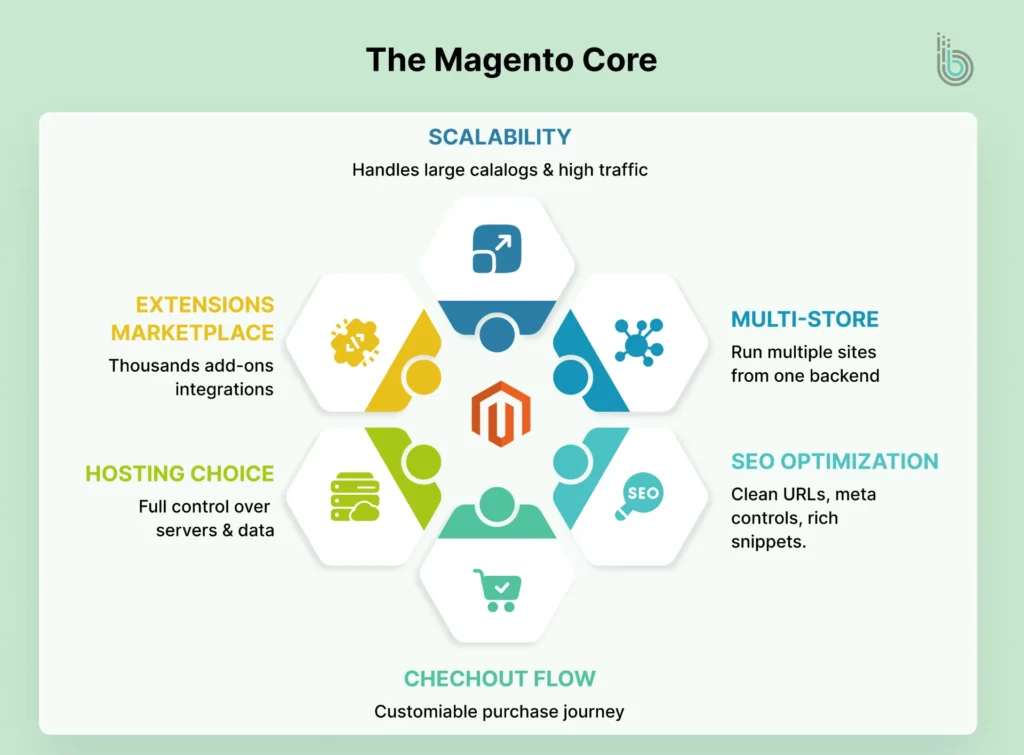
Full Customization: You can build your store exactly the way you want. There are no design or feature limitations.
Complete Control: You manage hosting, data, and performance settings yourself.
Strong Scalability: Handles large catalogs and high traffic without issues.
Rich Extension Marketplace: Thousands of add-ons and integrations available.
Multi-store Support: Run multiple stores from one backend, even for different countries.
Advanced SEO Features: Clean URLs, meta controls, and technical SEO flexibility built in.
Cons
Technical Knowledge Required: Not beginner-friendly. You will likely need a developer.
Higher Costs: Hosting, development, and maintenance can increase expenses.
Longer Setup Time: Building and configuring the store takes time.
Manual Updates and Security: You are responsible for keeping the system secure and up to date.
Steep Learning Curve: It can feel complex if you are new to eCommerce platforms.
Limited Free Support: The free support is limited. Dedicated technical support is available only with a paid plan.
Simply put, Magento offers deep customization, scalability, multi-store support, and advanced SEO for complex online businesses. It provides full control and flexibility but requires technical expertise, higher costs, longer setup time, and ongoing manual maintenance.
To make the most of Magento’s capabilities, partner with a professional Magento development company to design, develop, and maintain a store that meets your unique business goals.
BigCommerce Overview
BigCommerce is a leading cloud-based SaaS platform, which means the company manages hosting, security, updates, and server performance for you. You don’t install software or manage infrastructure. Everything runs in the cloud.
It comes with built-in tools for payments, SEO, marketing, and multi-channel selling. BigCommerce focuses on ease, speed, and stability, making it ideal for businesses that want to launch quickly without handling technical complexity.
BigCommerce Pros and Cons
Pros
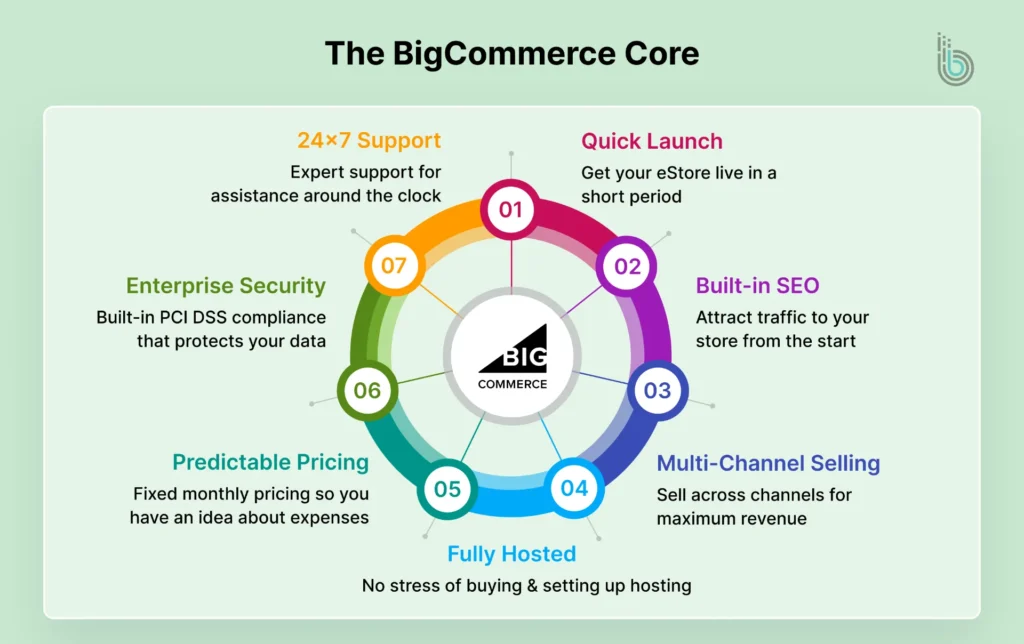
Easy to Use: Clean dashboard and simple store management. Good for non-technical users.
Fully Hosted: No server setup, manual security patches, or maintenance stress.
Quick Launch: Built-in features help you go live faster.
Predictable Pricing: Clear monthly plans make budgeting easier.
Automatic Updates and Backups: The platform handles security and performance.
Strong Built-in Tools: SEO, analytics, and marketing features are ready to use.
Multi-channel Selling: Sell on marketplaces and social platforms from one system.
24/7 Support: Access to customer service when you need help.
Cons
Limited Deep Customization: Complex changes may not be possible without apps.
Less Hosting Control: You don’t manage the server environment.
Extra Cost for Advanced Features: Some tools require higher-tier plans or paid apps.
App Dependency: Unique requirements often need third-party integrations.
Developer Needed for Complex Design Edits: Not fully code-free for advanced work.
Not ideal for Highly Complex Enterprise Builds: May feel restrictive for very large custom projects.
In short, BigCommerce handles hosting, security, updates, and performance, making it easy to launch quickly with built-in sales, SEO, and marketing tools. It is one of the best eCommerce platforms for startups seeking stability and speed.
Comparing Magento vs BigCommerce on Key Parameters
To help you decide which platform fits your business best, let’s compare BigCommerce vs Magento across key parameters that impact performance, usability, scalability, and long-term growth.
Performance
Magento:
Performance depends on your hosting setup. With powerful servers and proper optimization, Magento handles large catalogs and heavy traffic effectively. Many high-volume stores prefer it because it does not restrict growth. It gives you room to optimize speed as your business expands.
Magento gives you deeper control over caching, database management, and content delivery. You can fine-tune how data loads and how pages are served. This flexibility can result in excellent speed and stability. But keep in mind that if the hosting or setup is weak, performance will suffer as well.
BigCommerce:
BigCommerce delivers stable performance without requiring technical effort. Since hosting is included, the platform automatically manages speed, updates, and traffic spikes. Most stores experience consistent load times from the start. This makes it dependable for growing businesses.
The system runs on cloud infrastructure designed to efficiently balance traffic. You don’t need to manage servers or configure performance tools. Although you cannot adjust deeper system settings, you still benefit from a secure, optimized environment. It offers reliability with less operational burden.
Ease of Use & Setup
Magento:
Magento requires preparation before launch. You must arrange hosting, configure the environment, and install the necessary components. The dashboard is powerful and detailed, which experienced teams appreciate. For beginners, it may feel dense at first.
Its structure separates store logic, design, and data layers. This gives flexibility but increases setup complexity. Every element can be shaped to fit your business model. The trade-off is time and effort during the initial build.
BigCommerce:
BigCommerce is easier to start with. You sign up, select a plan, and begin building immediately. Core features like payments and shipping are already integrated, significantly reducing launch time.
The interface is clear and guided. Most tasks can be completed without coding knowledge. You can focus on products and marketing instead of system setup. This simplifies the early stages of building an online store.
Customizability & Scalability (Themes and Templates)
Magento:
Magento offers extensive design and structural flexibility. You can modify themes, templates, the checkout flow, and backend logic. Businesses with unique workflows or product structures benefit from this freedom. It supports multiple storefronts and complex catalogs with ease.
Its modular framework allows custom features to be added without limiting future growth. As your traffic and product count increase, Magento can scale alongside you.
BigCommerce:
BigCommerce provides professionally designed themes that are easy to customize. You can adjust layout elements, branding, and product pages through built-in tools. For most businesses, these options are more than enough.
The platform maintains a structured environment to ensure stability. You can edit front-end code if needed, but the core architecture remains fixed. Scalability is handled automatically by the platform. It grows smoothly with your sales, though it may not suit highly complex custom requirements.
SEO & Marketing
Magento:
Magento gives you deep control over how your store appears in search engines. You can customize URLs, meta titles, descriptions, and structured data. It allows detailed control over page hierarchy and internal linking. This is useful for businesses that rely heavily on organic traffic.
You can also refine technical elements such as canonical tags, redirects, and indexing rules. For stores with a clear SEO roadmap, Magento provides the flexibility to execute advanced strategies. It supports content-heavy sites and large catalogs where structured optimization matters. The platform favors businesses that take search seriously.
BigCommerce:
BigCommerce includes essential SEO tools built in. Clean URLs, automatic sitemaps, and editable metadata are available from the start. You do not need to configure complex settings to achieve solid search visibility. It covers the fundamentals well.
Marketing features such as email integrations, analytics, and multi-channel selling are also included. This helps businesses manage campaigns without relying on third-party tools. While it may not offer the same depth of SEO customization as Magento, it provides a practical and ready-to-use setup for most stores.
Extensions & Integration (Apps and Plugins)
Magento:
Magento has a broad extension marketplace with advanced modules. You can expand functionality for payments, shipping, analytics, and customer management. It supports integration with ERP systems, CRM platforms, and custom business tools. This makes it suitable for stores with complex workflows.
Because of its flexible structure, you can build or modify modules to fit unique requirements. The system does not restrict deep integrations. However, more advanced setups often require experienced developers. It offers freedom, but that freedom must be managed carefully.
BigCommerce:
BigCommerce provides a well-organized app marketplace. Most tools can be added quickly without custom development. Integrations with shipping carriers, payment gateways, and online marketplaces are straightforward. This makes expansion simple for everyday business needs.
For specialized features, you may rely on third-party apps. The platform keeps the core system stable by limiting structural changes. While this ensures reliability, it can restrict highly customized integrations. It works best for businesses that prefer convenience over deep modification.
Security & Maintenance
Magento:
With Magento, security management is in your hands. You must handle software updates, security patches, backups, and server monitoring. This allows you to control how your system is protected. Businesses with internal technical teams often value this independence.
However, it also means you are responsible for staying up to date and compliant. Neglecting updates can expose vulnerabilities. Proper maintenance requires discipline and ongoing attention. It suits businesses that are prepared to actively manage their infrastructure.
BigCommerce:
BigCommerce manages security at the platform level. Updates, compliance standards, and system protection are handled automatically. You do not need to monitor servers or manually install patches. This reduces operational stress.
The platform maintains PCI compliance and regular backups as part of its service. Store owners can focus on sales and marketing rather than maintenance. While you give up direct control, you gain peace of mind and consistent protection.
Pricing
Magento:
Magento pricing depends on which version you choose. Magento Open Source is free to download, but you pay for hosting, design, development, extensions, and maintenance. The total cost varies based on store size and customization level.
Beyond the free version, there is Magento Commerce and Magento Commerce Cloud (Adobe Commerce). These are licensed enterprise editions. They include advanced features, cloud hosting (for the cloud version), and dedicated support. However, they carry significant annual license fees.
Below is a detailed pricing breakdown:
Cost Element
Magento Open Source
Magento Commerce
Magento Commerce Cloud
License Cost
$0
$20,000-$130,000 per year
$40,000-$190,000 per year
Hosting
$100-$500 per year
$500-$6,500 per year
Included
Domain Name
$10-$400 per year
$10-$400 per year
$10-$400 per year
SSL Certificate
$50-$300 per year
$50-$300 per year
$50-$300 per year
Design
$0-$5,000+
$0-$5,000+
$0-$5,000+
Development
$1,800-$10,000+
$10,000+
$10,000+
Extensions
$60-$600 per extension
$60-$600 per extension
$60-$600 per extension
Payment Processing
~2.9% + $0.30 per transaction
~2.9% + $0.30 per transaction
~2.9% + $0.30 per transaction
SEO & Marketing
$10,000-$40,000 per year
$10,000-$40,000 per year
$10,000-$40,000 per year
Estimated Total (Annual)
$12,000-$57,000+
$43,000-$189,000+
$60,000-$247,000+
BigCommerce:
BigCommerce uses a monthly subscription model with predictable pricing. Hosting and security are included. Costs increase as you upgrade to higher plans or add premium apps.
BigCommerce offers three main plans:
Standard – $29.95 per month
Plus – $79.95 per month
Pro – $299.95 per month
Customer Support
Magento:
Magento support largely depends on who manages your store. If you use the open-source version, there is no direct official support team assigned to you. Most businesses rely on hosting providers, development agencies, or in-house teams for help. This gives flexibility in choosing experts who understand your setup.
Magento also has a strong global community. Forums, documentation, and certified developers are widely available. For experienced teams, this ecosystem is valuable. However, resolution time depends on the quality of your technical partner. Support is available, but it is not centralized.
BigCommerce:
BigCommerce offers direct 24/7 customer support. You can reach their team through live chat, phone, or support tickets. This is especially helpful for store owners without technical staff. Quick access to assistance reduces downtime and confusion.
The platform also provides detailed documentation, tutorials, and onboarding guidance. Since BigCommerce controls the hosting environment, support teams can diagnose issues more efficiently. This structured support system makes it easier for small and mid-sized businesses to operate with confidence.
In the Magento vs BigCommerce debate, Magento offers greater control and depth, while BigCommerce offers ease and stability. Your choice depends on whether you value flexibility or simplicity more.
If you feel Magento suits your needs better, then you should hire Magento developers to build a customized, high-performing online store tailored to your business needs.
Magento 2 vs BigCommerce: What to Choose When
Choosing the right eCommerce platform is about finding the best fit for your business.
Choose Magento 2 (Adobe Commerce) If
You need a store that stands out and meets a long list of unique requirements.
You have an in-house development team or a Magento development company available.
Full control over hosting, data, and store operations is important to you.
You require advanced safety, as it has built-in features like improved fraud protection (Signifyd) and secure password hashing (SHA-256).
Choose BigCommerce If
You want an online store that works from day one and grows with your sales.
You don’t want to get bogged down in technical details.
You are a small or medium-sized business seeking stable, transparent pricing.
You’re looking for open API flexibility.
Magento suits businesses that need full control and custom functionality, while BigCommerce is better for those who want a ready-to-use platform with minimal technical involvement.
Real-World Use Cases
Below are two real-world use cases of these eCommerce platforms.
Liverpool FC Official Store Powered by Magento
The official online shop for Liverpool FC is built using Magento. It sells official team uniforms (kits), practice attire, collectibles, and other apparel to fans worldwide.
The website receives a high volume of visitors and a large number of products. It is designed to present items in a way that resonates with supporters across different countries. The goal is to make shopping easy and seamless for fans, allowing them to find and purchase merchandise while feeling connected to the club’s history and identity.
Magento’s flexibility enables the store to manage location-specific content, offer multiple currencies, and use appealing images that align with the Liverpool brand. The website’s design honors the club’s history and offers simple navigation and quick checkout. These features are key to the online store’s global success.
Berlin Packaging Crafted With BigCommerce
It is a major online store that sells business-to-business (B2B) packaging. It uses the BigCommerce platform to serve industries including food and beverage, personal care, and industrial goods.
The company picked BigCommerce over other options because it offered the best combination of flexibility, clear pricing, and useful features.
The platform helps Berlin Packaging manage its vast product catalog and unique product details and integrate with its main business software (ERP). It also supports features for business customers, such as viewing account credit and managing complex delivery options.
Magento vs BigCommerce - Which Fits Your Growth Plan?
The choice between Magento and BigCommerce comes down to control versus convenience. Magento offers deep customization and full ownership for technically supported businesses. BigCommerce provides ease, stability, and a faster setup for those who want a ready-to-run store.
Both platforms are capable. The better option depends on your budget, team strength, and long-term goals. If you want freedom and technical depth, Magento is the better choice. If you prefer ease, built-in tools, and predictable costs, BigCommerce makes sense.
FAQs on Magento vs BigCommerce
Q1. Which platform is better suited to small businesses: BigCommerce or Magento?
BigCommerce is generally a better fit for small businesses. It is easier to set up and doesn’t require technical expertise. The clear monthly pricing helps with budgeting. Magento can work for small businesses, but only if they have technical support and sufficient resources.
Q2. How do BigCommerce and Magento manage international sales?
Both platforms support global selling, allowing you to offer multiple currencies and adjust language settings. Magento provides deeper control for complex international setups, while BigCommerce handles global features in a simpler, more guided way.
Q3. What technical skills are required for each platform?
Magento requires strong technical knowledge. You need skills in development, hosting, and system management. BigCommerce is more beginner-friendly, so most store owners can manage it without coding experience.
Q4. What is the total cost of ownership (TCO) for Magento and BigCommerce?
BigCommerce starts with lower monthly plans, but costs can increase as you add premium apps and themes. Magento has higher upfront costs, especially for licensing and developers. Over time, both platforms can reach similar total costs depending on store complexity. The real expense depends on how custom and large your store becomes.