
Quick Summary
- B2B eCommerce helps businesses sell faster, manage bulk orders, and improve buyer relationships digitally.
- The right B2B eCommerce platform reduces manual work, lowers costs, and supports long-term business growth.
- Manufacturing, wholesale, SaaS, and enterprise brands all use B2B eCommerce for better operations and sales.
- AI, automation, mobile buying, and global selling are shaping the future of B2B eCommerce.
B2B eCommerce means one business selling products or services to another business through an online platform. Instead of selling to individual customers, companies sell to wholesalers, retailers, distributors, and manufacturers. Orders, pricing, payments, and deliveries are managed online, making the process faster and easier.
Understanding what is B2B eCommerce is important for businesses that want to grow in today’s market. A strong B2B eCommerce platform helps improve customer experience, reduce manual work, and increase sales. We’ve covered the benefits of B2B eCommerce, different business models, and the latest B2B trends in this blog. Let’s dive in!
What is B2B eCommerce?
B2B eCommerce, or business-to-business electronic commerce, is the process of one business buying from or selling to another business through online channels. Unlike regular online shopping, where individuals buy for personal use, B2B transactions typically involve bulk orders, negotiated pricing, repeat purchases, and longer decision-making cycles.
For example, a retailer buying stock from a wholesaler or a company purchasing software for its team is part of B2B eCommerce. It helps businesses manage purchasing, sales, and supplier relationships through a structured digital system rather than relying solely on offline methods.
Key Features of B2B eCommerce
- Mobile-friendly storefronts for on-the-go buyers
- Secure B2B payment options
- Personalized pricing and catalogs
- ERP & CRM integration for smooth workflows
- Real-time inventory tracking
Benefits of B2B eCommerce
- Better Customer Experience: Business buyers want quick and simple purchasing, just like regular online shopping. A good B2B eCommerce website allows them to browse products, view custom pricing, place repeat orders, and track deliveries at any time. It helps build trust and strengthen long-term customer relationships.
- Wider Market Reach: A physical store limits the number of customers a business can serve. With B2B digital commerce, companies can sell across different cities, states, and even countries without opening multiple locations. Businesses can expand their customer base and create more sales opportunities.
- Faster and Smoother Ordering: Manual orders via phone, WhatsApp, or email often lead to delays and errors. B2B eCommerce automation simplifies ordering by allowing customers to place orders 24/7, check stock availability, and receive faster confirmations. Business owners get better speed and less operational stress.
- Lower Operating Costs: Running sales manually often needs more staff, paperwork, and follow-ups. A B2B eCommerce platform reduces these extra costs by automating routine tasks like order processing, invoice generation, and inventory updates. Lower overhead means better profit margins.
- Easy Business Scalability: As order volume grows, manual management becomes difficult. B2B eCommerce solutions make scaling easier because the system can handle more customers and transactions without requiring a proportional increase in staff or infrastructure.
- Better Business Decisions with Data: A strong B2B eCommerce platform provides access to valuable customer data, including buying patterns, repeat orders, and popular products. It leads to smarter decisions about pricing, stock planning, and sales strategy.
B2B eCommerce benefits go far beyond online selling. It improves operations, strengthens buyer relationships, and creates a stronger foundation for future growth. So if you’re planning to sell your products or solutions online to businesses, opt for our B2B eCommerce development services.
Key Players in B2B eCommerce
Today’s leading B2B ecommerce platforms help businesses streamline operations, cut costs, and stay competitive in a digital-first world.
Still doubt us? Then look at some of the key players in B2B eCommerce:
- Alibaba: As one of the largest B2B eCommerce platforms globally, Alibaba connects manufacturers and suppliers with buyers worldwide. It’s known for its vast product catalog, international reach, and trade assurance services.
- Amazon Business: Amazon’s B2B platform offers a wide range of products and services tailored to business customers. It provides features such as bulk purchasing, business pricing, and access to Amazon’s extensive logistics network.
- Global Sources: Specializing in electronics and components, Global Sources connects businesses with suppliers primarily from Asia. It features a wide range of electronics, hardware, and machinery products.
- Thomasnet: Thomasnet is a B2B platform focused on industrial and manufacturing goods. It provides a comprehensive directory of suppliers and manufacturers across various industries, making it a valuable resource for industrial procurement.
- eBay for Business: eBay’s B2B arm is designed to cater to businesses. It allows sellers to list products in bulk, offers B2B pricing options, and provides a platform for businesses to source products.
These B2B eCommerce companies cater to a wide range of industries and provide a variety of services. That makes it possible for businesses of all sizes to find suitable platforms to source products and conduct transactions efficiently.
So what is the role of the small and medium-sized businesses (SMBs)? Well, SMBs bring diversity to the market by offering niche products and specialized services, expanding the range of available solutions. SMBs also drive competition and innovation, challenging larger players to stay agile and adapt to changing market demands.
What are the Types of B2B eCommerce Models?
When we talk about “What is B2B eCommerce?”, we can’t move forward without mentioning the different types. Even though B2B is a business model in itself, there are a number of various subsets to this strategy. They are designed to suit the various requirements of businesses easily.
B2B2C (Business-to-Business-to-Consumer): In the B2B2C model, a business sells its services or products to other businesses, which, in turn, sell them to consumers. This model tends to incorporate the middlemen, such as wholesalers or distributors, who buy the business and, in turn, sell the goods to retailers or directly to final consumers. It is a normal practice to expand into the consumer market using the established business-to-business relationships.
Wholesale: This type of business model relates to the purchase of goods in large quantities at discounted prices by businesses from manufacturers or suppliers and the sale of the goods to other businesses or retailers. In many cases, wholesalers act as the distributors between manufacturers and retailers of goods to different channels.
Manufacturer: In the manufacturer-focused B2B eCommerce model, the manufacturer sells its products directly to other businesses. This will remove middlemen and enable manufacturers to form direct contact with their business clients. It is especially prevalent in the sphere of industries in which the manufacturers possess brand recognition and are able to address the needs of other businesses in question.
Distributor: Distributors are companies that purchase goods (products) at the manufacturing or supplier end and sell them to other companies, retailers, or consumers. The value-added services that distributors can offer include warehousing, logistics, and product assortment in order to facilitate easy access to a great variety of products from a single source for businesses.
These B2B ecommerce models show that every industry has a best-fit approach. The right model depends on your scale, buyer needs, and long-term goals in the industry, market dynamics, and business objectives.
If you find any of these B2B eCommerce models, hire eCommerce developers, and we’ll take care of the rest.
Top Trends in B2B eCommerce
B2B ecommerce is evolving fast. Here are the top B2B ecommerce trends shaping how businesses buy and sell today.
So let’s take a look at the top trends in B2B eCommerce and their importance.
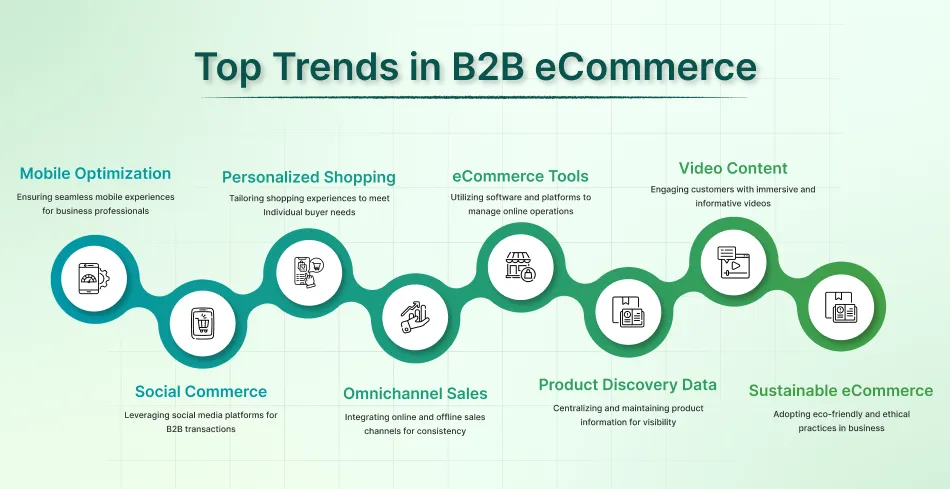
Mobile Optimization
Mobile optimization has become paramount in B2B eCommerce, as an increasing number of business professionals rely on their smartphones and tablets for purchasing decisions. With the rise of remote work and on-the-go decision-making, ensuring a seamless mobile experience is crucial. According to recent data, mobile commerce accounts for over 50% of global eCommerce sales, underscoring the importance of catering to mobile users in B2B transactions.
Social Commerce
Social media platforms are no longer just for sharing updates; they have evolved into powerful tools for B2B eCommerce. Businesses are leveraging social commerce to engage with potential customers, showcase products, and facilitate transactions directly on platforms like Facebook, Instagram, and LinkedIn. Statistics reveal that 74% of consumers rely on social networks to guide purchase decisions, making it a potent channel for B2B sellers.
Customized Internet Shopping.
B2B customers in the age of customization need customized shopping experiences. They expect product suggestions, content, and prices according to their tastes and history of engagement.
Addressing these expectations means that complex personalization tools need to be implemented, and the studies have revealed that the companies that adopt personalization would experience up to 20% sales growth.
Omnichannel Sales
Omnichannel sales have become the gold standard in B2B eCommerce. The method also provides a smooth and uniform shopping process across diverse platforms, including websites, mobile applications, and brick-and-mortar outlets. Businesses have to close the gap between online and offline sales channels.
Then there is omnichannel as opposed to multichannel sales, where the channels are separate and thus customer satisfaction and loyalty are magnified.
eCommerce Tools
There is a broad range of ecommerce software and platforms that help businesses manage their online operations in many ways. These tools include eCommerce platforms (Shopify, WooCommerce, and Magento), payment gateways, customer relationship management (CRM) systems, inventory management software, and marketing automation tools.
Embracing these tools is vital for automating sales processes, optimizing customer experiences, and staying competitive in the B2B eCommerce space.
Product Discovery Data
Proper product information is used in proper product discovery. Product Information Management (PIM) software plays a pivotal role in centralizing and maintaining product data, ensuring consistency across all sales channels. The application of the PIM software can help increase product exposure, minimize mistakes, and improve marketing tactics that will result in sales.
Video Content
Video content is gaining prominence in B2B eCommerce as businesses recognize its potential to engage and inform customers. Live demonstrations, tutorials, and product videos are more enthralling and educational.
The investment in video content can be paid back (ROI) since studies have shown that video can enhance website traffic and conversions, and that is the priceless thing that B2B sellers have.
Sustainable eCommerce
Sustainability has become a key consideration in B2B eCommerce. Consumers are becoming more interested in eco-friendly and socially responsible products. To satisfy this demand, companies are adopting sustainable practices, such as using environmentally friendly packaging, fair sourcing, and energy-efficient products.
Sustainability isn’t just a moral imperative; it’s also a strategic advantage, as it resonates with conscientious consumers and can bolster a company’s reputation.
Embrace these trends to make sure you find success in the competitive world of B2B eCommerce. If you want to adopt and integrate any of these latest trends in your business-to-business website, our eCommerce specialists might be able to help you out.
B2B eCommerce Examples
Understanding what is B2B eCommerce becomes much easier when looking at real business examples. Different industries use different B2B eCommerce solutions based on their products, buyers, and sales processes. From factories to software companies, B2B digital commerce helps businesses sell faster, manage orders more effectively, and improve the customer experience.
Manufacturing Industry
Manufacturing companies often deal with bulk orders, repeat purchases, and long supply chains. Managing these through calls and emails creates delays and mistakes. A B2B eCommerce platform helps manufacturers connect with suppliers and buyers in one place.
For example, a machine parts manufacturer can allow distributors to check stock, request custom pricing, and place large orders online. Order accuracy increases, and time is saved for both sides. Companies like McKesson also use strong B2B systems to manage large-scale product distribution where speed and accuracy are critical.
Wholesale Distribution
Wholesale distributors sell products in large quantities to retailers, dealers, and resellers. They usually manage different pricing for different buyers, which is difficult to do manually. A B2B eCommerce website offers customer-specific pricing, bulk ordering, and faster reordering.
Alibaba is one of the best examples of B2B eCommerce in wholesale distribution. Businesses use it to find suppliers, buy products in bulk, and connect with manufacturers worldwide. This shows how a B2B online marketplace can help businesses grow beyond local markets.
SaaS/Digital Products
Software companies also follow the B2B eCommerce business model. Instead of physical products, they sell digital services like CRM tools, cloud software, marketing platforms, and business applications.
Salesforce is a perfect example. It sells CRM software to businesses through a subscription model. Microsoft and Google also provide B2B eCommerce solutions through tools like cloud services, productivity software, and business licensing. It is a type of B2B eCommerce strategy that focuses on long-term customer value and recurring revenue.
Enterprise B2B Brands
Large enterprise brands use advanced enterprise eCommerce solutions to manage high-value transactions, multiple buyers, and global operations. Their systems often include ERP integration, automation, and account-based pricing.
Amazon Business is a strong example of enterprise B2B digital commerce. It helps businesses purchase office supplies, equipment, and bulk products with business-specific pricing and approval workflows. Oracle is another example, offering enterprise software that supports procurement, finance, and supply chain operations for large companies.
These B2B eCommerce examples show that online business selling is not limited to one industry. Whether it is manufacturing, wholesale, SaaS, or enterprise sales, the right B2B eCommerce platform helps businesses work smarter, serve buyers better, and grow with fewer manual challenges.
Challenges in B2B eCommerce
While B2B eCommerce brings huge opportunities, it also comes with its own set of challenges. Businesses need to be aware of these hurdles so they can plan better and avoid common mistakes.
- Long and complex buying cycles – B2B deals often involve multiple decision-makers, which can slow down the process.
- High setup and integration costs – Building the right platform and connecting it with ERP or CRM systems can require time and money.
- System compatibility issues – Many businesses struggle to connect new eCommerce tools with their existing software.
- Data security and compliance – Handling large transactions means extra focus on keeping data safe and meeting industry regulations.
- Customer expectations – Buyers now expect a B2C-like shopping experience with personalization, quick support, and mobile access.
Addressing these challenges early makes it easier for companies to get the most value out of B2B eCommerce.
Future Outlook of B2B eCommerce
B2B eCommerce is growing fast, and the way businesses buy and sell will keep changing in the coming years. The future is focused on speed, convenience, and smarter decision-making.
AI-Powered Buying Experience
Artificial intelligence is becoming a major part of B2B eCommerce. It helps businesses understand customer behavior, recommend the right products, automate support, and improve pricing decisions. AI also helps sales teams save time by handling routine tasks and improving response speed.
Mobile-First Business Purchasing
More business buyers now use mobile phones and tablets to place orders, compare products, and manage approvals. Because of this, mobile-friendly B2B eCommerce websites are no longer optional. Fast loading, simple navigation, and easy checkout on mobile devices will become a basic business need.
Growth of Global B2B Selling
Cross-border selling is becoming easier with better logistics, secure payment systems, and stronger business-to-business online marketplace platforms. Businesses can now reach buyers in different countries without needing physical offices in every location. Revenue opportunities increase, and expansion becomes faster.
Smarter Automation and Integration
Future B2B eCommerce platforms will focus more on automation. Tasks such as inventory updates, invoice generation, order tracking, and customer follow-ups will require less manual effort. Strong B2B eCommerce integration with ERP, CRM, and supply chain systems will make operations smoother and more reliable.
Voice Search and Faster Product Discovery
Business buyers want quick access to information. Voice search and smart tools help here. Buyers can search products faster, check stock, and place repeat orders with less effort. This makes buying more convenient and speeds up decisions.
The future of B2B eCommerce is not only about selling online. It is about building a complete digital buying experience that is simple, fast, and reliable. Businesses that adapt early will have a stronger advantage in the market. So if you are ready to scale, partner with us to build a robust B2B platform.
Wrap It Up
Understanding what is B2B eCommerce is important for any business that wants to stay competitive today. More than just selling products online, it is about creating a better buying experience for business customers, improving operations, and building long-term growth.
From manufacturers and wholesalers to SaaS companies and enterprise brands, every industry is finding better ways to sell through digital channels. The right B2B eCommerce platform helps businesses manage pricing, bulk orders, payments, inventory, and customer relationships in one place. It also supports faster decisions, lower costs, and better scalability.
As new B2B eCommerce trends continue to shape the market, businesses that move early will always stay ahead of those still depending only on traditional sales methods.
FAQs on What is B2B eCommerce
1. How does B2B eCommerce differ from B2C?

B2B eCommerce is business-to-business, where companies sell to other companies. B2C (business-to-consumer) is when companies sell directly to individual shoppers. In B2B, orders are usually larger, pricing is often negotiated, and the buying cycle takes longer compared to the faster, more personal shopping experience in B2C.
2. What are B2B marketplaces, and why are they important?
B2B marketplaces are online platforms that connect multiple suppliers with buyers, providing a centralized space for transactions. They are important because they offer convenience, a wide range of products, competitive pricing, and streamlined procurement processes for businesses.
3. What is a B2B eCommerce platform?
A B2B eCommerce platform is software that allows businesses to sell products or services online to other businesses. It helps manage catalogs, bulk pricing, custom orders, and integrations with systems like ERP or CRM. Examples include Shopify Plus, Magento, BigCommerce, and Oracle NetSuite.
4. What are the top B2B eCommerce platforms in 2026?
Some of the most popular B2B eCommerce platforms in 2026 are Shopify Plus, Adobe Commerce (Magento), BigCommerce B2B Edition, Oracle NetSuite, and WooCommerce with B2B plugins. The best choice depends on your budget, integration needs, and business model.
5. Is B2B eCommerce suitable for small businesses?
Yes. B2B eCommerce isn’t just for large enterprises. Small businesses can use it to reach wholesalers, distributors, and other partners more efficiently. Platforms like Shopify, BigCommerce, or WooCommerce make it easier for smaller firms to set up professional online stores without heavy upfront costs.
6. How do payments work in B2B eCommerce?
Payments in B2B eCommerce are more flexible than in B2C. Along with standard options like credit cards or digital wallets, B2B buyers often use invoices, bank transfers, purchase orders, or extended credit terms. Modern platforms also support secure gateways and automated invoicing to handle larger transactions smoothly.