A few years ago, an eCommerce store was just a digital brochure for manufacturers. They used it to showcase their products to distributors and retailers with ease. But now, customers are trying to source their products directly from manufacturers.
A high-quality eCommerce website for manufacturers can drive greater profits and ensure direct customer contact. It supports B2B bulk ordering, custom catalogs, role-based accounts, and repeat purchases while improving visibility and fulfillment.
This blog explores how manufacturers create eCommerce platforms for bulk and repeat purchases, including their benefits, challenges, trends, and more.
Why is eCommerce Critical for Manufacturers?
eCommerce modernizes how manufacturers sell, serve, and scale their operations. They no longer have to rely solely on distributors or manual sales workflows, although they are still helpful. Here’s why it matters:
Direct Customer Access: With a high-quality eCommerce store, manufacturers can build strong, direct relationships with customers. It’s a great way to gather valuable insights into buyer preferences for better products and strategies.
Better Customer Experience: The eStore offers features like personalized catalogs, quick reordering, custom pricing, and more. It lets the manufacturers offer 24/7 service to the B2B retailers.
Innovative Strategy: With the eCommerce store, manufacturers can test their new products with retailers more quickly and also adapt to the changing demands. It helps build a more innovative, future-proof business.
Broader Market Reach: Manufacturers can use the eCommerce website to sell their products globally without physical stores, eliminating location limitations.
Higher Sales & Profitability: The website enables selling products in larger volumes across multiple channels. That means higher margins without relying on middlemen.
More Efficient Operations: Manufacturers can automate order processing, inventory management, and payments. So there are little to no errors, cost savings, and it frees up the staff for core tasks.
eCommerce for manufacturers is a great way to support sales from both traditional distributors and the D2C model. Distributors get a comprehensive product catalog, and retailers can enjoy the traditional eCommerce features.
Essential Features of a Manufacturer’s eCommerce Platform
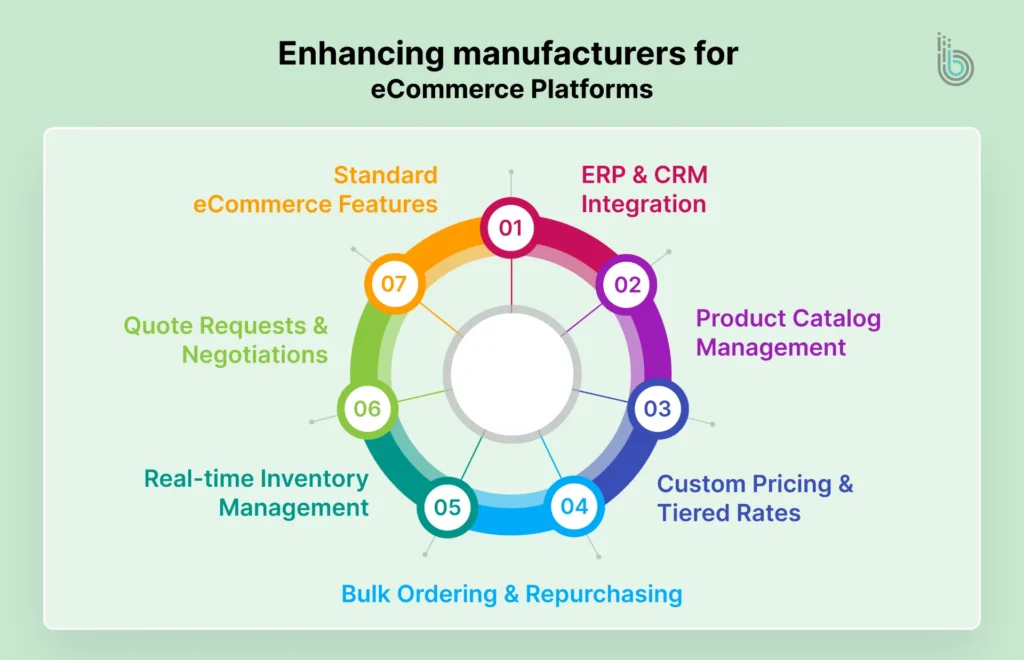
Beyond the standard eCommerce features, a platform dedicated to manufacturers offers key enhancements for distributors, retailers, and customers.
ERP & CRM Integration
Connect the eCommerce platform for manufacturers to ERP and CRM systems to automatically sync customer data, pricing, inventory, orders, and invoices. So there is little to no need for manual entries and fewer chances of errors. Plus, these systems can align the finances with real-time order and customer data.
Product Catalog Management for Complex SKUs
Manufacturers often create and sell multiple variants (color, technical specs, sizes, etc.) of the same product. So they need a robust catalog system to organize the SKUs using advanced filters. That ensures the buyers can quickly and accurately find what they are looking for.
Custom Pricing & Tiered Rates
B2B buyers often look for tiered, custom pricing based on their order volumes and relationships with the manufacturers. So your platform should support customer-specific pricing, volume-based discounts, and tiered pricing structures. Then each buyer gets accurate pricing based on their order size and negotiated terms.
Bulk Ordering & Repurchasing
This feature lets customers add items in bulk quickly using SKU lists, quick order forms, and similar tools. Also, make sure to integrate repurchasing features, such as saved carts and reorder options, to make repeat orders easier. So the procurement teams can order quickly and more frequently.
Real-time Inventory Management
With a real-time inventory system, customers can check stock availability before placing orders. So there are fewer chances of back orders, delays, and other issues. Manufacturers can also plan more accurate stock levels across warehouses and even reserve inventory for priority customers.
Quote Requests & Negotiation
Sometimes, bulk orders don’t fit a standard checkout. That’s why you have to offer quote request workflows. With it, buyers can submit custom requirements and negotiate terms before purchase. It’s especially useful for larger orders and long-term contracts.
Beyond these features, you need to create an eCommerce website with the standard features. Like, security with SSL and PCI compliance, mobile optimization, search and navigation, payment processing, live chat support, and analytics.
Benefits of Building an eCommerce for Manufacturers
Thanks to the features showcased in the previous section, there are some outstanding benefits of an eCommerce website for manufacturers. Let’s take a look.
More Efficient Operations (with automated workflows and real-time order management)
eCommerce stores for manufacturers include features such as automated order intake, invoicing, and status updates. Moreover, there’s a real-time order management system, so the team won’t have to waste time on follow-ups. Manufacturers can instead focus on production planning and faster and more accurate turnaround.
Better Customer Satisfaction (with 24/7 availability and mobile-first sales)
With an eCommerce store, customers can browse product catalogs, place bulk orders, and track their shipments. And they won’t have to wait for business hours. Plus, eCommerce websites offer a mobile-first experience, so buyers can reorder quickly from anywhere and anytime. It improves convenience, trust, and long-term retention.
New Sales Opportunities (through distributor and D2C models)
Manufacturers’ eCommerce websites support both distributor-based selling and Direct-to-Consumer (D2C) channels. They’ll be able to do business with new customer segments to expand their reach. And there will be less dependency on a single sales route.
Innovative Approach (AI-first features in eCommerce)
You can add AI features like smart search and filtering, live chat, predictive reordering, and automated support in your eCommerce website. It improves the buying experience. For manufacturers, there are more conversions, fewer drop-offs, and customers can find the products faster.
Stronger Brand Building (through integrated digital marketing)
A good-quality eCommerce website is a brand-building asset. You can control how the products are displayed and marketed. And it can be made from scratch using digital marketing strategies like SEO, email marketing, and even remarketing. It makes your brand more visible and attracts high-intent buyers. Plus, it can boost repeat purchases.
Deeper Customer Insights
With an analytics-driven eCommerce website, manufacturers can gain a clear picture of top-selling SKUs, buyer preferences, and reorder cycles. With these insights, they can refine pricing, optimize inventory, and personalize offers.
To make the most of these benefits, you need the best feature-packed eCommerce website. Get our eCommerce website development services for a quality store.
Challenges With eCommerce for Manufacturers
While there are benefits, there are also challenges associated with the B2B eCommerce platform for manufacturers. Let’s look at the common ones.
Integration with Existing Systems
Manufacturers and other B2B businesses often rely on ERP, CRM, and other top tools, but these tools don’t easily connect with eStores. But poor integration can result in pricing inconsistencies, inventory mismatches, and even order delays. It creates confusion for both teams and customers.
Data Security & Compliance
An eCommerce website often handles sensitive customer and payment data, as well as private contracts. So the manufacturers need to ensure secure hosting, compliance, role-based access, and other security features. So the website complies with the industry standards. It avoids breaches, penalties, and reputation damage.
Customer-specific Pricing & Terms
Different retailers and distributors negotiate and maintain different relationships with manufacturers. So they expect unique pricing, credit limits, discounts, and payment terms. Managing these rules accurately online can be complex. Inconsistencies can lead to disputes, lost trust, and order abandonment.
Complex B2B Checkout
B2B retailers and distributors often require bulk ordering, custom approvals, tax exemptions, and partial shipments and payments. A standard eCommerce website may not support these workflows. It slows purchasing and may force customers back to manual ordering.
Channel Conflicts With Distributors
Selling products directly to customers and retailers online can create tension with existing distributors. If manufacturers don’t plan carefully, it may lead to pricing conflicts and lost relationships. Manufacturers need clear channel strategies to protect long-term growth.
Shipping & Logistics Complexity
Manufacturing shipments may involve heavy items, split deliveries, or region-based freight rates. So you can expect coordinating carriers, deliveries, and tracking to be challenging. Without proper logistics, shipping costs can rise while customer satisfaction declines.
To ensure successful manufacturing eCommerce operations, many businesses work with an experienced eCommerce consulting agency to manage system integrations, pricing complexity, and channel conflicts effectively.
Future Trends in eCommerce for Manufacturers
Future-proofing the eCommerce business for manufacturers is no longer just about digitizing the catalogs. You need to build the best eStore experience personalized for the customers, retailers, and distributors.
Mobile-Friendly Experience Adoption
Manufacturers are moving to mobile-first experiences, so buyers can order their products quickly on the go. Good mobile responsiveness reduces purchasing friction and ensures quick decision-making.
Blockchain for Secure Transactions
In the past 5-6 years, blockchain has reached beyond cryptocurrencies to secure eCommerce websites. It helps create tamper-proof records of orders, payments, and shipments. Manufacturers can better trace the orders and secure the high-value, high-volume purchases.
Augmented Reality for Virtual Product Demos
With augmented reality, customers and retailers can better visualize the products in real-world environments before purchasing. Manufacturers can showcase equipment, parts fitment, and product dimensions. It lowers demo costs and reduces the risk of returns.
Subscription-Based Models for Frequent Purchasing
For manufacturers selling consumables, spare parts, or similar products, repeat purchases are quite common. So they need to adopt a subscription-based eCommerce model for scheduling deliveries, fixed pricing, and auto-repurchasing. It makes product purchasing easier for retailers and consumers while providing manufacturers with predictable revenue.
AI as the Operational Backbone
Beyond product recommendations, AI can help forecast demand, optimize inventory planning, and automate customer support. It helps reduce stock issues, improve eCommerce fulfillment, and personalize experiences without adding manual workload.
Voice & Conversational Commerce
Retailers can reorder their favorites more easily through voice commerce. They can ask for pricing, availability, and order status. So B2B fulfillment will be faster, combined with personalized catalogs and pricing.
To future-proof your store amid these trends, you’ll need professional assistance. For that, you can hire dedicated eCommerce developers. They’ll analyze your operations and integrate the best advanced features to make the eCommerce website more future-proof.
Conclusion
For manufacturers, an eCommerce website is more than just an add-on. It can help streamline the bulk ordering, improve the customer experience, and drive revenue from diverse channels. With a high-quality eStore, they can simplify complex B2B purchasing and offer customer-specific pricing.
However, manufacturers need to choose an eCommerce platform with smooth integrations and flexible workflows. Plus, they will need to incorporate trends like AI-driven operations, mobile-first purchasing, and conversational voice commerce.
By leveraging professional B2B eCommerce development services, manufacturers can build a high-quality website that allows them to better compete, innovate, and scale up with ease.
FAQs on Manufacturing eCommerce
Q1. What’s the difference between retail and manufacturing eCommerce?
eCommerce websites for manufacturers feature complex SKUs, customer-specific pricing, quote requests, bulk pricing, purchase orders, and ERP integrations. The focus is on repeat purchases and account-based buying rather than single retail purchases.
Q2. Can manufacturers sell directly to customers (D2C) without affecting distributors?
Yes, many manufacturers use separate product lines, pricing rules, and exclusive distributor programs. This approach can reduce channel conflicts while expanding sales through D2C channels.
Q3. How do manufacturers handle customer-specific pricing online?
They display different pricing based on customer groups, contract terms, purchase volumes, and individual negotiations.