

Quick Summary
- Magento 2 SEO is a structured ecosystem, not a fragmented set of layers. Success is achieved by aligning content, architecture, and crawlability.
- Magento on-page SEO connects search intent to conversions through optimized product, category, and metadata strategies.
- Technical SEO drives visibility by improving indexation, Core Web Vitals, and crawl efficiency at scale.
- Clean URLs, internal linking, and controlled indexing prevent duplication and wasted crawl budget in Magento eCommerce SEO.
In the 2026 eCommerce landscape, aesthetics and design are no longer the key drivers of growth. A visually stunning storefront is invisible to customers if your website isn’t ranking well in SERPs. This is where Magento 2 SEO shines the spotlight on your business.
A recent study highlights how Magento powers:
- 20% of the top 1,000 USA retailers
- 115,000 online stores globally
Its wide presence across the USA, Germany, and the UK indicates its ability to manage and optimize large-scale, complex eCommerce businesses. But “SEO-friendly” does not mean that your Magento store is optimized from the outset.
Applying precise expert-led configurations and Magento SEO best practices enables you to unlock the full potential of this platform.
Go beyond generic advice and gain strategic Magento SEO tips with this guide. Let’s build a discoverable, scalable eCommerce ecosystem for your business.
Basic vs. Advanced Magento 2 SEO: Moving from Tasks to Strategy
Most Magento 2 SEO applications remain at the surface, for instance, adding meta tags, generating a sitemap, and installing an extension. Although these implementations are essential, they don’t help position your business as an industry leader.
Complications start when your SKU/catalog/product line scales up. A wide range of products and categories, dynamic URLs, and layered navigation can attract a clutter of crawl paths to your website. Magento SEO goes beyond mere “website management” to full-scale “website optimization,” enabling SERP crawlers to navigate your webpages more intelligently. On most occasions, crawl activity is wasted on an exponential number of unique URLs generated by combinations of filters, while important product pages remain unindexed. This is not just a content or design problem; it’s an SEO architecture failure.
From URL management and internal linking to page hierarchy, every component affects indexation, crawl efficiency, and consequently, your website ranking. To achieve optimal results, your Magento eCommerce SEO focus must shift from tactical execution to an integrated, strategic architecture.
Basic vs Advanced Magento SEO Approach:
| Aspect | Basic SEO Approach | Advanced Magento SEO Strategy |
|---|---|---|
| Core Focus | Individual page optimization | End-to-end site architecture and crawl flow |
| Content & Metadata | Optimizing product titles and meta descriptions | Structuring categories, internal linking, and keyword mapping at scale |
| Sitemap | Single XML sitemap submission | Segmented sitemaps with priority and crawl signals |
| Structured Data | Using generic schema extensions | Custom schema tailored to product types and business logic |
| Image Optimization | Adding alt text | WebP conversion, lazy loading, CDN integration for Core Web Vitals |
| URL Management | Submitting URLs to search engines | Managing crawl budget via robots.txt, canonicals, and parameter control |
| Scalability | Works for small catalogs | Designed for large, dynamic Magento environments |
? To make it simpler: Magento 2 SEO functions across five layers, each of which has a distinct place that affects your online store’s performance on SERPs.
| SEO Type | What It Solves | Magento Context | Risk If Ignored |
|---|---|---|---|
| On-Page SEO | Relevance and keyword targeting | Optimizing product and category pages for transactional intent | Pages fail to rank for key queries |
| Off-Page SEO | Authority and trust | Building backlinks, brand mentions, and external credibility | Weak competitive positioning |
| Technical SEO | Crawlability and indexation | Fixing duplicate URLs, improving speed, and managing site structure | Pages don’t get indexed or lose visibility |
| International SEO | Geo-targeting and language relevance | Managing multi-store views, hreflang tags, currency, and localized content | Wrong audience targeting, duplicate content issues, and poor regional rankings |
| Semantic SEO | Context, intent, and topical depth | Structuring content around entities, attributes, and relationships across pages | Limited keyword reach, weak topical authority, over-reliance on single keywords |
But first, we need to understand this simple yet powerful shift, stop implementing isolated or fragmented optimizations and start building a framework for SERP performance as a holistic system. The foundation of the system begins with the technical structure and crawlability of your webpages.
Let’s break down Best Practices for On-Page SEO Magento 2.
Magento On Page SEO: Turning Relevance into Revenue
If technical SEO is the brain and backbone, Magento on page SEO is the heart of your website. When implemented and maintained correctly, it doesn’t just help SERP rankings; it bridges the gap between search intent and customer experience. This ensures the traffic it attracts is ready to convert.
Instead of treating on-page optimization as a one-time implementation, it should be treated as an ongoing process. Your website’s categories, product pages, and content navigation must align with how the target audience searches and how SERPs assess relevance. Let’s dive deeper and understand how to do SEO on Magento.
Meta Titles & Meta Descriptions Optimization
A meta title with the relevant keywords and click-worthy content creates an unmatched first impression of your business. Start with your primary keyword, fit the title within 60 characters, and embed modifiers (“Top 10…”, “Free Shipping”, “Discount”, “Best in USA”) that improve visibility.
Although it doesn’t directly affect your SERP ranking, meta descriptions impact your website’s Click-Through Rate (CTR). Within 155-160 characters, elaborate on your brand’s value proposition. Try to showcase your exclusive offers and brand USPs while avoiding meta keywords stuffing or repetitive content; ultimately, your consumers want clarity and transparency.
Magento 2 SEO provides default metadata settings, but you should still manually optimize your high-conversion-potential pages to achieve optimal SERP results.
Product & Category Page SEO Best Practices
Your high-intent webpages attract most of your revenue, so Magento eCommerce SEO optimization requires you to go deeper, beyond keywords.
By focusing on transactional and commercial queries instead of generic ones, keyword mapping becomes intentional, refined, and tailored to your target audience. For instance, you may find that long-tail keywords work better for conversions and help rank your newly formed website quickly.
Try to build topical depth by going beyond mere production descriptions, adding top features, materials, customer reviews, comparisons, etc., to improve ranking signals. You can also integrate semantic keywords to improve context without any forced repetition.
Images are a significant part of your product and category pages. Unoptimized images can make your website bulky and slow down load times, which can adversely affect Core Web Vitals and Magento 2 SEO. Converting images to WebP and ensuring keyword-rich Alt Text helps reduce file size and improve accessibility, respectively.
Don’t think of just segmenting your category pages, think of it like a user journey. Let your website navigation guide them in a way that they enjoy both, the journey (navigation) and the destination (conversion). For instance, smartly bundled products, exclusive discounts, uncluttered content, etc.
SEO-Friendly URLs
URLs are the signals that define the structure of your website. It is best recommended to keep them concise, well-defined, and keyword-relevant.
Here are a few Dos and Don’ts for your understanding:
- Maintain a clean, single URL path for each product
- Eliminate “index.php” by enabling web server rewrites
- Place automatic 301 redirects to manage old URLs and preserve SEO value
- Maximize readability for SERPs by utilizing hyphens to structure
- Avoid uppercase inconsistencies, special characters, and spaces
- Do not use default SKU or ID-based URLs
- Avoid tracking parameters or session IDs in indexable URLs
- Be consistent about using or not using a trailing slash at the end of URLs
Keeping a well-strategized, consistent URL helps reduce repetition and makes it easier for SERP crawlers to assess your website, which is critical for a scalable Magento 2 SEO architecture.
XML Sitemap Optimization
The XML sitemap serves as a discovery tool for your website, yet many business owners treat it as just a formality.
Here are a few checklist items to consider:
- Include canonical, high-value pages
- Segment your sitemap logically
- Maintain a sitemap index
- Create multiple sitemaps for large stores
- Align catalog changes to update frequency
- Proactively monitor search consoles’ indexing status
Help guide search engines to crawl your webpages efficiently with a clean sitemap.
Robots.txt Customization
Crawlers control how your website ranks on search engines, and Robots.txt lets you control the crawlers. Specific instructions can help you manage and optimize the flow of crawlers through your website.
Block URLs that don’t offer much value and allow complete access to high-intent pages like your main products and categories. Avoid accidental deindexing by including the sitemap link and validating changes at all times.
Important Robots.txt commands for Magento 2:
- Disallow: /checkout/ – Blocks indexing of the checkout process
- Disallow: /customer/ – Blocks indexing of user account-related pages
- Disallow: /catalogsearch/ – Blocks indexing dynamic search results
- Disallow: /wishlist/ – Blocks indexing of wishlists
- Disallow: /index.php/ – Blocks indexing of default base URLs
- Disallow: /sendfriend/ and /review/ – Blocks indexing of pages created by user interactions
- Disallow: /admin/ – Blocks crawlers from reaching the backend
The primary purpose of this file is to maximize crawl efficiency across your webpages.
Internal Linking Strategy
Internal linking is one of the most underutilized Magento SEO best practices. It’s the navigation breadcrumbs that help your users and SERP crawlers to journey across webpages effectively.
Done correctly, it distributes authority, improves crawl paths, and enhances user navigation. Embed contextual links, connect categories logically, and link related products within content.
Prioritize automation while maintaining relevance for the best possible outcome. Every link should ideally guide both the SERP crawler and the user toward high-value webpages.
Here’s an example of interlinking distribution flow:
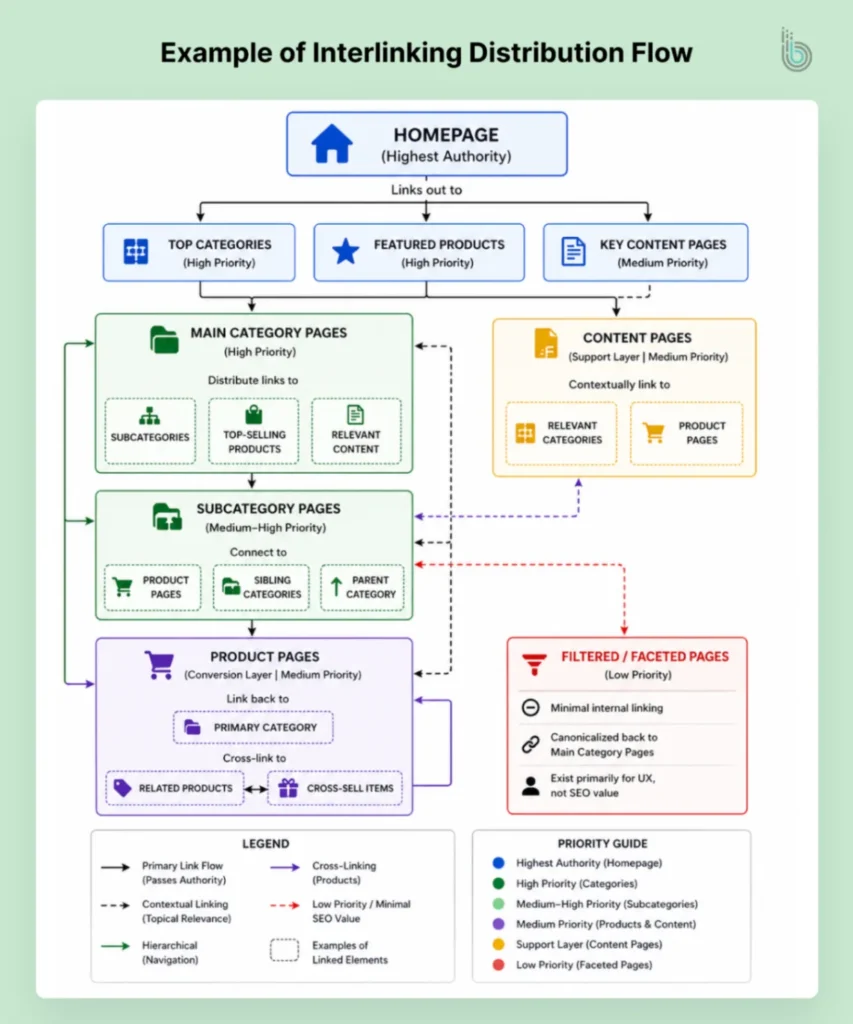
At its core, Magento 2 SEO on-page optimization is about aligning keywords, content, structure, and user intent. When these elements work harmoniously, rankings follow naturally.
But even the most optimized on-page strategy can falter if your site isn’t technically sound.
Let’s move into the foundation that holds everything together: Why Technical SEO Matters for Magento 2.
Magento Technical SEO: The Engine Behind Rankings
On-page SEO determines relevance, while technical SEO is the deciding factor of your store’s chance to rank on SERPs. In Magento 2 SEO, this layer is non-negotiable, especially as your business expands, your product line grows, and your website’s complexity increases.
Most performance and ranking issues in Magento eCommerce SEO don’t come from poor content. They come from inefficient crawling, duplicate URLs, and slow page experience. That’s why understanding how to do SEO on Magento goes beyond keywords and content; it requires engineering your store for search engines at scale.
Core Web Vitals Optimization (INP, LCP, CLS)
Google’s Core Web Vitals extend beyond traditional performance metrics, affecting both search rankings and user behavior.
- INP (Interaction to Next Paint) measures responsiveness. Excessive JavaScript from extensions can decline your page’s responsiveness. Deferring third-party tools, minimizing unused scripts, and using lightweight frontends can significantly enhance website interactivity.
- LCP (Largest Contentful Paint) focuses on the loading speed of key visual elements. Faster rendering of above-the-fold content can be achieved by enabling full-page caching, reducing server response time (TTFB), and preloading critical assets.
- CLS (Cumulative Layout Shift) measures visual stability. Your website layout can be disrupted by missing image dimensions, font shifts, and banners that load late. Defining the necessary details and reserving space for dynamic content maintains consistent stability.
In Magento SEO, speed affects more than just performance; it directly influences crawl rate, user engagement, and conversions.
Canonical Tags & Index Management
With extensive categories, filters, and sorting options, Magento’s flexibility often generates multiple URLs for the same content. This leads to duplication and weak ranking signals.
Canonical tags are the validation or confirmation layer. It informs search engines which version of a page should be considered the primary one, mitigating confusion and preserving domain authority.
Along with this, Mangeto’s indexing system plays a critical role for both users and crawlers. Switching indexers to “Update by Schedule” ensures backend efficiency while maintaining a smooth frontend performance.
Mangeto SEO best practices dictate that it is foundational to keep robust canonical and indexing practices, especially for stores with extensive, dynamic catalogs.
Crawl Budget Optimization for Large Stores
Search engine crawlers continuously prioritize and analyze webpages that seem valuable to them. This makes crawl budget a limiting factor for large Magento stores.
The challenge? Without proper monitoring or control, low-value URLs in layered navigation (filters such as color, size, and price) can consume most of your crawl budget.
Key strategies include:
- Blocking faceted URLs via robots.txt (not just noindex)
- Ensuring only canonical URLs appear in XML sitemaps
- Minimizing redirect chains across webpages
- Strengthening internal linking to highlight priority pages
- Improving site speed to increase crawl efficiency
Fundamentally, Magento 2 SEO is about guiding the journey of your users and search engine crawlers, leading them to high-value pages for high impact.
Wouldn’t you like to navigate through a structured, high-performing website instead of a loose collection of webpages? Without technical SEO, even the most visually pleasing Magento store fails to achieve the desired results.
However, to truly future-proof your presence, Magento Upgrade Services are essential.
Now that the foundation is clear, let’s bring everything together into a practical framework.
Magento 2 SEO Checklist: Your Execution Blueprint
Correct execution matters more than additional knowledge when it comes to Magento 2 SEO at scale. Industry leaders are not doing anything out of the box; they’re just implementing the fundamentals in a much cleaner way.
Get an in-depth idea of how to do SEO on Magento with our checklist, an operational blueprint for you.
Magento SEO Execution Chart
On-page SEO builds the foundation of Magento store visibility by aligning pages with search intent and business goals. Optimized content, metadata, headings, URLs, and internal links improve relevance, usability, and rankings. This helps search engines understand your store better while driving more conversions.
| Layer | Focus Area | Real Impact |
|---|---|---|
| On-Page SEO | Content & Targeting | Each page is mapped to a clear primary keyword; content aligns with user intent and avoids duplication |
| Metadata | Titles are concise, unique, and keyword-led; descriptions drive clicks without overusing Magento meta keywords | |
| Content Quality | Product pages are detailed and persuasive; category pages include meaningful SEO copy (not just listings) | |
| Headings | One H1 per page; structured H2–H4 hierarchy improves readability and context | |
| URL Structure | Clean, short, and keyword-focused URLs with no unnecessary parameters | |
| Index Control | Filter and sorting pages kept out of the index where needed; no keyword overlap across pages | |
| Internal Linking | Logical linking between categories, products, and related items; no orphan pages | |
| Navigation | Breadcrumbs in place; key pages reachable within three clicks | |
| Media Optimization | Images compressed, named properly, and supported with descriptive alt text | |
| UX Signals | Strong CTAs, visible reviews, trust indicators, and FAQs that support both users and SEO |
Technical SEO improves Magento store performance by helping search engines crawl, index, and rank pages efficiently. Clean sitemaps, strong site structure, fast loading speed, and schema markup enhance visibility and user experience. A solid technical setup supports better rankings and long-term SEO growth.
| Layer | Focus Area | Real Impact |
|---|---|---|
| Technical SEO | Crawl Management | robots.txt properly guides bots; no accidental blocking or indexing issues |
| Sitemap | XML sitemap is clean, updated, and includes only canonical URLs | |
| Site Structure | Clear hierarchy (Home → Category → Product) with no structural gaps | |
| Link Health | Broken links eliminated; redirect chains minimized | |
| Performance | Core Web Vitals optimized; fast server response; assets minified | |
| Mobile & Security | Fully responsive design; HTTPS enforced across all pages | |
| Structured Data | Product, review, and breadcrumb schema implemented accurately | |
| International SEO | hreflang tags aligned; country/language targeting handled without conflict |
Off-page SEO builds your Magento store’s authority by strengthening trust signals beyond your website. Quality backlinks, brand mentions, digital PR, and content distribution improve credibility and search visibility. A strong off-page strategy helps increase rankings, brand awareness, and long-term organic growth.
| Layer | Focus Area | Real Impact |
|---|---|---|
| Off-Page SEO | Backlinks | Strong, relevant backlinks pointing beyond just the homepage |
| Authority Building | Brand mentions tracked and converted into links where possible | |
| Digital PR | Consistent outreach, press visibility, and industry placements | |
| Content Distribution | Guides, blogs, and assets promoted externally for reach | |
| Social Signals | Active presence with consistent branding across platforms | |
| Reputation | Reviews are actively collected and leveraged across platforms |
Ongoing optimization keeps your Magento store SEO strong by regularly improving performance and fixing issues before they affect rankings. Monitoring, content updates, technical audits, and continuous improvements help maintain visibility and search relevance. This ensures steady growth, better user experience, and long-term organic success.
| Layer | Focus Area | Real Impact |
|---|---|---|
| Ongoing Optimization | Monitoring | Crawl errors, indexing, and rankings are reviewed regularly |
| Content Updates | Underperforming pages refreshed with better targeting and depth | |
| Technical Audits | Periodic audits to identify structural or performance issues | |
| Continuous Improvement | SEO aligned with catalog changes and business priorities |
Magento eCommerce SEO can’t be considered as separate layers; it’s an ecosystem that supports itself when executed and managed correctly. Stunning content and graphics don’t work without technical clarity and precision.
This checklist provides a guide for everyone, but the real competitive edge lies in how you adapt your Magento store to your products, audience, scale, and industry.
Hire Magento development experts to consult, create, and manage a Magento store that aligns with your current vision and future goals.
In 2026, Mangeto 2 SEO isn’t just about doing things correctly; it’s about being future-ready.
Looking Ahead: Building for the Future, Not Just Rankings
Search is evolving, AI results and changing user behavior are reshaping discovery. But the fundamentals of Magento SEO remain the same: fast pages, clear structure, and content aligned with user intent.
What’s changed is the margin for error.
In Magento eCommerce SEO, small inefficiencies (like slow speed, poor URLs, weak content alignment) scale into bigger problems. That’s why knowing how to do SEO on Magento means building it into your daily workflow. Every update should strengthen your foundation.
Keep the focus simple:
- Prioritize high-intent products
- Maintain speed and usability
- Create content that answers real buying needs
That’s where Magento on-page SEO drives actual revenue.
In 2026, consistency wins. The brands that lead aren’t experimenting more; they’re executing better, grounded in Magento SEO best practices.
Now, let’s move to the key questions that shape effective execution.
Frequently Asked Questions
1. Is Magento 2 still a strong platform for SEO in 2026?

Yes. When implemented correctly, Magento 2 SEO remains competitive and impactful. Gain complete control over URLs, canonicalization, metadata, and structured data. This kind of flexibility can be leveraged only when it’s configured with intent.
2. What are the biggest SEO challenges for Magento stores today?
The most common problems arise from execution gaps. Wasted crawl space due to duplicate URLs and layered navigation, and performance bottlenecks are caused by heavy extensions. Follow Magento SEO best practices when you set up and scale to bypass these challenges.
3. How critical is page speed for Magento SEO?
It must be a top priority. User behavior and search rankings are influenced by your webpage’s speed. Caching, lightweight themes, clean code, and optimized images can improve your Core Web Vitals, ultimately delivering seamless, rapid navigation.
4. Do Magento extensions impact SEO performance?
The impact is heavy, yet it is overlooked by many. Effective use of extensions can strengthen internal linking, improve indexing control, and enhance structured data. On the other hand, heavy/incorrect extensions can slow down your website, add unnecessary scripts, or create duplicate paths.
5. How long does it take to see results from Magento SEO?
Typically, it takes approximately 3-6 months to see noticeable improvements; it’s a compounding process. This depends on your technical health, content quality, and level of competition. Magento stores with a sound technical backend and a solid on-page foundation tend to gain traction faster, while bulky, poorly managed catalogs take longer to deliver results.