
Quick Summary
- Generative AI improves content creation, customer support, personalization, and discovery.
- Retailers use AI to enhance efficiency, engagement, and business growth.
- Successful implementation begins with clear objectives, quality data, and planning.
- Strong integrations and team readiness are essential for long-term success.
- Strategic scaling transforms isolated AI projects into enterprise-wide capabilities.
The retail experience has moved beyond just selling products. Today’s customers expect brands to serve their exact preferences and deliver highly relevant experiences at every touchpoint. Generative AI in eCommerce helps businesses meet those expectations by creating content, personalizing interactions, and automating complex workflows at scale.
What started as an emerging technology has quickly become an everyday business tool. From AI-powered shopping assistants to automated content and intelligent forecasting, this technology is redefining how online stores attract, engage, and retain customers.
In this guide, we’ll explore how generative AI in eCommerce works, how to use it to deliver the best results, the business challenges it presents, and future trends.
What Is Generative AI in eCommerce?
Generative AI, or GenAI, refers to artificial intelligence systems that can create original content, insights, and responses by learning from large datasets. In contrast to traditional data analysis AI tools, generative AI understands context and generates outputs dynamically.
In eCommerce, this can include:
- Writing product descriptions
- Generating marketing copy
- Answering customer questions
- Recommending products
- Creating multimedia content
- Supporting pricing and inventory decisions
The primary goal of using generative AI is to tailor its output based on customer behavior, business data, and real-time interactions.
How Is Generative AI Used in eCommerce
At its core, generative AI technology is a Large Language Model (LLM) trained on vast amounts of information to understand language, context, and intent.
In an eCommerce environment, these models are connected to systems such as:
- Product catalogs
- Customer data platforms
- CRM software
- Order management systems
- Inventory databases
For example, if a customer searches for a product or asks a question, the AI model analyzes the request, extracts relevant information, and generates a personalized response in real time.
Technologies that make it possible:
- Natural Language Processing (NLP): Understands customer queries and intent.
- Retrieval-Augmented Generation (RAG): Pulls accurate information from live business data.
- API Integrations: Connect AI models with eCommerce platforms and workflow systems.
- Machine Learning Models: Continuously improve outputs based on new data and interactions.
The main goal is to make shopping feel more conversational, personalized, and responsive.
Why eCommerce Businesses Are Adopting Generative AI
Artificial intelligence in retail is no longer limited to large enterprises with big technology budgets. AI-powered solutions are being explored, adopted, and deployed by every level of retail business.
According to Precedence Research, the global AI eCommerce market is expected to grow from approximately $11 billion in 2026 to more than $26 billion by 2030, underlining the increasing investment in AI-driven retail technologies.
At the same time, NVIDIA reports that more than 80% of retail and consumer packaged goods (CPG) companies already use or pilot AI initiatives. The reason is simple: businesses want to personalize customer engagement and streamline operations without a proportional increase in costs.
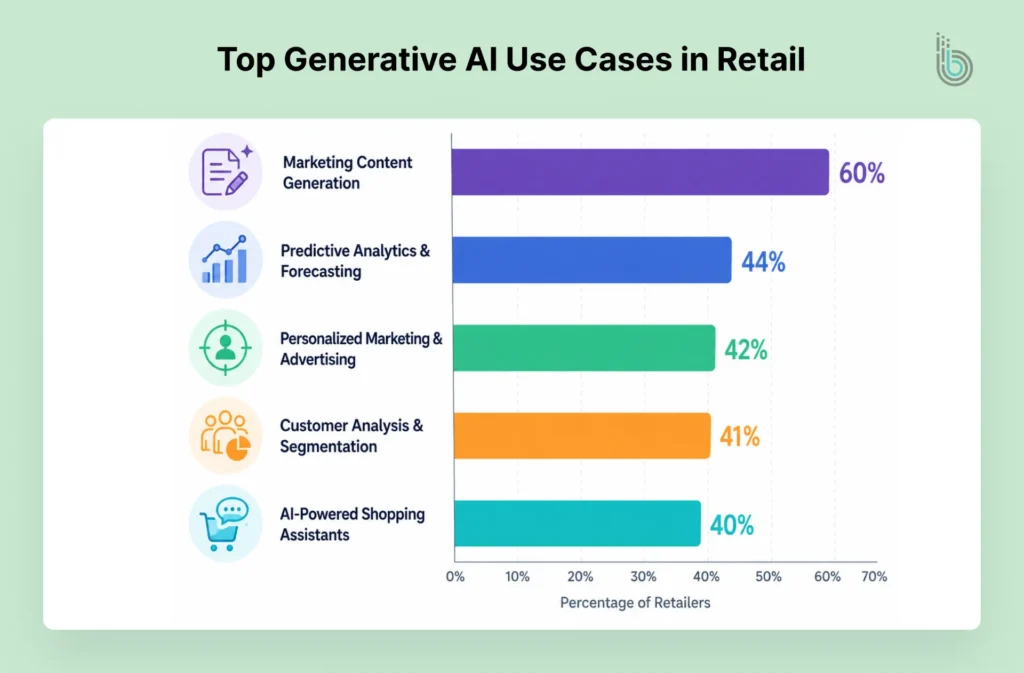
The next question is where generative AI creates the most practical value.
What Are the Top Generative AI Use Cases in eCommerce?
So how can retailers use generative AI? It can support every stage of the customer journey and daily operations. Some applications are already becoming standard across the industry.
Here are the generative AI use cases in eCommerce:
Product Content Generation
Generative AI in eCommerce can be used to rapidly produce product descriptions, titles, specifications, and category content. Reduce time to launch and market new products while maintaining consistency across extensive catalogs.
Conversational Shopping Assistants
AI-powered chat and voice assistants help customers find products, compare options, address issues, and get answers in real time. Instead of navigating multiple pages or contacting sales, shoppers can simply describe what they need or get support.
Personalized Recommendations
In-depth analysis of browsing behavior, purchase history, preferences, and contextual signals to recommend products that are more relevant to individual customers.
Dynamic Pricing
AI can evaluate and compare demand patterns, inventory levels, market conditions, and competitor activity, supporting pricing decisions to improve profitability.
Visual and Semantic Search
Enable image-based and conversational queries to help customers reach your online store seamlessly, making product discovery faster and more intuitive.
AI-Powered Customer Support
From product inquiries to order tracking and returns, provide your customers with real-time assistance through context-aware responses.
Automated Marketing Campaigns
Generate personalized email content, ad copy, SMS campaigns, and promotional copy tailored to different audience demographics, geographic locations, and industries.
Inventory and Demand Forecasting
Generative AI for eCommerce monitors historical sales data and maps it with emerging trends and competitor activities to anticipate demand and guide inventory decisions.
Sentiment Analysis
Identify repeated themes, opportunities, and potential risks with intelligent processing of customer reviews, surveys, and social media feedback.
The use cases may vary in complexity, but together they work towards a unified goal: Improving customer experiences, decision-making, and business efficiency.
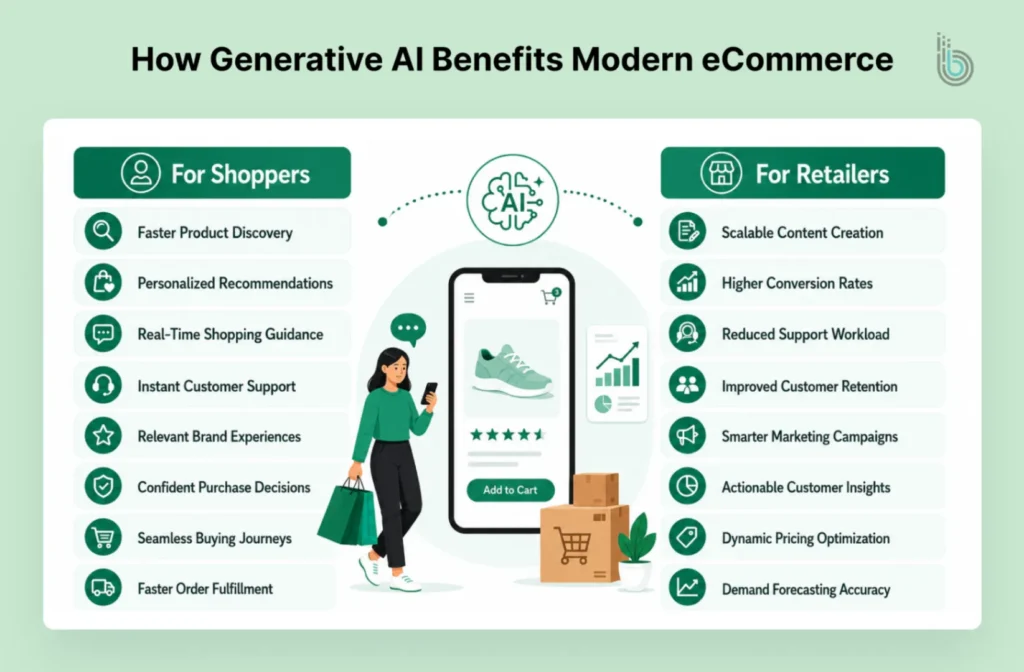
What Are the Key Benefits of Generative AI in eCommerce?
eCommerce automation is only part of the story. Let’s explore the broader business benefits generative AI can deliver when implemented effectively.
Hyper-Personalized Shopping Experiences
Use generative AI for product recommendations, tailored offers, and intent-aligned experiences.
GenAI enables you to personalize:
- Product suggestions
- Website experiences
- Search results
- Marketing messages
- Customer interactions
AI-powered personalization helps create more meaningful shopping experiences and encourages repeat purchases.
Faster Content Generation
Generate extensive content for large product catalogs, web pages, and campaigns, converting resource-intensive tasks into minimal efforts
Generative AI helps business owners:
- Launch products faster
- Scale content production
- Maintain consistency across channels
- Support multilingual content creation
Instead of replacing your content team, AI enables them to focus on strategy, optimization, and quality control.
Responsive Customer Support
Leverage an intelligent, context-aware system that can handle large volumes of inquiries simultaneously, delivering assistance to your customers around the clock.
Benefits include:
- Faster response times
- Reduced support workloads
- Consistent customer experiences
- Improved issue resolution
Seamless Product Discovery
Align your products with your target audience’s purchasing patterns and preferences to improve conversion rates.
Improve product discovery through:
- Conversational search
- Visual search
- Personalized recommendations
- Context-aware product suggestions
Optimized Conversion Rates
Can generative AI improve eCommerce sales? Yes, AI unlocks new pathways for business growth far beyond basic automation.
Avoidable friction and bounce rates can be minimized with AI-powered personalized experiences, relevant recommendations, simplified product discovery, and intelligent assistance. This helps customers move more confidently from product discovery to purchase.
Reduced Operational Costs
Save time and money by automating and streamlining repetitive tasks using generative AI.
This includes:
- Content creation
- Customer support
- Marketing execution
- Inventory planning
- Data analysis
However, realizing these benefits requires thoughtful implementation. But before we discuss execution, let’s analyze the challenges businesses face.
The Challenges of Implementing Generative AI in eCommerce
AI may seem like a plug-and-play solution, but it requires more expertise and experience than business owners realize. Let’s look at some of the hiccups businesses may face during implementation:
- Data Quality & Availability: Generative AI needs quality data to back its results. Incomplete information and inconsistent customer data can lead to errors in output and unreliable recommendations.
- Privacy & Compliance: AI systems must handle customer data responsibly and comply with applicable privacy regulations and other state privacy laws, supported by strong governance, transparency, and security practices.
- Bias & Fairness: AI models can become biased by their training data. That’s why regular audits and human monitoring are essential to ensure fairness and objectivity in results.
- Integration Complexity: Connecting generative AI to your eCommerce platform, database, and workflows may require technical planning, cross-team collaboration, and ongoing maintenance.
- Explainability & Accountability: Businesses can feed data into the AI model and get results, but it is difficult to understand or extract the underlying process. This creates challenges for transparency and accountability.
- Talent & Skill Gaps: Successful AI implementation requires certain skills that some organizations lack, including expertise in data management, machine learning, and prompt engineering.
- Measuring ROI: Accurately tracking the business impact of AI initiatives is difficult because they lack defined goals or performance metrics. An approximation can be made by measuring the results of AI-generated deliverables.
The businesses that are thriving with AI are the ones that approach this as a strategic layer, rather than a standalone technology.
The Best Practices for GenAI Deployments in eCommerce
Not every AI implementation yields positive results, underscoring the importance of a disciplined approach to successful deployment.
Start With High-Impact Use Cases
Focus on one business problem that can be resolved or automated with AI.
Common starting points include:
- Product content generation
- Customer support automation
- Search personalization
Simple, easy wins create momentum for complete adoption.
Use High-Quality Product and Customer Data
Generative AI in eCommerce relies on accurate, structured, and current data to perform effectively.
Before deploying and training AI, businesses should review product catalogs, customer records, and data governance processes.
Combine Human Oversight With AI
? Artificial Intelligence + Human Expertise = Best Possible Results
Your digital marketing team should review important outputs, monitor quality, and establish escalation processes for customer-facing interactions.
Optimize AI Outputs for SEO
AI-generated content should still follow SEO best practices.
This includes:
- Targeting relevant keywords
- Maintaining content quality
- Avoiding duplication
- Aligning with search intent
Continuously Improve Models
Customer behavior, purchase patterns, product catalogs, industry standards, and market conditions are evolving constantly.
Businesses should regularly evaluate performance and refine AI systems using real-world feedback.
Measure Meaningful ROI Metrics
AI implementation success should be measured against business outcomes such as:
- Conversion rates
- Average order value
- Customer satisfaction
- Support efficiency
- Content production costs
Once these foundations are in place, you can move toward implementation with greater confidence.
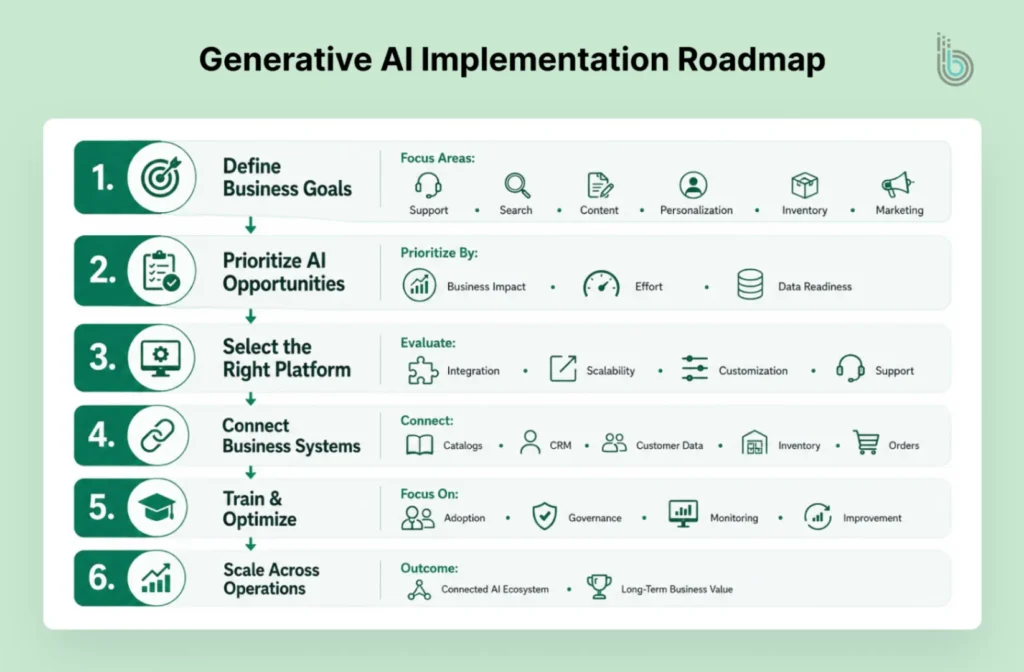
How to Implement Generative AI in Your eCommerce Business
Successful implementation of generative AI in eCommerce begins with business objectives rather than technology selection.
Define Business Goals
Start by identifying the specific gaps in your workflows, including daily operations, marketing efforts, cross-channel content, and product catalogs, that can be bridged by AI.
Examples include:
- Automating repetitive customer support interactions
- Optimizing product search and discovery experiences
- Accelerating product and marketing content creation
- Personalizing customer journeys across channels
- Improving inventory planning and demand forecasting
- Streamlining campaign creation and optimization
Clear goals give direction and create a framework for successful implementation.
Identify AI Opportunities
You can’t integrate AI into every process; it must be used thoughtfully to maximize ROI.
Prioritize initiatives based on
- Business value,
- Implementation effort,
- Data readiness
Review your existing workflows and identify areas where automation, personalization, or intelligent decision-making can deliver the greatest impact.
Choose the Right AI Tools/Platforms
Here are the most important technology selection considerations:
- Integration capabilities
- Scalability
- Data requirements
- Customization options
- Vendor support
Businesses that need guidance during this process often evaluate broader technology and operational requirements through eCommerce consulting services before making implementation decisions.
| ? Interesting Read: 14 Best AI Tools for eCommerce Stores |
Integrate With Existing eCommerce Systems
GenAI becomes significantly more valuable when connected to:
- Product catalogs
- CRM platforms
- Customer data systems
- Inventory tools
- Order management solutions
The quality of system integration determines the quality of AI outputs you receive.
Train Teams and Monitor Performance
Technology adoption depends heavily on people.
Your team should be trained to understand:
- What is generative AI in eCommerce?
- How is generative AI used in eCommerce?
- How does generative AI get integrated?
- When is human intervention needed?
- How does AI improve eCommerce customer experience?
Regular monitoring enables businesses to maintain a competitive advantage as AI capabilities continue to evolve.
Scale From AI-Adoption to AI-Maturity
Once initial projects demonstrate measurable results, businesses can gradually expand AI into additional areas of the organization. When your goals are established, teams are trained, technologies are shortlisted, integrations are in place, scaling becomes easy and achievable.
This layered approach enables businesses to progress from initial AI adoption to enterprise-wide implementation, building a cohesive AI ecosystem that delivers long-term value.
As adoption grows, emerging technologies will continue expanding the possibilities of generative AI in eCommerce.
Future Trends of Generative AI in eCommerce: What’s Coming Next
The next wave of GenAI innovation will focus on deeper personalization, autonomy, and more immersive shopping experiences.
AI-Powered Autonomous Shopping
AI systems are increasingly evolving from recommendation engines to intelligent decision-support tools, capable of automating merchandising, marketing, and operational workflows.
Voice Commerce Growth
Advances in intelligent transcription, enabled by natural language understanding, are making voice commerce interactions more conversational and context-aware. Customers can search for products, compare options, and complete purchases by speaking directly into a mic.
Hyper-Personalization at Scale
Next-generation AI will move beyond personalization to understand customer intent, preferences, and buying patterns at a deeper level. This will enable businesses to deliver the right products, content, and offers at exactly the right moment.
Agentic AI for eCommerce Operations
Purpose-built AI agents are emerging for functions such as:
- Inventory management
- Pricing optimization
- Fraud detection
- Supplier coordination
These systems will take on more specialized responsibilities over time, delivering specifically assigned tasks with utmost accuracy and quality.
Generative AI + AR/VR Commerce
We already know AR/VR is shaping the future of eCommerce businesses. The combination of AI with augmented and virtual reality can create more immersive shopping experiences, including virtual try-ons and 3D product visualizations.
Predictive Customer Experiences
Rather than responding to customer actions, future AI systems will increasingly anticipate needs and proactively recommend products, services, and solutions with precise targeting.
These advancements are actualizing a future where AI is completely, deeply embedded across the entire eCommerce ecosystem.
Is Generative AI Worth It for eCommerce Businesses?
Generative AI in eCommerce is rapidly moving from expensive experimentation to efficient adoption. If you approach the implementation strategically, it can offer significant improvements in customer experiences, increase operational efficiency, and support scalability.
The most successful AI implementations aren’t driven by pursuing every opportunity at once. They rely on thoughtful planning, adequate training, high-quality data, continuous performance measurement, and strategic expansion as generative AI becomes embedded within the organization.
Generative AI is not replacing the people, processes, or strategies that drive success; it supports and amplifies them.
FAQs
1. What is generative AI in eCommerce?

Generative AI in eCommerce refers to AI systems that create content, recommendations, customer responses, and business insights using product, customer, and operational data. It helps retailers personalize experiences and automate workflows at scale.
2. How is generative AI used in eCommerce?
Businesses use AI to generate product content, power shopping assistants, personalize recommendations, automate marketing campaigns, improve customer support, forecast demand, and optimize product discovery through conversational and visual search.
3. What are the benefits of generative AI for eCommerce?
The biggest benefits include faster content creation, personalized shopping experiences, improved customer support, better product discovery, higher conversion rates, and lower operational costs through automation.
4. What are the best generative AI tools for eCommerce?
The best tools depend on the use case. Common options include ChatGPT for content and customer interactions, Google Gemini for research and productivity, Claude for long-form content, Midjourney for product visuals, and enterprise AI platforms integrated with Shopify, Magento, and other eCommerce ecosystems.
5. Can generative AI improve product recommendations?
Yes. Generative AI in eCommerce analyzes browsing behavior, purchase history, preferences, and real-time interactions to deliver highly relevant product recommendations, helping increase engagement, average order value, and conversions.
6. Is generative AI expensive for eCommerce businesses?
Not necessarily. Many AI tools offer free solutions or affordable subscription models, making them accessible to small and mid-sized businesses. Costs typically increase when deploying custom AI solutions, large-scale integrations, or enterprise-grade automation.
7. What industries benefit most from generative AI eCommerce solutions?
Industries with large product catalogs and personalization requirements witness the greatest impact, including fashion, beauty, electronics, furniture, home décor, grocery, automotive parts, and consumer packaged goods (CPG).
8. What are the risks of generative AI in eCommerce?
Key risks include inaccurate outputs, poor data quality, privacy and compliance concerns, algorithmic bias, integration challenges, and over-reliance on automation. Human oversight and strong data governance are essential to mitigate these risks.