
Quick Summary
- Shopify gives you full control over your store, branding, customer data, SEO, and marketing.
- eBay offers built-in buyer traffic and an easier setup, but with less control and higher selling fees.
- Shopify is better for long-term brand building, scalability, and customer ownership.
- eBay is better for beginners, smaller catalogs, and testing product demand.
- You can also use Shopify and eBay together for multi-channel selling, inventory syncing, and centralized order management.
The debate is still going on: which one is the best, Shopify vs eBay? But honestly, it depends! Shopify is an independent ecommerce platform; you can build your own custom store and find your customers. On the other hand, eBay is a massive global online marketplace with built-in buyer traffic, allowing you to sell immediately.
So, if you want to sell a smaller quantity without designing your own website or want to go with auctions, you can choose eBay; if you are planning for a long-term brand, a personal label, or unique products that scale your revenue, then Shopify will be the best choice.
If you are still in a dilemma, this guide will help you decide whether to sell on Shopify vs. eBay.
What Is Shopify?
Shopify has over 5.6 million live stores across 175+ countries and 5.88 million daily active users worldwide. Shopify stores hold a 10.56% share of the global ecommerce market. But what exactly is Shopify?
Shopify is a cloud-based commerce platform that allows you to create, customize, and run your own online or in-person store without needing coding or technical skills. So, you will own your own online store, which will look exactly how you want, follow your pricing and policies, and send automated emails for cart abandonment, repeat purchases, thank-you notes, offer/deal details, and more.
What Is eBay?
Research shows that eBay hosts roughly 17-18 million active sellers and 136 million active buyers worldwide.
eBay is a direct-to-customer (DTC) massive global marketplace where you can sell small quantities or use an auction. You have to rent eBay’s pre-built buyer traffic, follow eBay’s policies, and can’t choose your customers. eBay can raise the rent or change the locks whenever they want, and you have to comply with the changes.
Shopify vs eBay: Detailed Comparison
Shopify vs eBay depends entirely on your needs; still, you have to consider the following when deciding which is best for you.
| Key Factors | Shopify | eBay |
|---|---|---|
| Ease of Setup & Getting Started | Takes time to build, design, and set up a standalone online store. | Setup within a few clicks. |
| Pricing & Selling Costs | $39/month (for basic plan). | List up to 250 products for free; then it will charge ~$5 to $60+ per month. |
| Selling Fees | 2.4% to 2.9% + 30¢ online | 12.9% to 13.25% of the final value as fees + 30¢ per transaction. |
| Store Ownership & Branding | Get complete ownership. | No or limited ownership. |
| Website Design & Customization | Get complete ownership of website design. | Follow eBay’s website structure. |
| Product Management & Customer Ownership | You have access to product management & customer ownership. | Follow eBay’s product management structure. |
| SEO Capabilities & Marketing Features | You can decide SEO and marketing strategies for your store. | Depends on strategic price bidding. |
| Traffic & Customer Acquisition | You can follow marketing practices and campaigns to get organic traffic and plan customer acquisition. | You are not allowed to follow any marketing strategies to catch customers’ eyes on your products. You have to follow eBay’s Cassini algorithm. |
| Payment Options | You can use multiple payment options, including Shopify payment, and integrate third-party payment gateways and quick checkout gateways. | You have to follow eBay’s checkout and payment process. |
| Shipping & Fulfillment | You have complete ownership of shipping & fulfillment activities. | You have to follow eBay’s shipping and fulfillment strategies. |
| Mobile Commerce Experience | You can optimize your ecommerce store for different devices. | You have to accept eBay’s rigid design structure. |
| Analytics & Reporting | You will get an end-to-end report of your customer journey, including their personal details. | You will get limited data, but you won’t get personal information about the customers. |
1. Ease of Setup & Getting Started
Shopify Setup
Shopify needs time to build, design, and set up a standalone online store, but after launch, you will have complete control of your store. To get started with a Shopify store, you need a multi-step setup, a customized theme customized to your business needs, a product catalog with images, ecommerce activity flow, shipping policies, and payment gateways.
eBay Setup
eBay is an established marketplace with built-in buyers’ traffic. It will just take a few clicks to set up a profile, upload your catalog or product details, and start selling. You have to follow eBay’s shipping and payment policies, so you don’t have direct control over the ecommerce activity.
2. Pricing & Selling Costs
Shopify Pricing
You have to pay a fixed monthly subscription fee starting at $39/month (for a basic plan). They also charge processing fees of roughly 2.4% to 2.9% + 30¢ online, and there are no per-item listing fees.
eBay Pricing
There will be no mandatory recurring subscription fees for basic eBay use, but they charge heavy pre-sale Final Value Fees plus insertion fees. You can consider Final Value Fees to be roughly between 12.55% to 15%, depending heavily on the product category, plus a fixed 30¢ per order.
3. Selling Fees Breakdown
While planning for selling on Shopify vs eBay, you have to consider the following fee breakdown before coming to any decision:
| Key Factors | Shopify | eBay |
|---|---|---|
| Monthly Subscription | $39 per month (for a basic plan) | List up to 250 products for free; then you have to pay ~$5 to $60+ per month |
| Listing Fees or Final Value Fees | No listing fees. You can list unlimited products without any cost | Roughly 12.9% to 13.25% final value fees, including shipping and taxes |
| Transaction/Processing Fees | 2.4% to 2.9% + 30¢ online | 30¢ will be added to each transaction |
4. Store Ownership & Branding
Shopify Store Ownership
You will have full ownership of your Shopify store. You can decide your domain name, website layout, ecommerce activity flow, purchase & return policies, shipping structure, and more. You will also own the direct customer details.
eBay Store Ownership
You are renting the platform; you have to follow eBay’s ecosystem. You don’t own the URL of your product listing and can’t alter the core checkout design or page layout. In short, you won’t get any ownership of the store.
5. Website Design & Customization
Shopify Web Design
You will get complete control over HTML, CSS, page structure, fonts, colors, content, and more. Shopify offers a variety of themes for your online store; you can even customize them. All the themes will support various devices, including mobile, tablets, and desktops.
Moreover, as you own the domain name, you can set up a complete ecommerce process, including the buyer’s journey & shipping structure. Customers or visitors will follow your policies.
eBay Web Design
eBay’s page will be your store. You can add a basic logo, a custom banner, and a short description of your product when setting up your profile & adding a catalog. You cannot set up a customized theme for your product catalog.
Your buyers will see the eBay menu, competing items, and standard eBay checkout buttons, all of which will be consistent across catalogs and sellers.
6. Product Management & Customer Ownership
Shopify Management
Shopify offers unlimited product listings under fixed monthly plans. You will also integrate third-party payment gateways, inventory tracking tools, shipment tracking tools, and more for your convenience; there will be no extra charges.
As you will gain full ownership of your ecommerce store, you will have full access to your customer database. You will access customers’ personal details, including phone number, email address, delivery and billing addresses, purchase history, cart abandonment, etc.
eBay Management
eBay offers limited product management and almost no customer ownership. You have to follow their policies for your product listing, shipping, and billing. Also, you can’t have direct access to their customer database. The chat feature will be filtered through eBay’s portal, so you cannot approach customers directly.
7. SEO Capabilities & Marketing Features
Shopify Capabilities
Shopify allows you to edit meta tags, product URL, image alt text, and more, which are essential for SEO. You can even follow traditional content marketing strategies, as Shopify offers a native blogging engine. Shopify online platform also generates a crawlable sitemap and structured schema for SEO. You can build a customized marketing plan for cart abandonment, repeat purchase, cross-selling, upselling, and more. You can integrate the platform with Google Ads, Meta, and more for promotional purposes.
eBay Capabilities
You won’t get access to edit meta tags or product catalog URL; you have to follow eBay’s structure. eBay platform follows the Cassini algorithm; hence, only strategic pricing will influence buyers. So, you won’t get any opportunities to perform SEO and promotional activities.
8. Traffic & Customer Acquisition
Shopify’s Approach
You have to follow various SEO and marketing strategies to get organic traffic on your website. And it is up to you how you keep your customers engaged. Shopify offers built-in triggers, so visitors will receive emails for purchases, deal details, cart reminders, and more, helping you retain your customers longer.
eBay’s Approach
eBay has built-in traffic, so customers will find your products using the Cassini algorithm or category research. No marketing tricks will work here to get buyers’ eyes on your products first. So the traffic and customer acquisition are completely in line with eBay’s ecosystem.
9. Payment Options
Shopify’s Payment Gateways
Shopify offers built-in payment options that don’t incur extra handling charges. You can also integrate third-party payment gateways like Stripe, PayPal, and more. Shopify will charge a 0.5% to 2% + 30¢ as an online transaction fee. Shopify also supports express checkouts such as Apple Pay, Google Pay, and Shop Pay.
eBay’s Payment Gateways
eBay handles the entire payment process. Buyers can pay with major credit and debit cards, as well as PayPal, PayPal Credit, Apple Pay, and Google Pay. For every checkout, buyers will pay final value fees (12.9% to 13.25% + 30¢), including taxes and shipping expenses. The sellers will receive the profit daily or weekly directly into their bank account.
10. Shipping & Fulfillment
Shopify’s Shipping
Shopify allows you full backend control with custom carrier rates, built-in label printing, and the Shopify Shipping network.
eBay’s Shipping
eBay relies on simple, integrated label printing through USPS, UPS, FedEx, or other third-party logistics and fulfillment services providers.
11. Mobile Commerce Experience
Shopify Mobile Experience
You will get full control of your store, so you can optimize the site for different devices. You can customize the themes and designs to meet mobile commerce experience requirements.
eBay Mobile Experience
You have to follow eBay’s rigid structure. You won’t get any idea of how your catalog and product descriptions look on different devices.
12. Analytics & Reporting
Shopify Analytics
You will get customized and behavior-driven analytics across sales, customers, marketing, finance, and inventory. You will get full data access, including customers’ personal details, behavioral patterns, and more, so you can track entire buyer journeys, multi-channel attribution, create custom reports, and track real-time live views.
eBay Analytics
You will get shallow, listing-focused reporting to track impressions, page views, sales trends, and promoted listing performance. You will have limited customer details, which ensures prevention of off-platform marketing activities. eBay is mainly focused on internal marketplace metrics, including conversion rates, click-through rates, and more.
Shopify vs eBay Pros & Cons
If you are still unsure about eBay vs Shopify, the following pros and cons will help you make a clear decision.
Pros of Shopify
- Brand Control: You can create a custom domain, store layout, fonts & colors, designs, flow, structure, prices & policies, as per your brand.
- Better Margin & Scalability: Shopify charges $39/month (for basic plan), which gives you unlimited product listings. Hence, you will get a better profit margin, and also won’t pay extra for business expansion.
- Custom SEO & Marketing Strategies: You can follow customized SEO and marketing strategies to get organic traffic on your online store.
- Data Ownership: You will get complete data ownership, including customers’ personal details, billing and shipping addresses, purchase history, cart abandonment, and more.
- Auto Triggers: Your customers will receive thank-you notes, shipping and tracking details, cross-selling and up-selling offers, and deal details via email.
Cons of Shopify
- No Built-in Traffic: eBay offers pre-built traffic for instant sales, whereas with Shopify you have to attract your target niche for sales.
- Store Setup: Store setup will take time as you have to design your own website from scratch.
Pros of eBay
- Easy Setup: Just create your profile, upload your catalog with a short description, and you’re done with setup.
- Built-in Buyers: You don’t need to perform any marketing activities, because eBay offers pre-built buyers.
Cons of eBay
- High Selling Fees: You have to pay 12.9% to 13.25% final value fees plus $0.30 per transaction, which reduces the profit margin.
- No Brand Loyalty: The customer will buy from eBay, so there will be no brand loyalty and lower repeat buying rates.
- Competition: eBay is highly used by price-sensitive users, so there will be heavy competition.
Selling on Shopify vs eBay: Which Is Better for Different Sellers?
A short answer is: it depends. Shopify offers end-to-end store control and lower scaling fees, but you have to find buyers on your own, while eBay offers pre-built buyers but no scope for branding and scaling activities.
If we talk about competition, there are again over 3 million active Shopify stores worldwide and 136 million active buyers on eBay. Shopify allows you to plan marketing campaigns for your brand to attract organic buyers, while eBay doesn’t allow any internal marketing practices.
So, competition will be there on each platform, and each platform has its own pros and cons; that’s why it will completely depend on your business to choose selling on Shopify vs eBay.
Can You Use Shopify and eBay Together?
Yes, you can use Shopify and eBay together. Both platforms have their own strengths and limitations, so it will give you advantages, including:
1. Benefits of Multi-Channel Selling
Multi-channel selling offers wider customer reach, real-time stock sync, a single analytics dashboard, shipping control, and more.
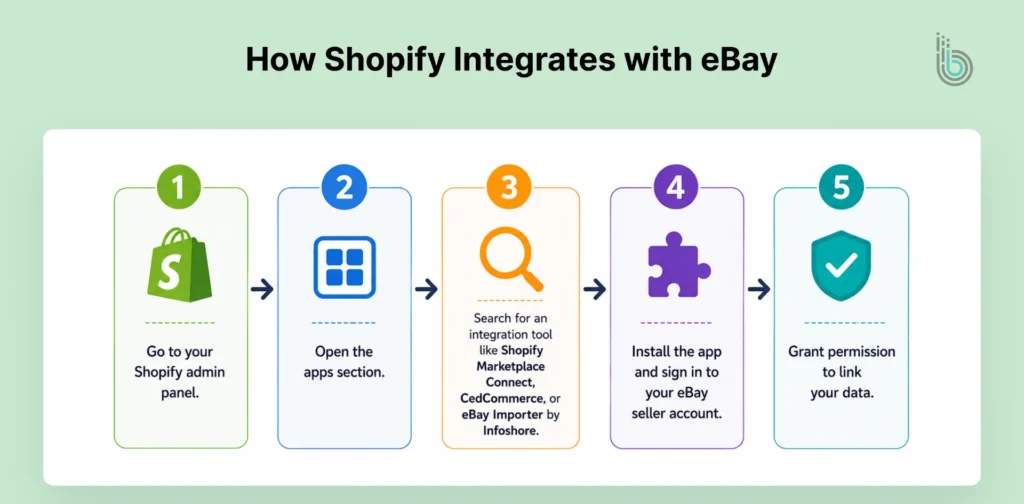
2. How Shopify Integrates with eBay
If you are planning to use both platforms together, follow the steps below to get started:
3. Inventory Sync
Integrating both platforms allows SKU matching, smooth order management, price updates, and two-way inventory sync. This means order fulfillment from Shopify will automatically reduce the stock quantity on eBay.
4. Order Management
Using Shopify and eBay together allows smooth order management. It allows incoming eBay orders to flow directly into your Shopify admin panel. Eases stock syncing and ensures centralized fulfillment.
Shopify vs eBay: Which Platform Should You Choose?
eBay vs Shopify, consider the following before making any decision:
Choose Shopify If
- You want complete control over your online store
- You want to access your customer data for upselling, cross-selling, and reducing the cart-abandonment rate
- You want to strategize marketing campaigns for your product catalog
- Customer acquisition matters the most even before initial sales
- You want to build business beyond a massive marketplace
Choose eBay If
- You want pre-built buyers
- You have a small quantity product catalog
- You want to get an idea of demand before investing in a Shopify store
- You don’t want to wait till your online store is built
Use Both If
- You want to enjoy the benefits of a multi-selling platform
- Manage orders and inventory smoothly
- You want to avoid stock issues
- You want to keep product information consistent
Common Mistakes to Avoid When Choosing Between Shopify and eBay
The following are some mistakes that you must avoid while deciding between Shopify vs eBay:
- Comparing financial aspects and not business values
- Assuming Shopify will generate leads/buyers automatically
- Not considering Final Value Fees while choosing eBay
- Not strategizing SEO and marketing activities to retain customers
- Not setting up triggers for auto-generated email (specifically for Shopify)
Final Verdict: Shopify vs eBay
In short, choosing Shopify vs eBay completely depends on your business requirements. You can choose eBay if you want to reach buyers immediately and don’t want to manage shipping and fulfillment.
You can choose Shopify if you want complete control of your ecommerce store and get end-to-end access to ecommerce activity and customer data. Here you will enjoy a higher profit margin than on eBay, but you have to find buyers on your own.
So, you have to choose wisely when deciding whether to sell on Shopify or eBay.
Frequently Asked Questions
1. Is Shopify better than eBay?

If you want to build a long-term brand, own your customer data, and control end-to-end ecommerce activity, then yes, Shopify is better than eBay.
2. Is Shopify cheaper than eBay?
It depends on your sales volume. eBay will be the safer platform for casual sellers because it allows free product listings for up to 250 products, while Shopify charges fixed monthly fees. But at the same time, eBay charges higher Final Value Fees, which reduces the profit margin compared to Shopify.
3. Can I sell on Shopify and eBay at the same time?
Yes, you can sell on Shopify and eBay at the same time by linking both accounts using integration apps like Shopify Marketplace Connect or third-party tools.
4. Which platform is better for beginners?
eBay is better for beginners. It allows you to make informed decisions based on your product demand before investing heavily in building your own Shopify store.
5. Which platform has lower selling fees?
Shopify has lower selling fees. eBay charges roughly 12.9% to 13.25% final value fees, including shipping and taxes, plus $0.30 per transaction.
6. Does Shopify help with SEO more than eBay?
Yes, Shopify helps with SEO more than eBay. Shopify is a standalone ecommerce platform that lets you control your store’s technical SEO, meta tags, URL structure, and content marketing.
7. Can I migrate from eBay to Shopify?
Yes, you can easily migrate from eBay to Shopify by exporting your catalog listings as a CSV file or using a reliable marketplace app from the Shopify App Store.
8. Which platform is better for long-term business growth?
Shopify is better for long-term business growth, as it lets you control your brand, customer data, and domain.